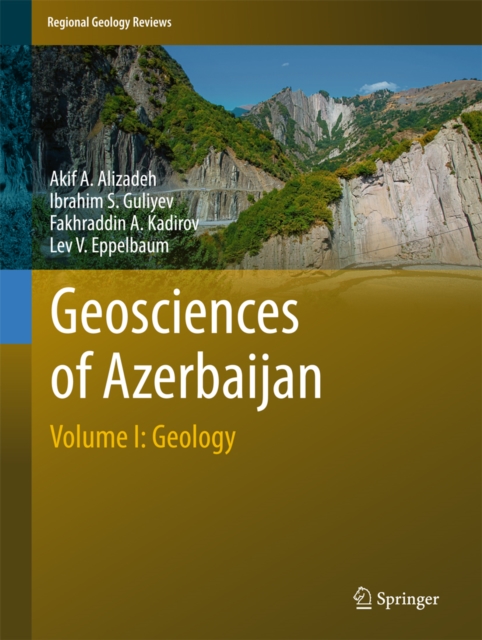
This book provides a multi-scale and multidisciplinary perspective on the geology of Azerbaijan, a country characterized by a unique tectonic and geological setting including the Greater and Lesser Caucasus, the Talysh Mountains, and the Caspian and Kur Basins.
This book deals with the rare earth elements (REE), which are a series of 17 transition metals: scandium, yttrium and the lanthanide series of elements (lanthanum, cerium, praseodymium, neodymium, promethium, samarium, europium, gadolinium, terbium, dysprosium, holmium, erbium, thulium, ytterbium and lutetium).
This book introduces readers to the field of seismic data interpretation and evaluation, covering themes such as petroleum exploration and high resolution seismic data.
This book by Vietnamese and Russian authors is the first of its kind and combines the extensive knowledge on the petrology and metallogeny of the late Paleozoic - early Mesozoic and Cenozoic periods in North Vietnam.
This book providesinformation on the distribution of the available energy resources throughoutthe continent and how it is linked to the development of individual states.
The book is devoted to three types of laser-based spectroscopy of minerals, namely Laser-Induced Time-Resolved Luminescence, Laser-Induced Breakdown spectroscopy and Gated Raman Spectroscopy.
This book reviews the geochemical and petrological characteristics of potassic igneous rock complexes, and investigates the different tectonic settings in which these rocks occur.
This book will broaden readers' understanding of pegmatites in a special geodynamic setting, dealing with the emplacement of the Hagendorf-Pleystein Pegmatite Province (HPPP) in the Central European Variscides.
This book presents several intelligent approaches for tackling and solving challenging practical problems facing those in the petroleum geosciences and petroleum industry.
Fifty years after the adoption of the Declaration on Permanent Sovereignty over Natural Resources by the General Assembly of the United Nations in December 1962, this volume assesses the evolution of the principle of permanent sovereignty over natural resources into a principle of customary international law as well as related developments.
This book highlights and discusses recent developments that have contributed to an improved understanding of observed mantle heterogeneities and their relation to the thermo-chemical state of Earth's mantle, which ultimately holds the key to unlocking the secrets of the evolution of our planet.
The subject of the book is helium, the element, and its use in myriad applications including MRI machines, particle accelerators, space telescopes, and of course balloons and blimps.
This book offers a high-level summary of shallow magmatic systems (dykes, sills and laccoliths) to support geoscience master and PhD students, scientists and practicing professionals.
These proceedings comprise the peer-reviewed contributions submitted to the 11th International Congress for Applied Mineralogy (ICAM) held July 5-10, 2013, at the Southwest University of Science and Technology (SWUST) in Mianyang, China.
Presented here is the story of the mining and sale of uranium and radium ore through biographical vignettes, chemistry, physics, geology, geography, occupational health, medical utilization, environmental safety and industrial history.
This book is the collection of papers from the latest International Uranium Mining and Hydrogeology Conference (UMH VII) held in September 2014, in Freiberg, Germany.
This book brings together in a single volume a grand overview of solutions - political, economic, and scientific - to social and environmental problems that are related to the growth of human populations in areas that can least cope with them now.
This book provides a wealth of geomathematical case history studies performed by the author during his career at the Ministry of Natural Resources Canada, Geological Survey of Canada (NRCan-GSC).
The book provides a model for the structural evolution of the Himalaya with relevant background information making it easily accessible to earth scientists specializing in other areas.
Thermodynamically constrained averaging theory provides a consistent method for upscaling conservation and thermodynamic equations for application in the study of porous medium systems.
Tight gas reservoirs have very low permeability and porosity, which cannot be produced at economical flow rates unless the well is efficiently stimulated and completed using advanced and optimized technologies.
This book provides a comprehensive description of the volcanological, petrological and geochemical features of the Poas Volcano (Costa Rica), one of the most active volcanic systems in Central America and part of the Central America Volcanic Arc (CAVA).
The first Catalogue of Meteorites from South America includes new specimens never previously reported, while doubtful cases and pseudometeorites have been deliberately omitted.
This book provides a review of Azerbaijan's water reserves and main economic deposits (both hydrocarbon and hard) and describes the integrated application of geophysical methods (land, airborne, shipborne and satellite) for studying near-surface and environmental features and regional tectonic-geophysical zonation as well as the study of deep structures in the search for hydrocarbon and hard (polymetallic, copper, gold-bearing, iron-ore, magnetite, etc.
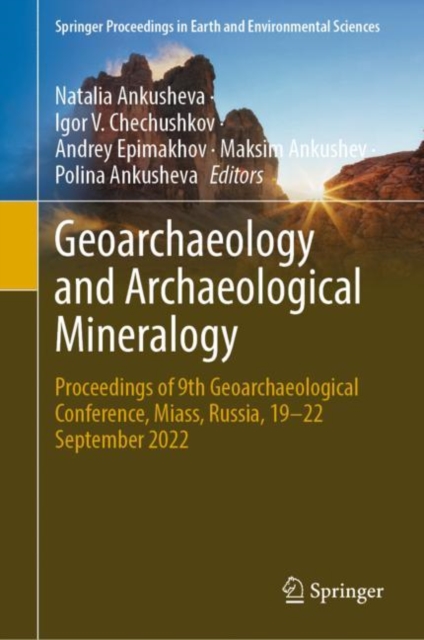
The volume of Springer Proceedings in Geoarchaeology and Archaeological Mineralogy contains selected papers presented at the 9th Geoarchaeology Conference, which took place during September 19-22, 2022, at the South Urals Federal Research Center, the Ural Branch of the Russian Academy of Sciences, Miass, Russia.
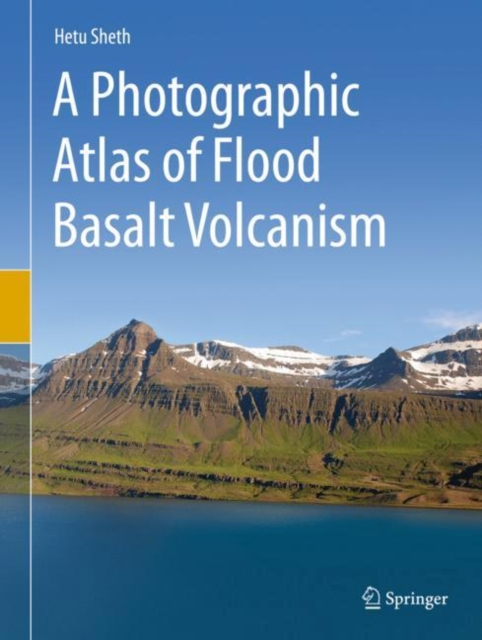
This unique book presents hundreds of spectacular photographs of large-scale to small-scale field geological features of flood basalt volcanism from around the world.
This book explores the geotectonic evolution of the lithosphere beneath the Indian Shield, which comprises a collage of cratons variously bounded by mobile belts and palaeo-rifts.
This volume is a compilation of the research presented at the International Asteroid Day workshop which was celebrated at Barcelona on June 30th, 2015.
The evolution of geological cartography in Cuba in its more than 135 years of history has been possible through the consultation of numerous archival reports, publications, maps and personal interviews with different authors and geologists of vast experience.
This book addresses the hazard of gas explosions in sealed underground coal mines, and how the risk of explosion can be assessed, modeled, and mitigated.