This book presents an overview of the fluvial processes theory developed in the former USSR at Lomonosov Moscow State University for the last 50 years, following the famous manuscript by Professor Makkaveev in 1955.
This book presents selected research highlights from the Seventh Argentine Geomorphology and Quaternary Studies Congress, hosted at Puerto Madryn, Northern Patagonia, Argentina by the Argentine Association of Geomorphology and Quaternary Studies (AACYG).
In this volume, operators, engineers, and researchers present information about all aspects of current processing technologies for nickel and cobalt, as well as emerging technologies for both metals.
This collection presents papers from a symposium on extraction of rare metals as well as rare extraction processing techniques used in metal production.
This well-illustrated book aims to enhance observations and understanding of structural features and proximity-indicator minerals, critical in exploration.
This book is a multidisciplinary manuscript bringing together contributions on water issues from natural and social scientists focused on water management and structures in a challenging environmental situation such as Dakhla Oasis in Egypt's western desert.
This volume is devoted to investigation of all aspects of heat-mass transfer processes at different scales and from various origins, as well as the formation and evolution of geological structures.
This book offers essential information on geospatial technologies for water resource management and highlights the latest GIS and geostatistics techniques as they relate to groundwater.
This book presents (i) a comprehensive methodological approach in analyzing karst surface features using contemporary GIS tools of high resolution applied on a large study area and extensive dataset, (ii) a revision and evaluation of the existing concepts valid in the modern karst geomorphology, (iii) a detailed elaboration of overlooked and yet undefined karst surface features, and (iv) an innovation in the discussion on origin and evolution of karst surface features.
This book provides thorough knowledge and detailed information of oil shales using a range of conventional and unconventional techniques and methodologies combined to elucidate the composition of oil shale deposits.
This book employs a suite of remotely sensed products and advanced technologies to provide the first comprehensive space-based sensing of Lake Victoria, the world's second largest freshwater lake that supports a livelihood of more than 42 million people, modulates regional climate, but faces myriads of challenges.
The aim of this book is to provide an overview of topics related to the extensive geoheritage of hot springs, their natural environments, and their integration into commercial and industrial functions.
This volume gathers the latest advances, innovations, and applications in the field of mining, geology and geo-spatial technologies, as presented by leading researchers and engineers at the International Conference on Innovations for Sustainable and Responsible Mining (ISRM), held in Hanoi, Vietnam on October 15-17 2020.
This volume sheds new light on the marine fauna and geological setting of the Tjornes Sequence, North Iceland, which is a classic site for the Pliocene and Pleistocene stratigraphy of the North Atlantic region.
This book documents and describes 32 natural caves from France and around the globe that have a width larger than 50 m, including data on the largest underground chamber in the world: Sarawak Chamber.
This volume provides international case studies of practical and advanced methods using satellite images integrated with other airborne, drone images and field data to monitor infrastructure.
This book presents an overview of volcanic debris avalanche deposits, which are produced by partial volcanic edifice collapse, a catastrophic natural phenomenon.
This book discusses the karst and pseudokarst of the Upper Midwest, USA, consisting of the states of Minnesota, Wisconsin, Iowa, and Illinois-the first regional synthesis in 40 years.
This book introduces the latest research regarding the adsorption of heavy metals, toxic ions, and organic compounds at the interfaces of water/minerals, such as mineralogical characterizations, surface chemistry, and modification of natural minerals as adsorbents, as well as the adsorption of cations, anions, and organic compounds in water.
This encyclopedia is a reference for aquatic physical, biological and biogeochemical sciences, collecting and connecting a number of topics, concepts and facts about aquatic systems and their scientific investigation.
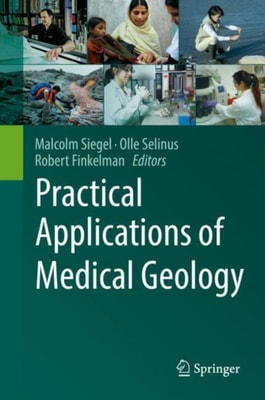
This edited volume provides a framework for integrating methods and information drawn from geological and medical sciences and provides case studies in medical geology to illustrate the usefulness of this framework for crafting environmental and public health policies related to natural materials.
This book discusses Nevada in the context of the history of soil investigations; soil-forming factors; general soil regions; soil geomorphology; taxonomic structure of the soils; taxonomic soil regions; soil-forming processes; benchmark, endemic, rare, and endangered soils; and use of soils.
This heavily illustrated book contains descriptions and geologic interpretations of photographs (mostly aerial) illustrating the power and magnitude of repeated Ice Age flooding in the Pacific Northwest, as recently as 14,000 years ago.
This book explores the geotectonic evolution of the lithosphere beneath the Indian Shield, which comprises a collage of cratons variously bounded by mobile belts and palaeo-rifts.
This book presents the findings of recent theoretical and experimental studies of processes in the atmosphere, oceans, and lithosphere, discussing their interactions, geology.
This book presents and describes an innovative method to simulate the growth of natural fractural networks in different geological environments, based on their geological history and fundamental geomechanical principles.
This book provides a complete study of the Central Andean volcanism and its most distinctive features, from the lower Paleozoic to the Cenozoic times in the framework of its processes, eruptive mechanisms and geodynamic conditions.