This topical new book provides an illuminating overview of enterprise education, and poses the question as to whether current establishments have adequate systems in place to prepare students for the world of work.
This book presents scholarly reflections on women's entrepreneurial propensity and on women's entrepreneurship in Science, Technology, Engineering, and Mathematics (STEM) fields.
"e;The fourth sector"e; consists of for-benefit organizations that combine market-based approaches of the private sector with the social and environmental aims of the public and non-profit sectors.
This book explores technological innovation in family firms, seeking to reconstruct the links between the heterogeneous dimensions of family businesses and their innovative behaviour.
In handicrafts and artisanal products, industry has witnessed both a technological shift and a renewed interest among customers, especially after the challenges and limitations of mass production became evident under the COVID-19 pandemic.
"e;The fourth sector"e; is a relatively new sector that consists of for-benefit organizations that combine market-based approaches of the private sector with the social and environmental aims of the public and non-profit sectors.
This book provides recent ideas, insights, facts, evidence, frameworks, and perspectives on how and why entrepreneurial families are successful over generations.
This book outlines the unique challenges and opportunities of doing business in Africa, analysing how varying degrees of development across its countries affects entrepreneurship.
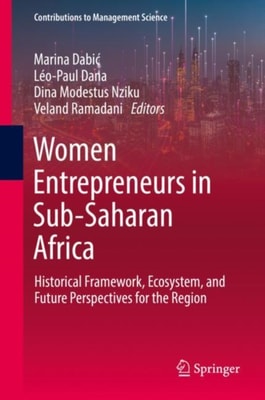
According to a 2018 World Bank report, Africa is the only region with more women than men choosing to become entrepreneurs - a phenomenon that is not the subject of adequate discussion.
This book explores the sea change in thinking about how to educate students of entrepreneurship, uses extant theory to develop a conceptual model of entrepreneurship skill development, describes an assessment tool for operationalizing this model, discusses how this tool can be utilized to develop entrepreneurship skills, and offers examples from the application of our approach in educational settings.
This book provides a comprehensive overview of role of entrepreneurship, technology commercialisation and innovation policy for the achievement of economic development and prosperity in African societies.
Highlighting the motivations of B Corp entrepreneurs in Chile, this book explores the phenomenon behind for-profit organisations that are committed to social and ecological sustainability as well as human welfare.
This book constitutes the refereed proceedings of the 11th International Conference on Software Business, ICSOB 2020, which was held during November 16-18, 2020.
Drawing on empirical insights from the field of desktop 3D printing, this book elaborates the concept of innovation communities as a pattern of open and distributed innovation.
This book draws attention to the classic, seminal articles in entrepreneurship that have made profound contributions to the field's emergence, development, and maturity.
For African enterprises, entrepreneurs and governments to take full advantage of new digital opportunities, they need a shared strategic understanding of where they are, what they have, and what they may need to have for the future.
This book examines the business models, performance, and decision-making approaches employed by financial institutions in Central and Southeast Europe.
Examining the experiences of Africans setting up businesses back home, the main focus of this book is to establish the economic, social and psychological reasons for such 'home direct investment'.
This book connects entrepreneurship and psychology research by focusing on the personality dimensions of entrepreneurs, entrepreneurial cognition, entrepreneurial leadership, and gender behavior.
This book focuses on topics such as the cultural specificity of Arab family businesses with regard to shaping their governance and management; the influence that specific values in the Arab world could exert on the management of family businesses; how spiritual and religious values influence business in Arab family firms; and the role of emotions in the management of family firms in the Arab World.
Since the process of liberalization and opening of markets in the 1990s, the emerging markets have created a thriving culture of entrepreneurship, creativity and global collaboration.
This book explores how novel digital services, including e-services, digital platforms and mobile apps, are increasingly being innovated through open processes.
While many texts on entrepreneurship and biographies of great entrepreneurs and leaders talk about vision and its importance, few delve into what vision is, how it comes to be, and, how it can be more successfully developed.
This book examines the nexus between the entrepreneur, the firm, and the region for drawing a comprehensive picture of entrepreneurship in a developing country context.
The editors and authors of this textbook introduce the relatively new subject of "e;academic and educational entrepreneurship"e; from a holistic viewpoint.