This publication presents a factual overview of the design and implementation of the Korea Emissions Trading Scheme, focusing on lessons from its implementation and opportunities under the Paris Agreement.
This publication explores the views of stakeholders in the two decades of partnership between the Asian Development Bank and the Kolkata Municipal Corporation in India.
This user guide provides step-by-step instructions on how to set up, use, and maintain the statistical business register of the Asian Development Bank.
This publication helps guide investment planning and financing across key urban infrastructure sectors of Azerbaijan to improve the performance of cities---with a focus on economy, equity, and environment.
This publication showcases 50 innovative case studies from cities in the People's Republic of China that are mitigating against and adapting to climate change.
This tool kit comprises information on how to create a shared vision for digital health through a national strategy, focused on maximizing the value of resources.
This report details the key achievements of the Regional Malaria and Other Communicable Disease Threats Trust Fund from its creation in 2013 to the first half of 2018.
This energy sector assessment, strategy, and road map documents the status and strategic priorities of the Government of the Philippines in the energy sector.
This publication is a history of the partnership between the Asian Development Bank (ADB) and the People's Republic of China (PRC) spanning three decades.
This publication launches the Inclusive Green Growth Index, a new comprehensive metric that captures the key dimensions of economic growth, social equity, and environmental sustainability.
The poor and vulnerable populations suffer disproportionately from the adverse impacts of climate change and disasters, which result in loss of life, damage to household and community assets, disruption of livelihoods, and loss of income.
This book presents research into the production of safe, high-quality, and environmentally friendly agriculture products in the Greater Mekong Subregion.
This special supplement to the Key Indicators for Asia and the Pacific 2018 showcases the role that technology can play in improving the quality, timeliness, and frequency of agricultural statistics.
This sourcebook provides up-to-date information regarding ADB environmental safeguards, poverty and social analysis, and compliance procedures in order to support the process of health impact assessment.
This publication develops a strategic focus for integrating gender concerns into programs and operations of the Asian Development Bank (ADB) in Kazakhstan.
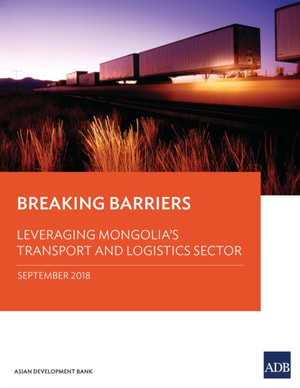
This study provides insights into the logistics sector in Mongolia and its relationship to international trade, domestic trade, and freight movement throughout the country.
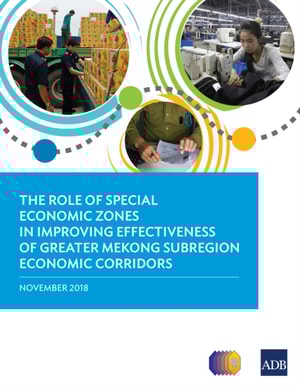
This study looks into the role of special economic zones in strengthening the competitiveness of economic corridors in the Greater Mekong Subregion (GMS).
This book provides a current and comprehensive analysis of the context in which Pacific women engage in the private sector, as well as a detailed list of strategies to increase their participation in business.
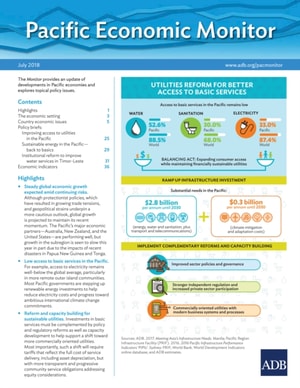
This issue highlights the economic prospects of the Pacific developing member countries (Pacific DMCs) and stresses the importance of improving the quality and access to basic and sustainable utilities in the Pacific DMCs.
The Key Indicators for Asia and the Pacific 2018, the 49th edition of this series, includes the latest available economic, financial, social, and environmental indicators for the 48 regional members of the Asian Development Bank.
The Bangladesh Public Financial Management Systems report documents the country's financial management systems covering primarily the areas of budgeting, funds flow, accounting and reporting, and auditing systems.
This report illustrates the current state of inclusive business (IB) models in the Asia-Pacific Economic Cooperation (APEC) economies, particularly the market potentials, constraints, and necessary policy instruments for an enabling environment for IB.
The report explains the current state of inclusive business (IB) models from the People's Republic of China, drawing from domestic and international company examples and practices.
Unique health identifiers help improve quality and continuum of care, strengthen surveillance of communicable diseases, eradicate diseases, and optimize provider and payer transactions in health financing schemes.
Across the Greater Mekong Subregion (GMS), there are over 500 special economic zones (SEZs) and industrial zones located near GMS economic corridors and covering over 50 million people.