To help overcome remoteness, Pacific economies are looking to improve economic integration not only through ICT and transport network investments, but also by promoting greater competition and private investment.
From in-country to cross-country connections, whether by land, air, or water, transport is a key ingredient that enables nations to achieve economic and social development goals.
The Singapore bond market has become one of the most developed open capital markets in Asia with over US$221 billion in total local currency bonds outstanding with an additional US$53 billion of bonds outstanding.
This report is an outcome of Phase 3 discussions under the ASEAN+3 Bond Market Forum Sub-Forum 2, which have focused on making bond market infrastructures in the region more inter-operable through the harmonization of transaction flows, standardization of messaging items, and implementation of international standards.
The ASEAN+3 Multi-Currency Bond Issuance Framework (AMBIF) is a policy initiative of the Asian Bond Markets Initiative to create a nexus among domestic professional local currency bond markets in the region by facilitating intra-regional transactions through standardized bond and note issuance and investment processes.
The Operational Plan for Health, 2015-2020 articulates the focused and scaled-up response of the Asian Development Bank (ADB) to the health sector needs of its developing member countries.
This progress report developed by the Cross-Border Settlement Infrastructure Forum (CSIF), composed of the central banks and central securities depositories in the Association of Southeast Asian Nations (ASEAN) and the People's Republic of China, Japan, and the Republic of Korea---collectively known as ASEAN+3, is an important step for the establishment of Central Securities Depository-Real-Time Gross Settlement (CSD-RTGS) Linkages as a regional settlement intermediary in the region.
This year's Annual Report of the Accountability Mechanism (AM) has the theme "e;Strengthening Partnerships"e; with good reason: Cooperation is the heart and soul of the mechanism.
This report critically analyzes the complex environment for private sector development in Papua New Guinea, showing the country's potential to capitalize on its vast wealth well into the coming decades.
The Office of Anticorruption and Integrity (OAI) helps ensure that development funds entrusted to the Asian Development Bank (ADB) are not misused through fraud or corruption.
This publication commemorates the 25 years of the opening of the Nepal resident mission, and provides an overview of how ADB's operation in Nepal has evolved over the years.
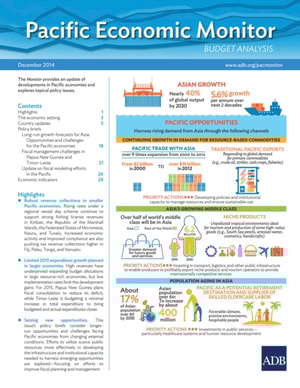
An analysis of 2014 budget outcomes and 2015 budget plans of Pacific developing member countries of the Asian Development Bank is the focus of this issue of the Pacific Economic Monitor.
The Journal of GMS Development Studies is a multidisciplinary peer-reviewed publication that seeks to promote a better understanding of a broad range of development issues of the Greater Mekong Subregion (GMS).
Spanning more than 800 kilometers of India's eastern coastline, the Vizag-Chennai Industrial Corridor (VCIC) is part of the country's East Coast Economic Corridor.
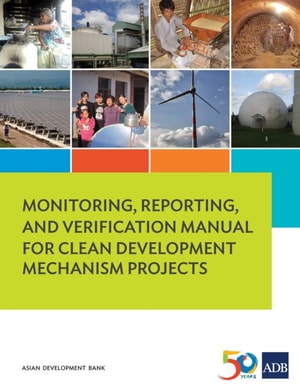
The Clean Development Mechanism (CDM), a market mechanism under the Kyoto Protocol, has been successful in supporting mitigation actions through carbon inance.
This publication details the rapid assessment of the urban sector in Georgia to understand key urbanization trends and patterns of growth and to analyze challenges and opportunities.
This publication is a result of a 2-year innovative, exploratory, and reflective study of cities as unique urban spaces that support life, work, and play.
Thailand's economic and social transformation of the last 50 years has placed it in the ranks of upper middle-income countries and made it an integral part of global value chains.
This publication captures the presentations and discussions of experts and policy makers during the Experts' Roundtable Meeting on Assessing Fragility for a Differentiated Approach in Dealing with Fragile and Conflict-Affected Situations, held on 15-16 June 2015 in Bangkok.
A 2001 report by the Australian Agency for International Development and the New Zealand Ministry for Foreign Affairs and Trade marked the beginning of efforts by both governments to increase their emphasis on aid harmonization in the Pacific.
The Vanuatu Legal Sector Strengthening Program (VLSSP) was launched in 2002 at a time when "e;the public was calling for a revamp of the whole judiciary.
Emerging from the ethnic tensions that tore the Solomon Islands apart from 1998 to 2003, the country's Ministry of Infrastructure Development faced a number of serious challenges.
The Community Justice Liaison Unit was established under Papua New Guinea's (PNG) law and justice sector program, with the support of the Australian government, to enhance the capacity of PNG's civil society and facilitate its involvement in policy development and delivery of services in the justice sector.
For years, Nauru, a small Pacific island nation (population 10,000), benefited from the considerable wealth generated from its only major natural resource, phosphate.
The Provincial Performance Improvement Initiative (PPII) is an undertaking of the Government of Papua New Guinea (PNG) that seeks to improve public administration at the subnational level.
Tuvalu, the fourth smallest country in the world, with an estimated population of 10,440, is an isolated and resource-poor country that relies mainly on royalties received for access to its exclusive economic zone and remittances as its main sources of foreign exchange.
The study contains analyses and recommendations on the approaches to capacity development that work best and the conditions that have been conducive to their success, the unique challenges faced by Pacific developing member countries in addressing capacity constraints, and the implications for future interventions at both the strategic and operational levels.
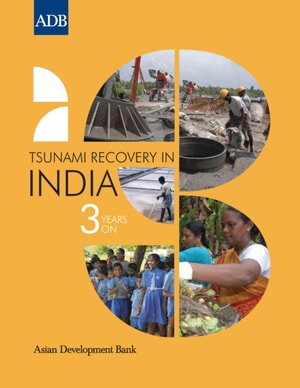
The report, published 3 years after the devastating tsunami struck on 26 December 2004, endeavors to record key achievements and lessons learned during the recovery and reconstruction efforts that the Asian Development Bank supported in areas affected by this tragedy.
In the 1990s, the Republic of the Marshall Islands (RMI) turned its fisheries industry to a more open, lucrative and private sector driven, with the support of a series of strategic capacity development interventions sponsored by the Asian Development Bank.
The Star Mountain Investment Holding Limited (SMIHL) is a Papua New Guinean (PNG) landowner holding company operating in Western Province, in the shadows of the huge Ok Tedi mine.