This textbook connects three vibrant areas at the interface between economics and computer science: algorithmic game theory, computational social choice, and fair division.
Influential libertarians from diverse backgrounds and professions who have worked toward a freer society across the globe share their personal and intellectual journeys, including what their lives and thoughts were before they embraced libertarianism; which people, texts, or events most inspired them; what experiences, challenges, tribulations, and achievements they have had as participants or leaders in this movement, and how this philosophy has affected their private and professional lives.
Research in the History of Economic Thought and Methodology Volume 41B features a selection of papers presented at the First History of Economics Diversity Caucus Conference, new research essays from Roger Sandilands and co-authors Daniel Schiffman and Eli Goldstein, as well as an interview of Francis Wilson conducted by Phil Magness and Micha Gartz.
This book bridges the gap between Islamic and conventional (micro)economics by demonstrating how modern tools and theories of microeconomics can be applied to Islamic assumptions regarding economics and finance.
By offering a critical assessment of the evolution of standard game theory, this book argues for a shift in the ontology and methodology of game theory for appraising games, one based on understanding the players' strategic reasoning process.
Research in the History of Economic Thought and Methodology Volume 41B features a selection of papers presented at the First History of Economics Diversity Caucus Conference, new research essays from Roger Sandilands and co-authors Daniel Schiffman and Eli Goldstein, as well as an interview of Francis Wilson conducted by Phil Magness and Micha Gartz.
By offering a critical assessment of the evolution of standard game theory, this book argues for a shift in the ontology and methodology of game theory for appraising games, one based on understanding the players' strategic reasoning process.
This edited volume offers a systematic exploration of the relations between Western and Eastern scientists during the Cold War from the Eastern European perspective using the example of economic history.
The growth of digital technologies and Artificial Intelligence (AI) has the potential to increase global wealth and tackle some of the world's most serious problems, including economic marginalization.
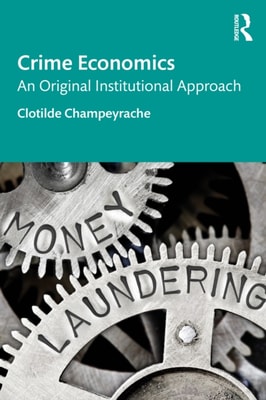
Presenting an original institutional approach, this book makes the case for an empirically based crime economics that aims to guide the fight against crime within a logic of reasonable capitalism and the common good.
This edited volume offers a systematic exploration of the relations between Western and Eastern scientists during the Cold War from the Eastern European perspective using the example of economic history.
This edited volume brings together some of the best papers from the 2022 Conference on Partial Least Squares Structural Equation Modeling (PLS-SEM), held at the Babes-Bolyai University, Cluj, Romania.
This book assembles main contributions to an alternative explanation of globalisation and the political economic structures of the international system.
This edited volume brings together some of the best papers from the 2022 Conference on Partial Least Squares Structural Equation Modeling (PLS-SEM), held at the Babes-Bolyai University, Cluj, Romania.
After the Great Financial Crisis, economic theory was fiercely criticized from both outside and inside the discipline for being incapable of explaining a crisis of such magnitude.
Volume 41A of Research in the History of Economic Thought and Methodology features a symposium on "e;Religion, the Scottish Enlightenment, and the Rise of Liberalism,"e; a new research essay by Syed Mohib Ali, and a roundtable on the institutionalist economics of Geoffrey Hodgson.
Influential libertarians from diverse backgrounds and professions who have worked toward a freer society across the globe share their personal and intellectual journeys, including what their lives and thoughts were before they embraced libertarianism; which people, texts, or events most inspired them; what experiences, challenges, tribulations, and achievements they have had as participants or leaders in this movement, and how this philosophy has affected their private and professional lives.
With a bias for action, this book offers valuable insights into the origins of the much-celebrated Danish design tradition and how it can be employed to create design solutions to address today's environmental crisis using the planetary boundaries as positive creative constraints.
This book bridges the gap between Islamic and conventional (micro)economics by demonstrating how modern tools and theories of microeconomics can be applied to Islamic assumptions regarding economics and finance.
The growth of digital technologies and Artificial Intelligence (AI) has the potential to increase global wealth and tackle some of the world's most serious problems, including economic marginalization.
This book contains detailed documentation of the CHINAGEM model - a large-scale dynamic computable general equilibrium (CGE) model of China and its applications.