Recessions are a recurring phenomenon and there are repeated debates about how to combat them when the crisis hits and after the economy begins to grow again.
Recessions are a recurring phenomenon and there are repeated debates about how to combat them when the crisis hits and after the economy begins to grow again.
This book argues that focusing on the green economy and green finance is essential to counteract the catastrophic, socio-economic effects of the COVID-19 pandemic.
Orthodox economics operates within a hypothesized world of perfect competition in which perfect consumers and firms act to bring about supposedly optimal outcomes.
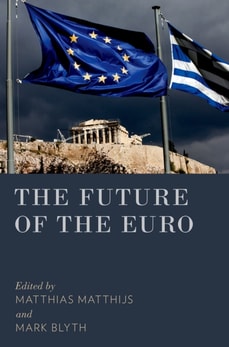
In The Future of the Euro, a group of the world's top political economists analyze the fundamental causes of the euro crisis, determine how it can be fixed, and consider what likely futures lie ahead for the currency.
Why has the Eurozone ended up with an unemployment rate more than twice that of the United States more than six years after the collapse of Lehman Brothers?
Why has the Eurozone ended up with an unemployment rate more than twice that of the United States more than six years after the collapse of Lehman Brothers?
In The Future of the Euro, a group of the world's top political economists analyze the fundamental causes of the euro crisis, determine how it can be fixed, and consider what likely futures lie ahead for the currency.
Written by four recognized experts with senior experience in research and government, this text is the first comprehensive survival kit for students and practitioners of economic policy.
Written by four recognized experts with senior experience in research and government, this text is the first comprehensive survival kit for students and practitioners of economic policy.
The first World Climate Conference, which was sponsored by the World Meteorological Organization in Geneve in 1979, triggered an international dialogue on global warming.
Over the past quarter-century China has seen a dramatic increase in income inequality, prompting a shift in China's development strategy and the adoption of an array of new policies to redistribute income, promote shared growth, and establish a social safety net.
Over the past quarter-century China has seen a dramatic increase in income inequality, prompting a shift in China's development strategy and the adoption of an array of new policies to redistribute income, promote shared growth, and establish a social safety net.
This short primer distils Ruchir Sharma's decades of global analytic experience into ten rules for identifying nations that are poised to take off or crash.
The Cash Nexus is the controversial history of money's central place in the world, from Niall Ferguson, bestselling author of Empire and CivilizationGenerations of historians have shied away from the truth behind the cliche: money makes the world go around.
In The Conscience of a Liberal Paul Krugman, one of the US s most respected economists and outspoken commentators, lays out his vision of a New Deal for a fairer society.
What happens in the City has never affected us moreIn this excellent guide, now fully revised and updated, leading financial journalist Philip Coggan cuts through the headlines, the scandals and the jargon to explain the nuts and bolts of the financial system.
The fascinating untold story of digital cash and its creators-from experiments in the 1970s to the mania over Bitcoin and other cryptocurrenciesBitcoin may appear to be a revolutionary form of digital cash without precedent or prehistory.
Sustainable finance involves making investment decisions that consider not only financial returns, but also environmental, social, and governance factors.
Modern money, having now become a key tool of government economic policy and a source of massive tax revenues, has strayed far from its original purpose.
This book analyses the use of qualitative and quantitative content analysis methodologies for risk disclosure practices in the European banking industry.
This volume presents techniques and theories drawn from mathematics, statistics, computer science, and information science to analyze problems in business, economics, finance, insurance, and related fields.
This book assesses major schools of thought in macroeconomic theory between the Great Depression and the Long Recession, focusing on their analysis of cycles, crises and macro-policy.