'This is the second book of a two-volume set that continues Adam Smith's work, using the tools mathematical, experimental, and behavioural economists have developed since 1776.
This work responds to the increasing need in many countries to better understand linkages between intellectual property, trade rules, and economic and social development, and to find new ways of implementing intellectual property rules and optimizing their effects.
This work responds to the increasing need in many countries to better understand linkages between intellectual property, trade rules, and economic and social development, and to find new ways of implementing intellectual property rules and optimizing their effects.
This book is a practical guide for theory-based empirical analysis in economics that guides the reader through the first steps when moving between economic theory and applied research.
This book is a practical guide for theory-based empirical analysis in economics that guides the reader through the first steps when moving between economic theory and applied research.
Edith Penrose was a remarkable woman and distinguished scholar who lived through, and witnessed at first hand, many of the major events of the 20th century; the great depression in the US; the rise of Nazism in Europe; the second world war when she worked as a special adviser to the US Ambassador in London; post-war reconstruction, assisting Eleanor Roosevelt with the drafting of the Universal Declaration of Human Rights; the McCarthy era; and the oil crisis of the 1970s.
In the past few decades, economic analysis of law has been challenged by a growing body of experimental and empirical studies that attest to prevalent and systematic deviations from the assumptions of economic rationality.
In the past few decades, economic analysis of law has been challenged by a growing body of experimental and empirical studies that attest to prevalent and systematic deviations from the assumptions of economic rationality.
The rapidly changing and evolving art market might appear to be chaotic to the casual observer, with new highs, potential lows, and tastes and fashions changing season to season.
The rapidly changing and evolving art market might appear to be chaotic to the casual observer, with new highs, potential lows, and tastes and fashions changing season to season.
This book explains how three major mechanisms of globalization international trade, international migration, and the activities of multinational companies have altered working conditions and labor rights around the world during the late 20th century.
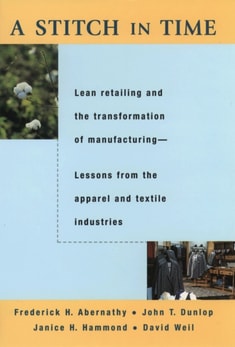
The apparel and textile industries have always been at the mercy of rapidly changing styles and fickle customers who want the latest designs while they are still in fashion.
The Oxford Handbook of the Economics of Networks represents the frontier of research into how and why networks they form, how they influence behavior, how they help govern outcomes in an interactive world, and how they shape collective decision making, opinion formation, and diffusion dynamics.
Steven Levitt, the original rogue economist, and Stephen Dubner have spent four years uncovering the hidden side of even more controversial subjects, from terrorism to shark attacks, cable TV to hurricanes.
Decision-Making Management: A Tutorial and Applications provides practical guidance for researchers seeking to optimizing business-critical decisions employing Logical Decision Trees thus saving time and money.
The book discusses, elaborates on and answers questions to the following points: Firstly, what has changed through the information technology represented by software, Internet and big data?
Entrepreneurship Trajectories: Entrepreneurial Opportunities, Business Models, and Firm Performance explores several entrepreneurship trajectories recognized by economists and entrepreneurs.
A response to the pressing need to address and clarify the substantial ambiguity within current literature, this edited volume aims to deepen readers' understanding of the impact of foreign aid on development outcomes based on the latest findings in research over the past decade.
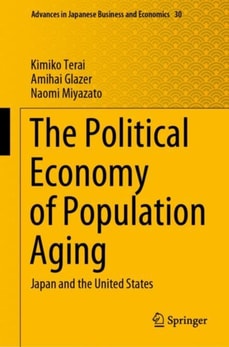
This book integrates the economics of aging and insight based on political economy and explores generational conflict in the context of governmental spending.
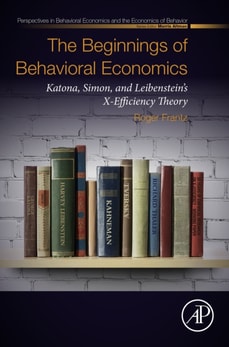
The Beginnings of Behavioral Economics: Katona, Simon, and Leibenstein's X-Efficiency Theory explores the mid-20th century roots of behavioral economics, placing the origin of this now-dominant approach to economic theory many years before the groundbreaking 1979 work on prospect theory by Daniel Kahneman and Amos Tversky.
This book provides for the first time the microfoundations of evolutionary economics, enabling the reader to grasp a new framework for economic analysis that is compatible with evolutionary processes.
This book paints a portrait of social life in America by providing an accessible discussion of empirical economics research on issues such as illegal immigration, health care and climate change.
How the optimism gap between rich and poor is creating an increasingly divided societyThe Declaration of Independence states that all people are endowed with certain unalienable rights, and that among these is the pursuit of happiness.
How Behavioral Economics Influences Management Decision-Making: A New Paradigm critically reexamines the management function in 21st century workplaces.
The ways financial analysts, traders, and other specialists use information and learn from each other are of fundamental importance to understanding how markets work and prices are set.