Clive, Proconsul of India (1976) examines the life of the man held by many to be one of the main originators of European imperialism in Asia in the eighteenth century.
The Gambia Colony and Protectorate (1967) provides both a history of the colony and a wealth of valuable practical and statistical information about its establishment and running.
The Gambia Colony and Protectorate (1967) provides both a history of the colony and a wealth of valuable practical and statistical information about its establishment and running.
History of the Conquest of Peru (1959) contains a detailed analysis of the political, religious and social organisation of the Incas prior to the arrival of the Spanish colonisers, and then moves on to look at the story of the conquest and subjugation of the Incan Empire, the largest in South America.
History of Nigeria (1969) was first published in 1929 and completely revised by its author, and gives the history of Nigeria from before its first encounters with the British, through colonial rule, and up to independence in 1960.
James Smith (1989) is study of this hitherto-neglected maker of colonial culture, and traces the rise and decline of the transplanted ideas and values that Smith and many of his fellow immigrants to Australia upheld.
Malta and the End of Empire (1971) examines the now-forgotten moment in 1956 when the people of Malta, Gozo and Comino were asked by the British and Maltese Governments to decide whether they wanted full integration with the United Kingdom - a remarkable proposal which ran quite contrary to colonial policy at the time.
History of the British West Indies (1954) examines the history of the islands of the Caribbean from their first discovery, through the periods of colonisation and slavery, and up to the beginnings of their status as independent nations.
Colonial Sequence 1949 to 1969 (1970) continues the sequence begun in Colonial Sequence 1930 to 1949 and presents a valuable body of evidence for the enquiry into Britain's colonial actions, written at a time when Britain was retreating from empire.
Buddhism, Imperialism and War (1979) is a lively, provocative and informative study of two of the most important Buddhist countries of South East Asia - Burma and Thailand.
Early Records of British India (1972) is an important collection of source material deriving from official documents which now form part of the India Office Records.
British Policy Towards the Indian States (1982) examines the concept of indirect rule in terms of both its application and consequences in the princely states of India during the first four decades of the twentieth century.
Colonialism and Underdevelopment in Ghana (1978) examines Ghana's integration into the world economic system, and the effects which such integration had on its development.
Dual Legacies in the Contemporary Caribbean (1986) is a comparative and systematic study of the legacies bequeathed by British and French colonial rule in the Caribbean.
Colonial Sequence 1930-1949 (1967) presents a valuable body of evidence for the enquiry into Britain's colonial actions, written at a time when Britain was retreating from empire.
In Defence of British India (1984) illustrates the problems arising from the British need to defend an Indian empire against the fluctuations in the European balance of power, preferably by isolating the empire from the European political system.
Crime, Justice and Society in Colonial Sri Lanka (1987) examines Sri Lanka's justice system under British rule, and concentrates on two of its aspects: the effectiveness of the administration of law and order, and the relationship between crime and social change.
Chatham's Colonial Policy (1917) examines Britain's colonial plans and ambition in the mid-eighteenth century, under the leadership of the Earl of Chatham - William Pitt the Elder.
Perspectives on Imperialism and Decolonization (1984) is a key collection of essays that analyse from many sides the growth and demise of Western imperialism.
Crime, Justice and Society in Colonial Sri Lanka (1987) examines Sri Lanka's justice system under British rule, and concentrates on two of its aspects: the effectiveness of the administration of law and order, and the relationship between crime and social change.
Parliament as an Export (1966) deals with the adoption of overseas countries and particularly the Commonwealth countries of the British Parliamentary system.
In Defence of British India (1984) illustrates the problems arising from the British need to defend an Indian empire against the fluctuations in the European balance of power, preferably by isolating the empire from the European political system.
Colonial Sequence 1949 to 1969 (1970) continues the sequence begun in Colonial Sequence 1930 to 1949 and presents a valuable body of evidence for the enquiry into Britain's colonial actions, written at a time when Britain was retreating from empire.
History of the Conquest of Peru (1959) contains a detailed analysis of the political, religious and social organisation of the Incas prior to the arrival of the Spanish colonisers, and then moves on to look at the story of the conquest and subjugation of the Incan Empire, the largest in South America.
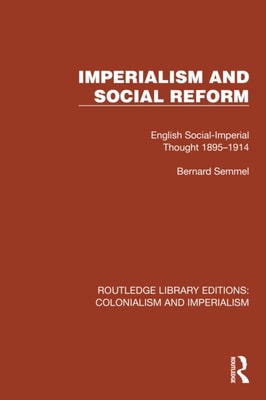
Imperialism and Social Reform (1960) examines British social-imperialism and the development of social-imperial thought: the promotion of a 'people's imperialism', or the support of the working classes for the imperialist system.
Early Records of British India (1972) is an important collection of source material deriving from official documents which now form part of the India Office Records.
Dual Legacies in the Contemporary Caribbean (1986) is a comparative and systematic study of the legacies bequeathed by British and French colonial rule in the Caribbean.
Colonial Sequence 1930-1949 (1967) presents a valuable body of evidence for the enquiry into Britain's colonial actions, written at a time when Britain was retreating from empire.
History of the British West Indies (1954) examines the history of the islands of the Caribbean from their first discovery, through the periods of colonisation and slavery, and up to the beginnings of their status as independent nations.
Perspectives on Imperialism and Decolonization (1984) is a key collection of essays that analyse from many sides the growth and demise of Western imperialism.
Imperialism and Social Reform (1960) examines British social-imperialism and the development of social-imperial thought: the promotion of a 'people's imperialism', or the support of the working classes for the imperialist system.
British India's Relations with the Kingdom of Nepal (1970) uses original documents and confidential papers never before available to examine the relations between Nepal and British India from 1857 to 1947.
Chatham's Colonial Policy (1917) examines Britain's colonial plans and ambition in the mid-eighteenth century, under the leadership of the Earl of Chatham - William Pitt the Elder.
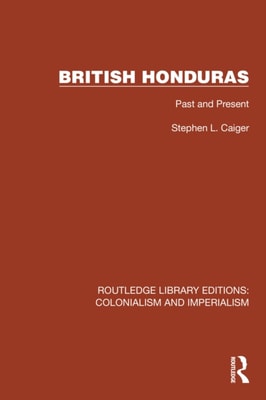
British Honduras (1951) examines this most neglected of the British colonies, from the early days of settlement by the logwood-cutters and buccaneers up to the post-war period.
Capitalism and Colonial Production (1982) examines the ways in which capitalism has transformed the societies it came to dominate, and the link between colonialism and capitalism.
Buddhism, Imperialism and War (1979) is a lively, provocative and informative study of two of the most important Buddhist countries of South East Asia - Burma and Thailand.