This original and engaging textbook is concerned with stylistic choices, and the textual analysis which can illuminate the choices that a text producer has made.
This book examines the importance of politeness in pragmatic expression and communication, making a significant contribution to the debate over whether the universal politeness theory is applicable globally regardless of cultural differences.
In considering the ways in which current theories of language in use and communicative processes are applied to the analysis, interpretation and definition of literary texts, this book sets an agenda for the future of pragmatic literary stylistics and provides a foundation for future research and debate.
This book synthesizes previous work on thanking, politeness and Japanese pragmatics and crystallises the theoretical underpinnings of thanking, how it is realized linguistically and the social meaning and significance of this aspect of Japanese communication.
Imaginative and attractive, cutting edge in its conception, this text explicates a model for the integration of language arts and literacy education based on the notion of framing.
Imaginative and attractive, cutting edge in its conception, this text explicates a model for the integration of language arts and literacy education based on the notion of framing.
Essentialism--roughly, the view that natural kinds have discrete essences, generating truths that are necessary but knowable only a posteriori--is an increasingly popular view in the metaphysics of science.
Essentialism--roughly, the view that natural kinds have discrete essences, generating truths that are necessary but knowable only a posteriori--is an increasingly popular view in the metaphysics of science.
Making pragmatics accessible to a wide range of students and instructors without dumbing down the content of the field, this text for language professionals: raises awareness and increases knowledge and understanding of how human beings use language in real situations to engage in social action fosters the ability to think critically about language data and use helps readers develop the ability to "e;do pragmatics"e; The book features careful explanations of topics and concepts that are often difficult for uninitiated readers, a wealth of examples, mostly of natural speech from collected data sources, and attention to the needs of readers who are non-native speakers of English, with non-Western perspectives offered when possible.
Making pragmatics accessible to a wide range of students and instructors without dumbing down the content of the field, this text for language professionals: raises awareness and increases knowledge and understanding of how human beings use language in real situations to engage in social action fosters the ability to think critically about language data and use helps readers develop the ability to "e;do pragmatics"e; The book features careful explanations of topics and concepts that are often difficult for uninitiated readers, a wealth of examples, mostly of natural speech from collected data sources, and attention to the needs of readers who are non-native speakers of English, with non-Western perspectives offered when possible.
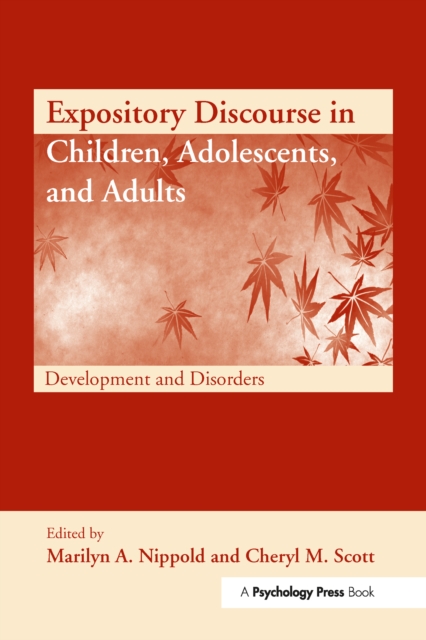
School success in the 21st century requires proficiency with expository discourse -- the use and understanding of informative language in spoken and written modalities.
This volume contains contributions from leaders in the field of child language in honor of one of the preeminent scholars in the field of child language acquisition, Melissa Bowerman.
This volume contains contributions from leaders in the field of child language in honor of one of the preeminent scholars in the field of child language acquisition, Melissa Bowerman.
This volume is devoted to the fascinating topic of social communication - fascinating because communication is ubiquitous, in that one cannot not communicate.
Accessible yet theoretically rich, this landmark text introduces key concepts and issues in critical discourse analysis and situates these within the field of educational research.
Aims to reorient the study of language by taking into serious consideration the perspective on linguistic matters taken by lay speakers themselves, as a response to the now inescapable conclusion that traditional linguistic theory, with its focus on revealing 'the facts of language in general', cannot handle the necessary indeterminacy of what is said and understood.
In this book, Gregoriou explores the portrayal of the serial killer identity and its related ideology across a range of contemporary crime narratives, including detective fiction, the true crime genre and media journalism.
In this book, Gregoriou explores the portrayal of the serial killer identity and its related ideology across a range of contemporary crime narratives, including detective fiction, the true crime genre and media journalism.
First published in 1980, this reissue is a study of the sociology of language, which aims to bridge the gap between textbook and monograph by alternating chapters of explication and analysis.
Regimes of Derivation in Syntax and Morphology presents a theory of the architecture of the human linguistic system that differs from all current theories on four key points.
Regimes of Derivation in Syntax and Morphology presents a theory of the architecture of the human linguistic system that differs from all current theories on four key points.
Semantic externalism is the view that the meanings of referring terms, and the contents of beliefs that are expressed by those terms, are not fully determined by factors internal to the speaker but are instead bound up with the environment.
Semantic externalism is the view that the meanings of referring terms, and the contents of beliefs that are expressed by those terms, are not fully determined by factors internal to the speaker but are instead bound up with the environment.
This book deals with two different pragmatic approaches to textual communication: (i) the mainstream approach followed by the 'Ash'ari s, Hanafi s and Mu'tazili s, (ii) the salafite approach followed mainly by the Hanbali s, defended and elaborated by Ibn Taymiyyah.
This book deals with two different pragmatic approaches to textual communication: (i) the mainstream approach followed by the 'Ash'ari s, Hanafi s and Mu'tazili s, (ii) the salafite approach followed mainly by the Hanbali s, defended and elaborated by Ibn Taymiyyah.