Synthesizing ideas from event semantics and psycholinguistics, this monograph provides a new perspective on the processing of linguistic aspect and aspectual coercion.
This book investigates how Japanese participants accommodate to and make use of genre-specific characteristics to make stories tellable, create interpersonal involvement, negotiate responsibility, and show their personal selves.
Based on the analysis of conversations between French and Australian English speakers discussing various topics, including their experiences as non-native speakers in France or Australia, this book combines subjective personal testimonies with an objective linguistic analysis of the expression of opinion in discourse.
The concept of theory of mind (ToM), a hot topic in cognitive psychology for the past twenty-five years, has gained increasing importance in the fields of linguistics and pragmatics.
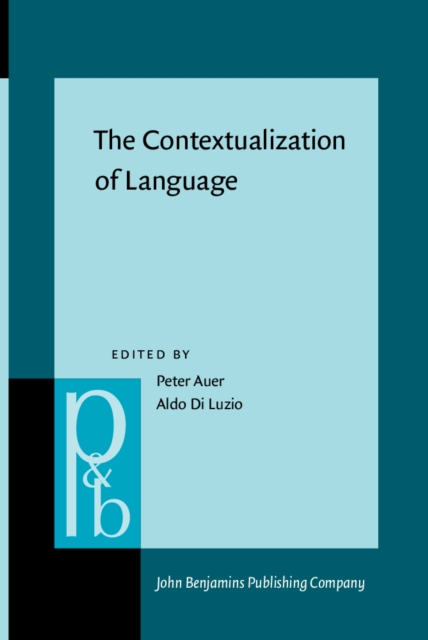
The fourteen contributions in this collection come from different approaches in pragmatics, interactional linguistics, conversation analysis, discourse analysis and dialogue analysis; the name given to what is studied ranges from spoken language and conversation to interaction, dialogue, discourse and communication.
The 'Mixed Game Model' represents a holistic theory of dialogue which starts from human beings' competence-in-performance and describes how language is integrated in a general theory of human action and behaviour.
Primarily focused on idioms and other figurative phraseology, Colouring Meaning describes how the meanings of established phrases are enhanced, refocused and modified in everyday language use.
In recent years, a lively debate ensued on an old issue, namely the proper distinction between semantics and pragmatics against the background of the classical Gricean distinction between 'what is said' and 'what is implicated'.
The Japanese sentence-final particles, ne, yo and yone have proved notoriously difficult to explain and are especially challenging for second language users.
This book investigates the ways that advanced speakers of Korean as a second language perceive, use and learn the complexities of the Korean honorifics system.
This book reconstructs the tradition of dialectic from Aristotle's Topics, its founding text, up to its "e;renaissance"e; in 16th century Italy, and focuses on the role of dialectic in the production of knowledge.
Requests, a speech act people frequently use to perform everyday social interactions, have attracted particular attention in politeness theories, pragmatics, and second language acquisition.
In the final chapter of this volume, the authors refer to the "e;pedagogical vantage points offered by narrative inquiry"e;, an apt comment that encapsulates the volume's purpose and its spirit.
While cognitive linguists are essentially in agreement on both the conceptual nature and the fundamental importance of metonymy, there remain disagreements on a number of specific but, nevertheless, crucial issues.
The role deixis plays in structuring language and its relation to the context of utterance provides the focus for an examination of information packaging in Russian discourse.
Since the celebration of the 100th anniversary of Darwin's The Language of the Emotions in Man and Animals (1872), emotionology has become a respectable and even thriving research domain again.
This volume contains a selection of reviewed and revised papers, originally presented at the International Pragmatics Conference held in Viareggio, Italy, 1-5 September 1985.
This volume, originally published in Russian, combines data from a wide range of languages, meticulously analyzed, with a sophisticated theoretical apparatus capable of isolating the most important syntactic and semantic parameters and of drawing those generalizations that are most significant from a cross-linguistic perspective.
In the course of the long debate on the nature and the classification of signs, from Boethius to Ockham, there are at least three lines of thought: the Stoic heritage, that influences Augustine, Abelard, Francis Bacon; the Aristotelian tradition, stemming from the commentaries on De Interpretatione; the discussion of the grammarians, from Priscian to the Modistae.
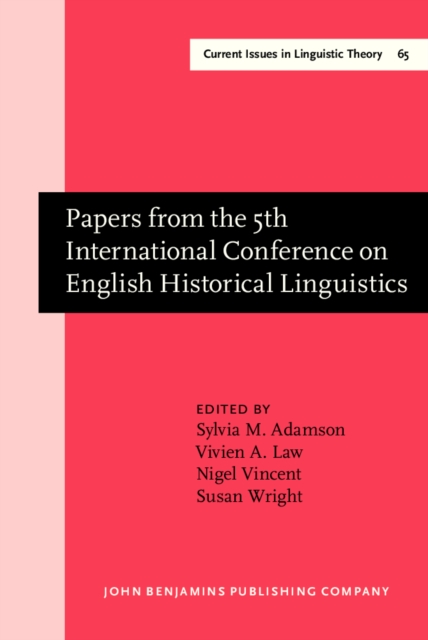
This volume is a collection of articles based on papers presented at the 5th International Conference on English Historical Linguistics at Cambridge in 1987.
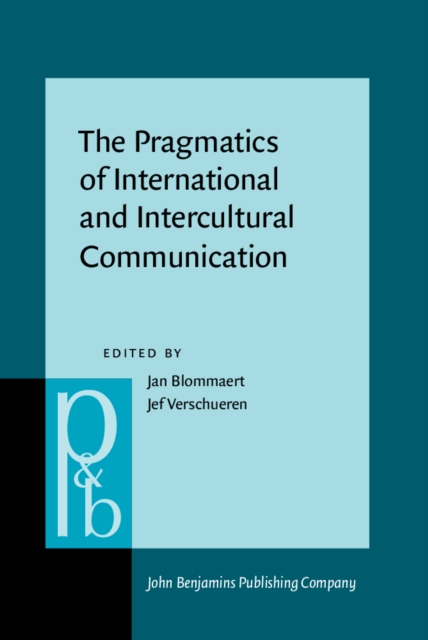
This volume contains a selection of papers from a special session of the International Pragmatics Conference (Antwerp, August 1987) and from the Symposium on Intercultural Communication (Ghent, December 1987).
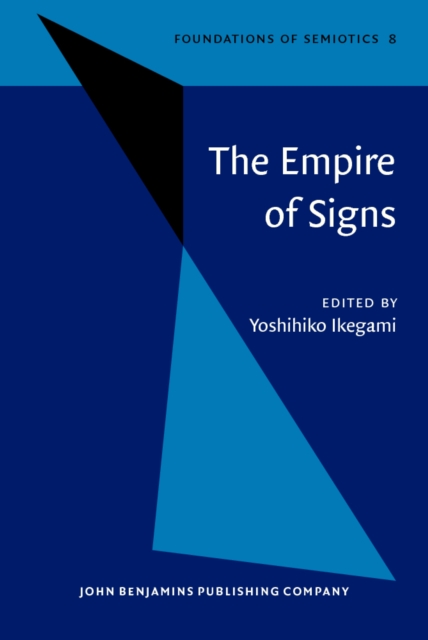
Like Roland Barthes' well-known book, L’Empire des signes, from which the title of the present collection is taken, this volume contains essays dealing with certain aspects of Japanese culture.
This book examines relations which hold between morphosyntactic form and communicative function in discourse by examining form-function correlations of noninterrogative questions in ordinary English conversation.
This set of papers represents a unique collection; it is the first attempt ever to empirically test a hypothetical set of semantic and lexical universals across a number of genetically and typologically diverse languages.