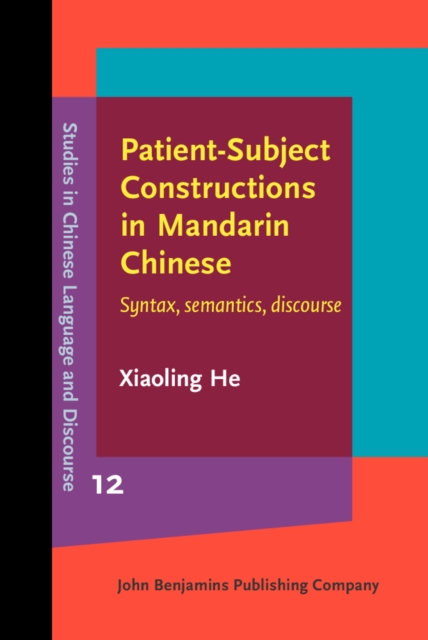
As a distinctive syntactic structure in Mandarin Chinese, the Patient-Subject Construction (PSC) is one of the most interesting but least well-understood structures in the language.
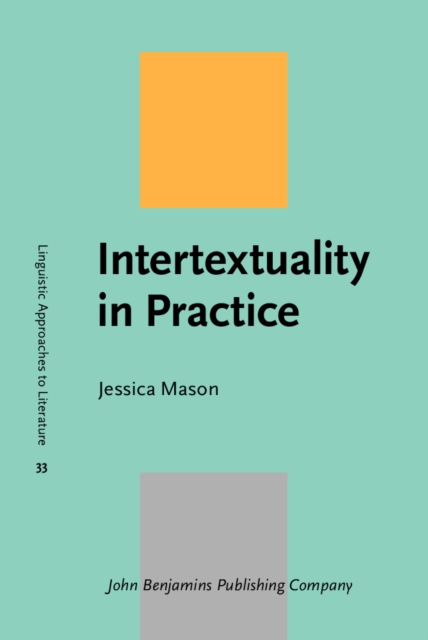
The books we've read, the films we've seen, the stories we've heard - and just as importantly the ones we haven't - form an integral part of our identity.
This edited volume offers new insights into contemporary political discourses in Slavic speaking countries by focusing on discursive and linguistic means deployed in relevant genres, such as parliamentary discourse, commemorative and presidential speeches, mediated communication, and literal and philosophical essays.
Storytelling in the Digital World explores new, emerging narrative practices as they are enacted on digital platforms such as Amazon, Facebook, Twitter, and YouTube.
Argumentation in Actual Practice contains a collection of topical studies about argumentative discourse in context written by argumentation scholars from a diversity of academic backgrounds.
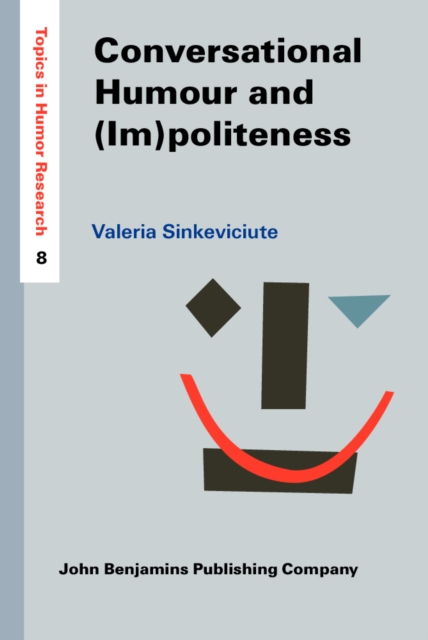
Conversational Humour and (Im)politeness is the first systematic study that offers a socio-pragmatic perspective on humorous practices such as teasing, mockery and taking the piss and their relation to (im)politeness.
Departing from the premise that 'being ordinary' is brought into the discourse and brought out in the discourse and is thus an interactional achievement, the contributions to this edited volume investigate its construction, reconstruction and deconstruction in media discourse.
This book showcases innovative research about the multi-functional and dynamic interrelatedness of questioning and answering practices in institution- and culture-specific interactions ranging from under-explored to extensively researched ones: South-Korean talk shows, Japanese interviews, Chinese news interviews, police-civilian interactions in the USA, Italian interviews and courtroom examinations, Japanese parliamentary debates and Prime Minister's Questions in the UK Parliament.
Despite the fact that they are often crucial to our understanding, the vague, ineffable elements of language use and communication have received much less attention from linguists than the more concrete, effable ones.
The relation between pragmatic markers and the peripheries of clauses, utterances and/or turns has been a topic of linguistic interest for the last few decades.
As Ragnar Rommetveit put it forty years ago, dialogue is "e;the architecture of intersubjectivity"e;: a tool not only for maintaining yet also constantly transforming our life-worlds.
The use of the second person singular pronoun anata 'you' in modern Japanese has long been regarded as mysterious and problematic, generating contradictory nuances such as polite, impolite, intimate, and distancing.
Through critical discourse analysis (CDA) and the discourse-historical approach (DHA), this book probes into political discourse imbued with historical legacies, with particular focus on explicating the structure and function of AKP stories and its relationship with Turkish politics.
Anchored in historical pragmatics, historical sociolinguistics, and corpus linguistics, this book weaves together a powerful narrative of the significance of stance marking in the history of English.
The book is a research monograph that reviews and revises the concept of linguistic pejoration, and explores the role of 15 suffixes and combining forms, such as -ie, -o, -ard, -holic, -rrhea, -itis, -porn, -ish, in the formation of English pejoratives.
This book adopts a broad cognitive-pragmatic perspective on irony which sees ironic meaning as the result of complex inferential activity arising from conflicting conceptual scenarios.
This volume is the first monograph exploring the functions of visual cues in humor, advocating for the development of a non-linguocentric theory of humor performance.
World Englishes and English in postcolonial contexts have been curiously neglected in an otherwise abundant research literature on text types and genres in English.
A Cognitive Perspective on Spatial Prepositions: Intertwining networks is devoted to the issue of the relation between language and thought approached from the perspective of spatial relations encoded by four equivalent spatial prepositions - English to, German zu, Polish do and Russian к.
This monograph presents analyses of filled and unfilled pauses, cut-offs, repair, discourse markers and other phenomena often referred to as disfluencies in the context of advanced language learners' PowerPoint presentations.