Preventing Domestic Homicides: Lessons Learned from Tragedies focuses on the diverse nature of domestic homicides and what has been learned about the most effective prevention strategies from emerging research and the work of domestic violence death review committees in Canada, the US, the UK, NZ and AU.
Human Remains - Another Dimension: The Application of 3D Imaging in the Funerary Contextbrings together scattered literature on the topic, assimilating disparate pieces that relate to the novel use of non-invasive three-dimensional imaging techniques in the forensic context.
Identifying Ignitable Liquids in Fire Debris: A Guideline for Forensic Experts discusses and illustrates the characteristics of different ignitable liquid products.
Standard Handbook Oil Spill Environmental Forensics: Fingerprinting and Source Identification, Second Edition, provides users with the latest information on the tools and methods that have become popular over the past ten years.
Essentials of Medicolegal Death Investigation uses a unique approach by combining medical issues, injury patterns, and investigative procedures to provide the reader with the basic fundamentals for a death investigation.
Latent prints are chance or accidental impressions left by friction-ridge skin on a surface, regardless of whether they are visible or invisible at the time of deposition.
Digital Forensics Trial Graphics: Teaching the Jury Through Effective Use of Visuals helps digital forensic practitioners explain complex technical material to laypeople (i.
Though polygraph has been the mainstay for government and police departments since World War II, it has undergone substantial transformation in recent years.
Anabolic Steroid Abuse in Public Safety Personnel: A Forensic Manual provides readers with information on both the history and overwhelming evidence relating to steroid abuse in the law enforcement subculture.
Crime Scene Photography, Third Edition, covers the general principles and concepts of photography, while also delving into the more practical elements and advanced concepts of forensic photography.
Forensic Science Reform: Protecting the Innocent is written for the nonscientist to help make complicated scientific information clear and concise enough for attorneys and judges to master.
Forensic Anthropology serves as a graduate level text for those studying and teaching forensic anthropology, as well as an excellent reference for forensic anthropologist libraries or for use in casework.
Forensic Pathology, the latest volume in the Advanced Forensic Science series that grew out of the recommendations from the 2009 NAS Report serves as a graduate level text for those studying and teaching forensic pathology, and is an excellent reference for forensic pathologists' libraries or for use in their casework.
Biological Distance Analysis: Forensic and Bioarchaeological Perspectives synthesizes research within the realm of biological distance analysis, highlighting current work within the field and discussing future directions.
Forensic Fingerprints, the latest in the Advanced Forensic Science Series which grew out of the recommendations from the 2009 NAS Report: Strengthening Forensic Science: A Path Forward, serves as a graduate level text for those studying and teaching fingerprint detection and analysis, and will also prove to be an excellent reference for forensic practitioner libraries and for use in casework.
Fundamentals of Forensic Science, Third Edition, provides current case studies that reflect the ways professional forensic scientists work, not how forensic academicians teach.
Unified Communications Forensics: Anatomy of Common UC Attacks is the first book to explain the issues and vulnerabilities and demonstrate the attacks, forensic artifacts, and countermeasures required to establish a secure (UC) environment.
The man who is "e;the embodiment of the Mythbusters, Sherlock Holmes, and Richard Feynman"e; weeds out the treasures from the shams in artifact investigations (Michael Shermer, founding publisher of Skeptic magazine).
Forensic Textile Science provides an introduction to textile science, emphasizing the terminology of the discipline and offering detailed coverage of the ways textile damage analysis can be used in forensics.
Cisco IOS (the software that runs the vast majority of Cisco routers and all Cisco network switches) is the dominant routing platform on the Internet and corporate networks.
One of the hottest topics in computer forensics today, electronic discovery (e-discovery) is the process by which parties involved in litigation respond to requests to produce electronically stored information (ESI).
From the fearless defense attorney and civil rights lawyer who rose to fame with NetflixsThe Staircasecomes a bracing account of abuses of power and corruption in the criminal justice system.
One of the biggest buzzwords in the IT industry for the past few years, virtualization has matured into a practical requirement for many best-practice business scenarios, becoming an invaluable tool for security professionals at companies of every size.
Drawing from an interdisciplinary body of research and data, Women of Piracy employs a criminological lens to explore how women have been involved in, and impacted by, maritime piracy operations from the 16th century to present day piracy off the coast of Somalia.
With the ever-increasing threat of cyber-attacks, especially as the COVID-19 pandemic helped to ramp up the use of digital communications technology, there is a continued need to find new ways to maintain and improve cybersecurity.
With the ever-increasing threat of cyber-attacks, especially as the COVID-19 pandemic helped to ramp up the use of digital communications technology, there is a continued need to find new ways to maintain and improve cybersecurity.
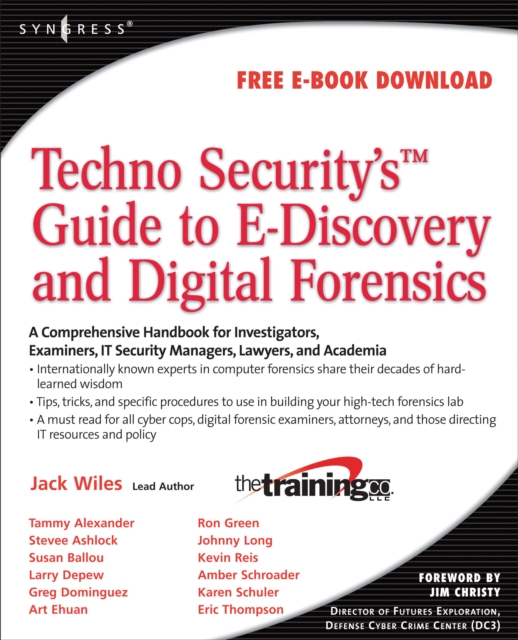
TechnoSecurity's Guide to E-Discovery and Digital Forensics provides IT security professionals with the information (hardware, software, and procedural requirements) needed to create, manage and sustain a digital forensics lab and investigative team that can accurately and effectively analyze forensic data and recover digital evidence, while preserving the integrity of the electronic evidence for discovery and trial.
Electronic discovery refers to a process in which electronic data is sought, located, secured, and searched with the intent of using it as evidence in a legal case.
Learn to pull "e;digital fingerprints from alternate data storage (ADS) devices including: iPod, Xbox, digital cameras and more from the cyber sleuths who train the Secret Service, FBI, and Department of Defense in bleeding edge digital forensics techniques.
Medical and Veterinary Entomology is a comprehensive text and is primarily intended for graduate students and upper level undergraduates studying the medical and veterinary significance of insects and related arthropods.