This book utilizes critical discourse analysis to illuminate the ways in which one of the largest agribusinesses in operation, Tyson Foods, disguises their actions whilst simultaneously presenting the image of a benign, good corporate citizen.
The present book shares critical perspectives on the conceptualization, implementation, discourses, policies, and alternative practices of environmental education (EE) for diverse and unique groups of learners in a variety of international educational settings.
This book examines international climate change mitigation and adaptation regimes with the aim of proposing fair climate stability implementation strategies.
This book explores the legal regime of non-product related process and production methods (NPR PPMs) in the context of trade-restrictive environmental measures, eco-labelling requirements and sanitary measures under the WTO.
The goals of this book are to update information on the effects of rural road development, both in Nepal and globally, explain the environmental, socioeconomic, and sociocultural impacts of expanding rural road networks in the Nepalese Himalaya, and to promote further studies on rural road development throughout the world based on studies and investigations performed in Nepal.
This book explores the regulation of pesticides in the European Union in order to reveal the complex, controversial, and contested nature of an assessment system proudly declared by the EU to be 'the strictest in the world'.
This anthology discusses important issues surrounding environmental law and economics and provides an in-depth analysis of its use in legislation, regulation and legal adjudication from a neoclassical and behavioural law and economics perspective.
This collection of papers aims to draw lessons and apply indigenous knowledge, wisdom and cultural traditions to suit policy contexts describing the (a) role of individuals (b) communities, and (c) the state to ensure effectively manage water resources.
This book explains, compares and assesses the legal implications of Dieselgate within a range of selected jurisdictions and at the EU, international and comparative law level.
This edited volume examines the multiple dimensions of sustainability in the Circumpolar North, a territory facing unprecedented environmental and social challenges at the start of the 21st century.
The book is written in the backdrop of the environmental impacts of and future requirements from the natural environment for rapid economic growth that has characterized recent economic history of China and India, especially over the past few decades.
In this book 60 authors from many disciplines and from 18 countries on five continents examine in ten parts: Moving towards Sustainability Transition; Aiming at Sustainable Peace; Meeting Challenges of the 21st Century: Demographic Imbalances, Temperature Rise and the Climate-Conflict Nexus; Initiating Research on Global Environmental Change, Limits to Growth, Decoupling of Growth and Resource Needs; Developing Theoretical Approaches on Sustainability and Transitions; Analysing National Debates on Sustainability in North America; Preparing Transitions towards a Sustainable Economy and Society, Production and Consumption and Urbanization; Examining Sustainability Transitions in the Water, Food and Health Sectors from Latin American and European Perspectives; Preparing Sustainability Transitions in the Energy Sector; and Relying on Transnational, International, Regional and National Governance for Strategies and Policies Towards Sustainability Transition.
This edited volume discuses urban transport issues, policies, and initiatives in twelve of the world's major emerging economies - Brazil, China, Colombia, India, Indonesia, Iran, Mexico, Nigeria, Russia, South Africa, Turkey, and Vietnam - countries with large populations that have recently experienced large changes in urban structure, motorization and all the associated social, economic, and environmental impacts in positive and negative senses.
While economic and other social science expertise is indispensable for successful public policy-making regarding global climate change, social scientists face trade-offs between the scientific credibility, policy-relevance, and legitimacy of their policy advice.
The first volume of the International Yearbook of Soil Law and Policy includes an important discussion on the implementation of the Sustainable Development Goals that are the basis for the post-2015 development agenda up to the year 2030; the Yearbook focuses in particular on Goal 15, which includes achieving a "e;land degradation-neutral world.
Divided into three sections, this book explores the three main pillars of sustainable development, namely economy, environment and society, and their interlinkages at the regional level.
In this book the author examines the illegal wildlife trade from multiple perspectives: the historical context, the impact on the environment, the scope of the problem internationally, the sociocultural demand for illegal products, the legal efforts to combat it, and several case studies from inside the trade.
This book aims to uncover the root causes of natural and man-made disasters by going beyond the typical reports and case studies conducted post-disaster.
Critically synthesising a range of disparate literatures and debates, this book asks what is at stake in mounting a decisive response to the 'socio-ecological crisis' - a crisis of humanity's relationship with the rest of nature that places social life as we know it in jeopardy.
This book aims to contribute significantly to the understanding of issues of value (including the ultimate value of space-related activities) which repeatedly emerge in interdisciplinary discussions on space and society.
This book examines the puzzle of why genetically modified organisms continue to be controversial despite scientific evidence declaring them safe for humans and the environment.
This book presents an extensive review of the context and an analysis of the market for clean energy technologies, with batteries as the primary case study.
The goal of this book is to explore disaster risk reduction (DRR), migration, climate change adaptation (CCA) and sustainable development linkages from a number of different geographical, social and natural science angles.
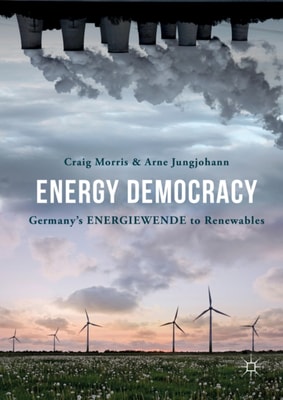
This book outlines how Germans convinced their politicians to pass laws allowing citizens to make their own energy, even when it hurt utility companies to do so.
Given the rapid spread of ETSs in an increasing number of countries and the important role that they are likely to play for the success or failure of the environmental policy in the years to come, this book provides an interdisciplinary analysis of the EU ETS from both the legal and economic perspectives comparing it with the other main ETSs existing worldwide, in order to assess whether the EU ETS has truly represented a prototype for the other ETSs established around the world and to investigate the current perspectives for linking them in the future.
This edited volume summarizes information about the situational context, threats, problems, challenges and solutions for sustainable pastoralism at a global scale.
Addressing global environmental challenges from a peace ecology perspective, the present book offers peer-reviewed texts that build on the expanding field of peace ecology and applies this concept to global environmental challenges in the Anthropocene.
This book originates from the work of contributors to initiatives and global networks promoting and pursuing lines of enquiry that recognise and probe relationships between sustainable consumption, design and production, and the implications of those relationships for new economic activity and the way we live and govern ourselves.