It was madness: Grand Prix drivers racing flat out from opposite ends of two long runways, only to turn away from each other at the last moment at corners improvised with hay bales.

In 2014 Pembroke Dock celebrates 200 years since its founding, when a Royal Dockyard - the only one ever to exist in Wales - was established here on the banks of Milford Haven.
The Royal National Lifeboat Institution was established in 1824, and has a long and proud tradition of saving life at sea; nowhere is this more evident than in the south-east of England.
Although, in pre-Grouping days, Oxfordshire was primarily Great Western territory, the county was also served by the Buckinghamshire branch of the London & North Western Railway, which was in many ways a 'foreign' intruder.
This is the first book to be published that takes a 'then and now' view of the fourteen lifeboat stations on the north east coast between Sunderland and the Humber estuary.
The Mallaig Extension was approved in 1894 to provide a continuation of the West Highland route for the benefit of the fishing industry on Scotland's west coast.
A Mersey ferry was recorded in the Domesday Book, and for around a thousand years, they have plied between Birkenhead and Wallasey on the Wirral and Liverpool.
The Birmingham & Midland Motor Omnibus Company began to operate motor buses in the Birmingham and Black Country area in 1912, radiating their services out as far as Leicester.
The stretch of railway line between Hull and Bridlington forms part of northern England's historic Yorkshire Coast Line (or the Hull to Scarborough line), which runs from Hull Paragon to Bridlington and Scarborough and is around 55 miles long.
Kirkcaldy Corporation Tramways began to operate an electric tram service in Kirkcaldy in 1903, connecting with the Wemyss and District Tramways Company service to Leven, further up the Fife coast, which began in 1906.
Tales of London's Docklands is an engaging and endearing account of the day-to-day experiences of hardworking dockers in the Port of London after the Second World War.
For twenty-three years, up to the First World War, Alfred Williams worked in the Great Western Railway's Works at Swindon, the locomotive capital of the west.
Living in a 1966 Albion Chieftain lorry, converted to a home, Traveller Dave has spent much of the past two decades in Europe, working on farms and travelling around, all the time taking photographs of the other interesting traveller homes he has seen.
On a blustery, West Highland summer's day in the early 1950s, a black-hulled mail steamer ploughed its way northwards from Mallaig up through the Sound of Sleat between the mainland of Scotland and the Isle of Skye.
The story of early British military aviation is one of trial and error, of triumph and adversity and it all began with a detachment of the Royal Engineers called the Air Battalion, which had previously been called the Balloon School.
Salt Marsh and Mud - Tales through a sailing year, is a compilation of interlinked stories about cruising around the Lower Thames, Swale and River Medway.
During the 1930s the need for a municipal aerodrome near Watford was debated at length, but it took almost a decade before the Air Ministry ultimately requisitioned the land at Leavesden for an aircraft factory.
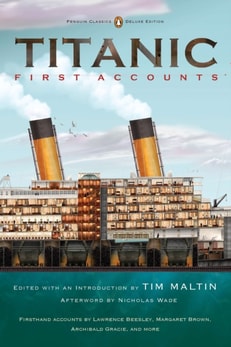
A steamer lay within sight of the RMS Titanic as she sank, according to ample witnesses - including highly experienced crew who studied this potential saviour through marine binoculars.
Entering service a full ten months ahead of Titanic, the Olympic was a near identical sister ship,the fi rst of a class of three liners, two of which would sink.
Originally published in 1912, and long out of print in the UK, this new edition has been reset and newly illustrated with over 100 contemporary photos and illustrations.
On 27 June 1910, the first ever all-British Flying Meeting began at Dunstall Park racecourse, Wolverhampton, and began an unbroken century of flying in the area.