As a spectroscopic method, Nuclear Magnetic Resonance (NMR) has seen spectacular growth over the past two decades, both as a technique and in its applications.
As a spectroscopic method, Nuclear Magnetic Resonance (NMR) has seen spectacular growth over the past two decades, both as a technique and in its applications.
As a spectroscopic method, Nuclear Magnetic Resonance (NMR) has seen spectacular growth over the past two decades, both as a technique and in its applications.
As a spectroscopic method, Nuclear Magnetic Resonance (NMR) has seen spectacular growth over the past two decades, both as a technique and in its applications.
As a spectroscopic method, Nuclear Magnetic Resonance (NMR) has seen spectacular growth over the past two decades, both as a technique and in its applications.
As a spectroscopic method, Nuclear Magnetic Resonance (NMR) has seen spectacular growth over the past two decades, both as a technique and in its applications.
As a spectroscopic method, Nuclear Magnetic Resonance (NMR) has seen spectacular growth over the past two decades, both as a technique and in its applications.
As a spectroscopic method, Nuclear Magnetic Resonance (NMR) has seen spectacular growth over the past two decades, both as a technique and in its applications.
As a spectroscopic method, Nuclear Magnetic Resonance (NMR) has seen spectacular growth over the past two decades, both as a technique and in its applications.
As a spectroscopic method, Nuclear Magnetic Resonance (NMR) has seen spectacular growth over the past two decades, both as a technique and in its applications.
As a spectroscopic method, Nuclear Magnetic Resonance (NMR) has seen spectacular growth over the past two decades, both as a technique and in its applications.
As a spectroscopic method, nuclear magnetic resonance (NMR) has seen spectacular growth over the past two decades, both as a technique and in its applications.
With applications across chemistry, physics and medicine, nuclear magnetic resonance is a proven, uniquely versatile and powerful spectroscopic technique.
This book consists of a series of lectures introducing what the author believes to be the theoretical minimum for the understanding of nuclear spin dynamics, the branch of physics underpinning magnetic resonance techniques such as NMR and MRI.
Nuclear magnetic resonance has proved a uniquely versatile and powerful spectroscopic technique, with applications across chemistry, physics and medicine.
Beginning with a review of the important areas of mathematics, this book then covers many of the underlying theoretical and practical aspects of NMR and MRI spectroscopy from a maths point of view.
The medical MRI community is by far the largest user of diffusion NMR techniques and this book captures the current surge of methods and provides a primary source to aid adoption in this field.
The medical MRI community is by far the largest user of diffusion NMR techniques and this book captures the current surge of methods and provides a primary source to aid adoption in this field.
Since the introduction of FT-NMR spectroscopy around five decades ago, NMR has achieved significant advances in hardware and methodologies, accompanied with the enhancement of spectral resolution and signal sensitivity.
The combination of two leading imaging techniques - magnetic resonance imaging and positron emission tomography - is poised to have a large impact and has recently been a driver of research and clinical applications.
Since the introduction of FT-NMR spectroscopy around five decades ago, NMR has achieved significant advances in hardware and methodologies, accompanied with the enhancement of spectral resolution and signal sensitivity.
Field-cycling NMR relaxometry is evolving into a methodology of widespread interest with recent technological developments resulting in powerful and versatile commercial instruments.
This book is aimed at informing organic chemists and natural products chemists on the use of NMR for structure elucidation to enable them to ensure they yield the most reliable possible data in the minimum possible time.
In the rapidly growing field of metabolomics, a comprehensive book describing the state of the art in the application of NMR spectroscopy will be a key title for practitioners.
The combination of two leading imaging techniques - magnetic resonance imaging and positron emission tomography - is poised to have a large impact and has recently been a driver of research and clinical applications.
Field-cycling NMR relaxometry is evolving into a methodology of widespread interest with recent technological developments resulting in powerful and versatile commercial instruments.
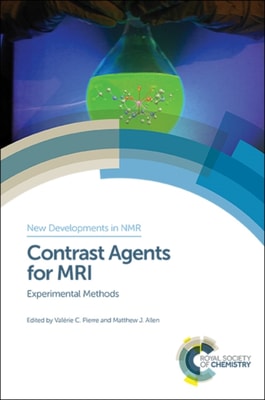
As a practical reference guide for designing and performing experiments, this book focuses on the five most common classes of contrast agents for MRI namely gadolinium complexes, chemical exchange saturation transfer agents, iron oxide nanoparticles, manganese complexes and fluorine contrast agents.
Spin relaxation parameters, although difficult to interpret, are attracting interest in NMR as these parameters are capable of yielding both structural and dynamic information.
Providing a definitive reference source on novel methods in NMR acquisition and processing, this book will highlight similarities and differences between emerging approaches and focus on identifying which methods are best suited for different applications.
Nuclear magnetic resonance has proved a uniquely versatile and powerful spectroscopic technique, with applications across chemistry, physics and medicine.
This book is aimed at informing organic chemists and natural products chemists on the use of NMR for structure elucidation to enable them to ensure they yield the most reliable possible data in the minimum possible time.
As a practical reference guide for designing and performing experiments, this book focuses on the five most common classes of contrast agents for MRI namely gadolinium complexes, chemical exchange saturation transfer agents, iron oxide nanoparticles, manganese complexes and fluorine contrast agents.
Providing the first comprehensive book on the current state of hyperpolarized Xenon-129 NMR and MRI, this book is guaranteed to appeal to a wide range of scientists interested in this growing field.
Providing a definitive reference source on novel methods in NMR acquisition and processing, this book will highlight similarities and differences between emerging approaches and focus on identifying which methods are best suited for different applications.
There has been a recent surge in hardware developments with respect to mobile NMR and MRI systems, from which novel applications are starting to emerge.