During the past two centuries, crystallography, mineralogy and petrology have evolved from simple compilations of data to powerful disciplines based on interlocking networks of laws, hypotheses and rules-of-thumb.
This book presents a computational scheme for calculating the electronic properties of crystalline systems at an ab-ini tio Hartree-Fock level of approximation.
Traditionally, when one deals with crystals, the first property to be presented is the periodicity of the lattice, and all methods of study are based on this characteristic, which is considered essential.
Dieser Buchtitel ist Teil des Digitalisierungsprojekts Springer Book Archives mit Publikationen, die seit den Anfängen des Verlags von 1842 erschienen sind.
Dieser Buchtitel ist Teil des Digitalisierungsprojekts Springer Book Archives mit Publikationen, die seit den Anfängen des Verlags von 1842 erschienen sind.
Dieser Buchtitel ist Teil des Digitalisierungsprojekts Springer Book Archives mit Publikationen, die seit den Anfängen des Verlags von 1842 erschienen sind.
Although the chemistry of boron is still relatively young, it is developing at a pace where even specific areas of research are difficult to compile into a monograph.
The International Winter School on Electronic Properties of High-Temperature Superconductors, held between March 7-14, 1992, in Kirchberg, (Tyrol) Austria, was the sixth in a series of meetings to be held at this venue.
Advances through carefully conducted quantitative work onwell designed, high quality materials characterize thepresent state of high-temperature superconductivityresearch.
Clusters of Atoms and Molecules I is devoted to theoretical concepts and experimental techniques important in the rapidly expanding field of cluster science.
The recent discovery of high-temperature superconductivity in copper- based oxides is an event of major importance not only with respect to the physical phenomenon itself but also because it definitely shows that solid state chemistry, and especially the crystal chemistry of oxides, has a crucial place in the synthesis and understanding of new materials for future appli- cations.
Considering aspects of symmetry rules in chemistry, one is faced with con- tradictory terms as for example, "e;90 % concertedness"e; sometimes being used in literature.
A lively demonstration of the great vitality and the multidisciplinary character of cluster research and of the usefulness of synthesizing its various aspects was given at this symposium.
New methods for the determination of the nature, proportion, and distribution of structural defects in microcrystallized lamellar systems are of utmost importance not only to experimentalists but also to theoreticians.
"e;An interesting and enlightening book well worth the time for someone who is grounded in the basics of spectroscopy, yet interested in newer techniques and applications.
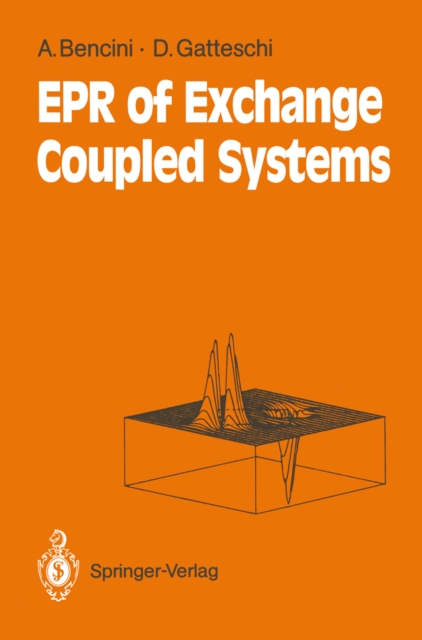
This book is intended to collect in one place as much information as possible on the use of EPR spectroscopy in the analysis of systems in which two or more spins are magnetically coupled.