Linear Algebra and Linear Models comprises a concise and rigorous introduction to linear algebra required for statistics followed by the basic aspects of the theory of linear estimation and hypothesis testing.
The constructive approach to mathematics has enjoyed a renaissance, caused in large part by the appearance of Errett Bishop's book Foundations of constr"e;uctiue analysis in 1967, and by the subtle influences of the proliferation of powerful computers.
A First Course in Noncommutative Rings, an outgrowth of the author's lectures at the University of California at Berkeley, is intended as a textbook for a one-semester course in basic ring theory.
"e;Proofs and Fundamentals: A First Course in Abstract Mathematics"e; 2nd edition is designed as a "e;transition"e; course to introduce undergraduates to the writing of rigorous mathematical proofs, and to such fundamental mathematical ideas as sets, functions, relations, and cardinality.
Descriptor linear systems theory is an important part in the general field of control systems theory, and has attracted much attention in the last two decades.
This IMA Volume in Mathematics and its Applications TOWARDS HIGHER CATEGORIES contains expository and research papers based on a highly successful IMA Summer Program on n-Categories: Foundations and Applications.
This is a collection of essays based on lectures that author has given on various occasions on foundation of quantum theory, symmetries and representation theory, and the quantum theory of the superworld created by physicists.
Emphasizes a Problem Solving ApproachA first course in combinatoricsCompletely revised, How to Count: An Introduction to Combinatorics, Second Edition shows how to solve numerous classic and other interesting combinatorial problems.
Using mathematical tools from number theory and finite fields, Applied Algebra: Codes, Ciphers, and Discrete Algorithms, Second Edition presents practical methods for solving problems in data security and data integrity.
Useful Concepts and Results at the Heart of Linear AlgebraA one- or two-semester course for a wide variety of students at the sophomore/junior undergraduate levelA Modern Introduction to Linear Algebra provides a rigorous yet accessible matrix-oriented introduction to the essential concepts of linear algebra.
Group inverses for singular M-matrices are useful tools not only in matrix analysis, but also in the analysis of stochastic processes, graph theory, electrical networks, and demographic models.
A comprehensive study of the main research done in polynomial identities over the last 25 years, including Kemer's solution to the Specht problem in characteristic O and examples in the characteristic p situation.
This text presents the concepts of higher algebra in a comprehensive and modern way for self-study and as a basis for a high-level undergraduate course.
The strength of this textbook lies in the careful exposition of mathematical thinking, basic set-theoretic notions, and proof techniques combined with contemporary numerical methods used throughout the book.
This classic, written by two young instructors who became giants in their field, has shaped the understanding of modern algebra for generations of mathematicians and remains a valuable reference and text for self study and college courses.
Written by an algebraic topologist motivated by his own desire to learn, this well-written book represents the compilation of the most essential and interesting results and methods in the theory of polynomial invariants of finite groups.
Starting with the most basic notions, Universal Algebra: Fundamentals and Selected Topics introduces all the key elements needed to read and understand current research in this field.
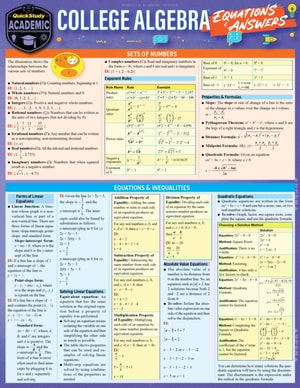
Essential core elements of mathematics to support early learning, continued development, and as a reference to review during and after building a strong foundation.
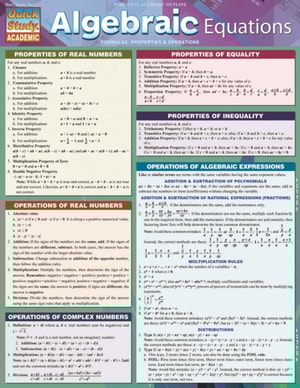
Best-selling guide for over 20 years, filled with essential elements of mathematics from properties of real numbers to beginning algebra in just 6 laminated pages.