A tendency exists in management theory and practice today to accept that our linear and deterministic ways of thinking about managerial problems create more problems than they solve.
The 4th Experimental Chaos Conference was a forum for members of the scientific and engineering communities to discuss recent developments in, and techniques of, experimental nonlinear dynamics.
Every reader will find something of interest in this book - from superdiffusion of the ocean surface to fetal heartbeats, from solar wind to the wearing-out of tools, from radioactive contamination to texture analysis, from image rendering to neural developments.
Recent findings in the computer sciences, discrete mathematics, formal logics and metamathematics have opened up a royal road for the investigation of undecidability and randomness in physics.
A system is loosely defined as complex if it is composed of a large number of elements, interacting with each other, and the emergent global dynamics is qualitatively different from the dynamics of each one of the parts.
True deterministic chaos is characterized by unpredictable, apparently random motion in a dynamical system completely described by a deterministic dynamic law, usually a nonlinear differential equation, with no stochastic component.
The book gives the Liapunov background for the analysis and synthesis (design) of dynamic behaviour of general networks which represent a large class of nonlinear systems, predominantly physical, and in particular mechanical.
Volume 2 of Directions in Chaos consists of the contributions made to the Beijing Summer School on Chaotic Phenomena in Nonlinear Systems held in August 1987.
This book is adapted and revised from the author's seminal PhD thesis, in which two forms of asymptotically universal structure were presented and explained for area-preserving maps.
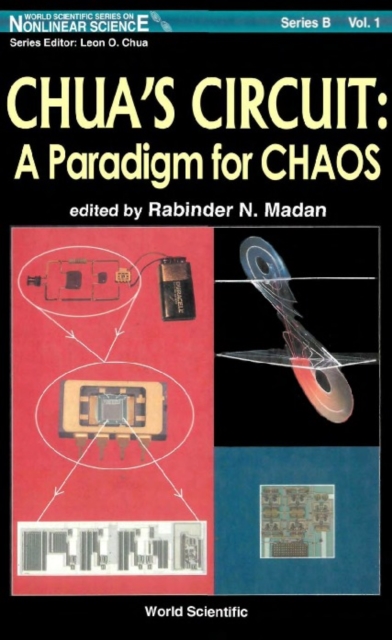
For uninitiated researchers, engineers, and scientists interested in a quick entry into the subject of chaos, this book offers a timely collection of 55 carefully selected papers covering almost every aspect of this subject.
This is the second volume in a series intended to give clear expositions of the applications of the new techniques developed to understand nonlinear phenomena in the life sciences.
The interaction of acoustic fields with submerged elastic structures, both by propagation and scattering, is being investigated at various institutions and laboratories world-wide with ever-increasing sophistication of experiments and analysis.
This book deals with the qualitative theory of dynamical systems and is devoted to the study of flows and cascades in the vicinity of a smooth invariant manifold.
This book is the first monograph on a new powerful method discovered by the author for the study of nonlinear dynamical systems relying on reduction of nonlinear differential equations to the linear abstract Schrodinger-like equation in Hilbert space.
This book gives an exposition of the exciting field of control of oscillatory and chaotic systems, which has numerous potential applications in mechanics, laser and chemical technologies, communications, biology and medicine, economics, ecology, etc.
Revolutionary and original, this treatise presents a new paradigm of EMERGENCE and COMPLEXITY, with applications drawn from numerous disciplines, including artificial life, biology, chemistry, computation, physics, image processing, information science, etc.
Methods of nonlinear time series analysis are discussed from a dynamical systems perspective on the one hand, and from a statistical perspective on the other.
The present book, Chaos and Fractals in Engineering, is written for all engineers and experts or graduate students or beginners working in the application fields, and for experimental scientists in general.
Although individual orbits of chaotic dynamical systems are by definition unpredictable, the average behavior of typical trajectories can often be given a precise statistical description.