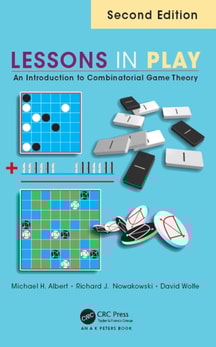
This second edition of Lessons in Play reorganizes the presentation of the popular original text in combinatorial game theory to make it even more widely accessible.
The Tutte Polynomial touches on nearly every area of combinatorics as well as many other fields, including statistical mechanics, coding theory, and DNA sequencing.
This second edition of Lessons in Play reorganizes the presentation of the popular original text in combinatorial game theory to make it even more widely accessible.
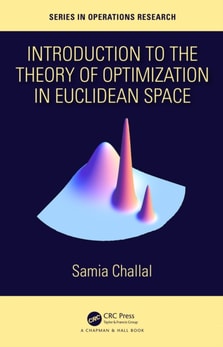
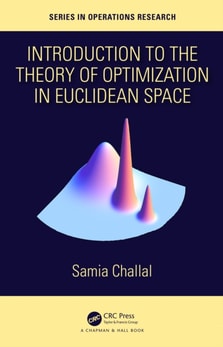
Introduction to the Theory of Optimization in Euclidean Space is intended to provide students with a robust introduction to optimization in Euclidean space, demonstrating the theoretical aspects of the subject whilst also providing clear proofs and applications.
Introduction to the Theory of Optimization in Euclidean Space is intended to provide students with a robust introduction to optimization in Euclidean space, demonstrating the theoretical aspects of the subject whilst also providing clear proofs and applications.
Combinatorics and Reasoning: Representing, Justifying and Building Isomorphisms is based on the accomplishments of a cohort group of learners from first grade through high school and beyond, concentrating on their work on a set of combinatorics tasks.
The Subject A little explanation is in order for our choice of the title Linear Opti- 1 mization (and corresponding terminology) for what has traditionally been called Linear Programming.
While we were busy putting together the present collection of articles celebrating the twentieth birthday of our journal, Discrete & Computational Geometry, and, in a way, of the ?
In this monograph, new combinatorial and computational approaches in the study of RNA structures are presented which enhance both mathematics and computational biology.
Performance optimization is vital in the design and operation of modern engineering systems, including communications, manufacturing, robotics, and logistics.
This book is a collection of about 500 problems in analytic number theory with the singular purpose of training the beginning graduate student in some of its significant techniques.
Introduction to Discrete Event Systems is a comprehensive introduction to the field of discrete event systems, offering a breadth of coverage that makes the material accessible to readers of varied backgrounds.
Putnam and Beyond takes the reader on a journey through the world of college mathematics, focusing on some of the most important concepts and results in the theories of polynomials, linear algebra, real analysis in one and several variables, differential equations, coordinate geometry, trigonometry, elementary number theory, combinatorics, and probability.
Sequential Dynamical Systems (SDS) are a class of discrete dynamical systems which significantly generalize many aspects of systems such as cellular automata, and provide a framework for studying dynamical processes over graphs.
Although discrete geometry has a rich history extending more than 150 years, it abounds in open problems that even a high-school student can understand and appreciate.
In this new text, designed for sophomores studying mathematics and computer science, the authors cover the basics of difference equations and some of their applications in computing and in population biology.
Over the last twenty years, Professor Franco Giannessi, a highly respected researcher, has been working on an approach to optimization theory based on image space analysis.
Graph Theory, Combinatorics and Algorithms: Interdisciplinary Applications focuses on discrete mathematics and combinatorial algorithms interacting with real world problems in computer science, operations research, applied mathematics and engineering.
Supervisory Control Theory (SCT) provides a tool to model and control human-engineered complex systems, such as computer networks, World Wide Web, identification and spread of malicious executables, and command, control, communication, and information systems.
Combinatorial (or discrete) optimization is one of the most active fields in the interface of operations research, computer science, and applied ma- ematics.
The idea of this book came to us in October 2002 at the international conference "e;Production systems design, supply chain management and logistics"e; (Miedzyzdroje, Poland).