The group of Hamiltonian diffeomorphisms Ham(M, 0) of a symplectic mani- fold (M, 0) plays a fundamental role both in geometry and classical mechanics.
Historical interest and studies of Weyl's role in the interplay between 20th-century mathematics, physics and philosophy have been increasing since the middle 1980s, triggered by different activities at the occasion of the centenary of his birth in 1985, and are far from being exhausted.
To mark the World Mathematical Year 2000 an International Conference on Number Theory and Discrete Mathematics in honour of the legendary Indian Mathematician Srinivasa Ramanuj~ was held at the centre for Advanced study in Mathematics, Panjab University, Chandigarh, India during October 2-6, 2000.
This volume began as the last part of a one-term graduate course given at the Fields Institute for Research in the Mathematical Sciences in the Autumn of 1993.
This book is based upon my monograph Index Theory for Hamiltonian Systems with Applications published in 1993 in Chinese, and my notes for lectures and courses given at Nankai University, Brigham Young University, ICTP-Trieste, and the Institute of Mathematics of Academia Sinica during the last ten years.
Among all the Hamiltonian systems, the integrable ones have special geometric properties; in particular, their solutions are very regular and quasi-periodic.
Assuming that the reader is familiar with sheaf theory, the book gives a self-contained introduction to the theory of constructible sheaves related to many kinds of singular spaces, such as cell complexes, triangulated spaces, semialgebraic and subanalytic sets, complex algebraic or analytic sets, stratified spaces, and quotient spaces.
The discoveries of the past decade have opened new perspectives for the old field of Hamiltonian systems and led to the creation of a new field: symplectic topology.
Questions that arose from linear programming and combinatorial optimization have been a driving force for modern polytope theory, such as the diameter questions motivated by the desire to understand the complexity of the simplex algorithm, or the need to study facets for use in cutting plane procedures.
This meeting has been motivated by two events: the 85th birthday of Pierre Lelong, and the end of the third year of the European network "e;Complex analysis and analytic geometry"e; from the programme Human Capital and Mobility.
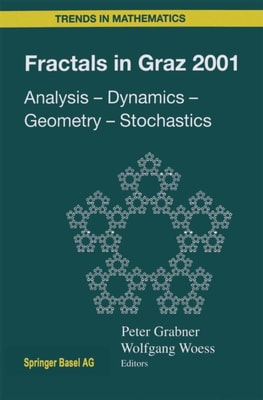
This book contains the proceedings of the conference "e;Fractals in Graz 2001 - Analysis, Dynamics, Geometry, Stochastics"e; that was held in the second week of June 2001 at Graz University of Technology, in the capital of Styria, southeastern province of Austria.
A set in complex Euclidean space is called C-convex if all its intersections with complex lines are contractible, and it is said to be linearly convex if its complement is a union of complex hyperplanes.
In this book, I present an expanded version of the contents of my lectures at a Seminar of the DMV (Deutsche Mathematiker Vereinigung) in Dusseldorf, June, 1986.
The seminar Symplectic Geometry at the University of Berne in summer 1992 showed that the topic of this book is a very active field, where many different branches of mathematics come tog9ther: differential geometry, topology, partial differential equations, variational calculus, and complex analysis.