Surviving Domestic Abuse examines how formal and informal supports and services can mitigate the damaging, and sometimes fatal, social cost of domestic violence.
This radical book explores a new understanding of psychology based on human engagement with external contexts, rather than what goes on inside our heads.
This radical book explores a new understanding of psychology based on human engagement with external contexts, rather than what goes on inside our heads.
Groups are arguably an essential and unavoidable part of our human lives-whether we are part of families, work teams, therapy groups, organizational systems, social clubs, or larger communities.
Groups are arguably an essential and unavoidable part of our human lives-whether we are part of families, work teams, therapy groups, organizational systems, social clubs, or larger communities.
This book examines the phenomenon of silence in relation to human behaviour from multiple perspectives, drawing on psychological and cultural-philosophical ideas to create new, surprising connections between silence, quiet and rest.
This book examines the phenomenon of silence in relation to human behaviour from multiple perspectives, drawing on psychological and cultural-philosophical ideas to create new, surprising connections between silence, quiet and rest.
This rich volume explores the complex problem of obedience and conformity, re-examining Stanley Milgram's famous electric shock study, and presenting the findings of the most extensive empirical study on obedience toward authority since Milgram's era.
This rich volume explores the complex problem of obedience and conformity, re-examining Stanley Milgram's famous electric shock study, and presenting the findings of the most extensive empirical study on obedience toward authority since Milgram's era.
This ground-breaking book is designed to raise awareness of human rights implications in psychology, and provide knowledge and tools enabling psychologists to put a human rights perspective into practice.
This ground-breaking book is designed to raise awareness of human rights implications in psychology, and provide knowledge and tools enabling psychologists to put a human rights perspective into practice.
This book explores what social psychology can contribute to our understanding of real-life problems and how it can inform rational interventions in any area of social life.
This book explores what social psychology can contribute to our understanding of real-life problems and how it can inform rational interventions in any area of social life.
This unique book lays out the motivational basis for tolerance, the most important underlying factor that shapes people's social attitudes and determines our ability to get along with others.
This unique book lays out the motivational basis for tolerance, the most important underlying factor that shapes people's social attitudes and determines our ability to get along with others.
Going beyond the mechanics of professional communication, this book combines insights into the overlooked implicit demands of corporate communication challenges with the proven strategies and techniques that distinguish professionals as capable communicators and candidates for promotion.
A comprehensive discussion of group theory in the context of molecular and crystal symmetry, this book covers both point-group and space-group symmetries.
The basics of group theory and its applications to themes such as the analysis of vibrational spectra and molecular orbital theory are essential knowledge for the undergraduate student of inorganic chemistry.
Multiple Dirichlet Series, L-functions and Automorphic Forms gives the latest advances in the rapidly developing subject of Multiple Dirichlet Series, an area with origins in the theory of automorphic forms that exhibits surprising and deep connections to crystal graphs and mathematical physics.
Hans Duistermaat, an influential geometer-analyst, made substantial contributions to the theory of ordinary and partial differential equations, symplectic, differential, and algebraic geometry, minimal surfaces, semisimple Lie groups, mechanics, mathematical physics, and related fields.
For the past several decades the theory of automorphic forms has become a major focal point of development in number theory and algebraic geometry, with applications in many diverse areas, including combinatorics and mathematical physics.
One of the mathematical challenges of modern physics lies in the development of new tools to efficiently describe different branches of physics within one mathematical framework.
Dedicated to Jacques Carmona, an expert in noncommutative harmonic analysis, the volume presents excellent invited/refereed articles by top notch mathematicians.
The spinor calculus employed in general relativity is a very useful tool; many expressions and computations are considerably simplified if one makes use of spinors instead of tensors.
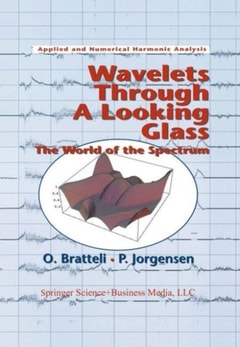
This book combining wavelets and the world of the spectrum focuses on recent developments in wavelet theory, emphasizing fundamental and relatively timeless techniques that have a geometric and spectral- theoretic flavor.
Rationality problems link algebra to geometry, and the difficulties involved depend on the transcendence degree of $K$ over $k$, or geometrically, on the dimension of the variety.
The first book of its kind, New Foundations in Mathematics: The Geometric Concept of Number uses geometric algebra to present an innovative approach to elementary and advanced mathematics.
Semisimple Lie groups, and their algebraic analogues over fields other than the reals, are of fundamental importance in geometry, analysis, and mathematical physics.
The field of vertex operator algebras is an active area of research and plays an integral role in infinite-dimensional Lie theory, string theory, and conformal field theory, and other subdisciplines of mathematics and physics.
Several well-established geometric and topological methods are used in this work in an application to a beautiful physical phenomenon known as the geometric phase.