Computability Theory: An Introduction to Recursion Theory provides a concise, comprehensive, and authoritative introduction to contemporary computability theory, techniques, and results.
The Nuts and Bolts of Proofs: An Introduction to Mathematical Proofs provides basic logic of mathematical proofs and shows how mathematical proofs work.
An inviting collection of fun, hands-on applications in mathematics and computingThis book provides a fun, hands-on approach to learning how mathematics and computing relate to the world around us and help us to better understand it.
Although cryptography plays an essential part in most modern solutions, especially in payments, cryptographic algorithms remain a black box for most users of these tools.
The first part of this book concerns the present state of the theory of chains (= total or linear orderings), in connection with some refinements of Ramsey's theorem, due to Galvin and Nash-Williams.
The papers appearing in this volume are part of those originally intended for presentation at the conference: Logic Colloquium '80 - European Summer Meeting of the Association for Symbolic Logic (A.
In this revolutionary work, the author sets the stage for the science ofthe 21st Century, pursuing an unprecedented synthesis of fields previouslyconsidered unrelated.
This first part presents chapters on models of computation, complexity theory, data structures, and efficient computation in many recognized sub-disciplines of Theoretical Computer Science.
The Handbook of the History of Logic is a multi-volume research instrument that brings to the development of logic the best in modern techniques of historical and interpretative scholarship.
'Numbers and Proofs' presents a gentle introduction to the notion of proof to give the reader an understanding of how to decipher others' proofs as well as construct their own.
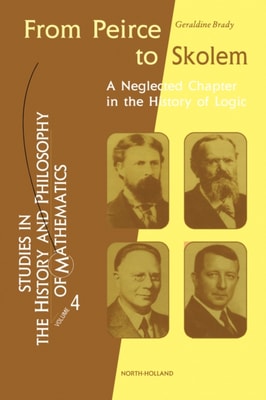
This book offers a historical explanation of important philosophical problems in logic and mathematics, which have been neglected by the official history of modern logic.
With the ever-increasing threat of cyber-attacks, especially as the COVID-19 pandemic helped to ramp up the use of digital communications technology, there is a continued need to find new ways to maintain and improve cybersecurity.
With the ever-increasing threat of cyber-attacks, especially as the COVID-19 pandemic helped to ramp up the use of digital communications technology, there is a continued need to find new ways to maintain and improve cybersecurity.
Starting at the very beginning with Aristotle's founding contributions, logic has been graced by several periods in which the subject has flourished, attaining standards of rigour and conceptual sophistication underpinning a large and deserved reputation as a leading expression of human intellectual effort.
For a brief time in history, it was possible to imagine that a sufficiently advanced intellect could, given sufficient time and resources, in principle understand how to mathematically prove everything that was true.
While it is well known that the Delian problems are impossible to solve with a straightedge and compass - for example, it is impossible to construct a segment whose length is cube root of 2 with these instruments - the discovery of the Italian mathematician Margherita Beloch Piazzolla in 1934 that one can in fact construct a segment of length cube root of 2 with a single paper fold was completely ignored (till the end of the 1980s).
This contributed volume overviews recently presented approaches for carrying out QSPR/QSAR analysis by using a simplifying molecular input-line entry system (SMILES) to represent the molecular structure.
The present volume of the Handbook of the History of Logic is designed to establish 19th century Britain as a substantial force in logic, developing new ideas, some of which would be overtaken by, and other that would anticipate, the century's later capitulation to the mathematization of logic.
The expanded and updated 2nd edition of this classic text offers the reader a comprehensive introduction to the concepts of logic functions and equations and their applications across computer science.
Problem solving is the very area of articifical intelligence AI which, probably, will never result in a complete set of formalized theories, in a pragmatic philosphy, or in a "e;universal"e; applied discipline.
Modal logics, originally conceived in philosophy, have recently found many applications in computer science, artificial intelligence, the foundations of mathematics, linguistics and other disciplines.
This Handbook documents the main trends in current research between logic and language, including its broader influence in computer science, linguistic theory and cognitive science.