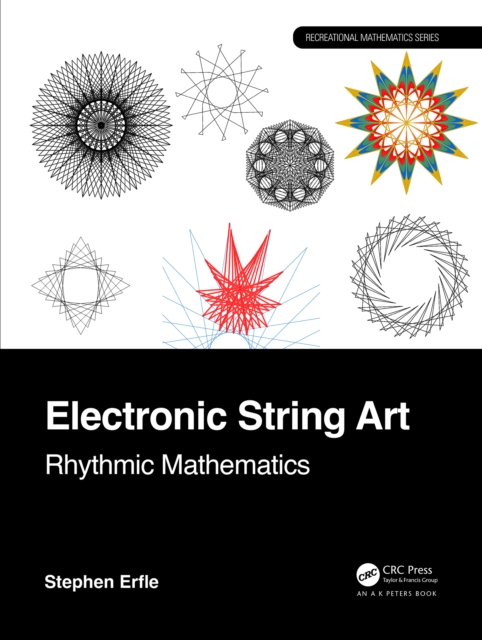
String art is a well-known and popular activity that uses string, a board, and nails to produce artistic images (although there are variations that use different modalities).
Combinatorial research has proceeded vigorously in Russia over the last few decades, based on both translated Western sources and original Russian material.
Introduction to Modern Cryptography, the most relied-upon textbook in the field, provides a mathematically rigorous yet accessible treatment of this fascinating subject.
Explore the main algebraic structures and number systems that play a central role across the field of mathematics Algebra and number theory are two powerful branches of modern mathematics at the forefront of current mathematical research, and each plays an increasingly significant role in different branches of mathematics, from geometry and topology to computing and communications.
Cryptography, in particular public-key cryptography, has emerged in the last 20 years as an important discipline that is not only the subject of an enormous amount of research, but provides the foundation for information security in many applications.
The book contains the main results of class field theory and Artin L functions, both for number fields and function fields, together with the necessary foundations concerning topological groups, cohomology, and simple algebras.
The book contains the main results of class field theory and Artin L functions, both for number fields and function fields, together with the necessary foundations concerning topological groups, cohomology, and simple algebras.
The author offers a thorough presentation of the classical theory of algebraic numbers and algebraic functions which both in its conception and in many details differs from the current literature on the subject.
The author offers a thorough presentation of the classical theory of algebraic numbers and algebraic functions which both in its conception and in many details differs from the current literature on the subject.
Several years ago I was invited to an American university to give one-term graduate course on Siegel modular forms, Hecke operators, and related zeta functions.
The Primality Testing Problem (PTP) has now proved to be solvable in deterministic polynomial-time (P) by the AKS (Agrawal-Kayal-Saxena) algorithm, whereas the Integer Factorization Problem (IFP) still remains unsolvable in (P).
Over the past two decades, the once small local Colorado Springs Mathematics Olympiad, founded by the author himself, has now become an annual state-wide competition, hosting over one-thousand high school contenders each year.
This book is a collection of about 500 problems in analytic number theory with the singular purpose of training the beginning graduate student in some of its significant techniques.
Putnam and Beyond takes the reader on a journey through the world of college mathematics, focusing on some of the most important concepts and results in the theories of polynomials, linear algebra, real analysis in one and several variables, differential equations, coordinate geometry, trigonometry, elementary number theory, combinatorics, and probability.
This impressive volume is dedicated to Mel Nathanson, a leading authoritative expert for several decades in the area of combinatorial and additive number theory.
This monograph treats the classical theory of quadratic Diophantine equations and guides the reader through the last two decades of computational techniques and progress in the area.
Number theory, spectral geometry, and fractal geometry are interlinked in this in-depth study of the vibrations of fractal strings, that is, one-dimensional drums with fractal boundary.
The square root of 2 is a fascinating number - if a little less famous than such mathematical stars as pi, the number e, the golden ratio, or the square root of -1.