Since their popularization in the 1990s, Markov chain Monte Carlo (MCMC) methods have revolutionized statistical computing and have had an especially profound impact on the practice of Bayesian statistics.
This textbook provides the foundation for a course that takes PhD students in empirical accounting research from the very basics of statistics, data analysis, and causal inference up to the point at which they conduct their own research.
This book provides an overview and compilation of contemporary topics and innovative approaches in biostatistical modeling through their applications to evidence-based public health research and decision-making.
This book provides an overview and compilation of contemporary topics and innovative approaches in biostatistical modeling through their applications to evidence-based public health research and decision-making.
Learn How to Program Stochastic ModelsHighly recommended, the best-selling first edition of Introduction to Scientific Programming and Simulation Using R was lauded as an excellent, easy-to-read introduction with extensive examples and exercises.
This work describes several statistical techniques for studying repeated measures data, presenting growth curve methods applicable to biomedical, social, animal, agricultural and business research.
Large observational studies involving research questions that require the measurement of several features on each individual arise in many fields including the social and medical sciences.
While there have been few theoretical contributions on the Markov Chain Monte Carlo (MCMC) methods in the past decade, current understanding and application of MCMC to the solution of inference problems has increased by leaps and bounds.
Building on its best-selling predecessors, Basic Statistics and Pharmaceutical Statistical Applications, Third Edition covers statistical topics most relevant to those in the pharmaceutical industry and pharmacy practice.
Economic evaluation has become an essential component of clinical trial design to show that new treatments and technologies offer value to payers in various healthcare systems.
This book investigates the critical gain design in stochastic iterative learning control (SILC), including four specific gain design strategies: decreasing gain design, adaptive gain design, event-triggering gain design, and optimal gain design.
This textbook, which is based on the second edition of a book that has been previously published in German language, provides a comprehension-oriented introduction to asymptotic stochastics.
Ziel dieses Übungsbuches ist es, den Studierenden eine umfassende Möglichkeit zu geben, ihre bereits erworbenen Statistik-Kenntnisse intensiv zu nutzen und zu vertiefen.
This book investigates the critical gain design in stochastic iterative learning control (SILC), including four specific gain design strategies: decreasing gain design, adaptive gain design, event-triggering gain design, and optimal gain design.
Orthopaedics and orthopaedic trauma are highly complex subjects that can prove difficult to quantify, but accurate measurement is required for setting standards of care and for assessing the severity of an injury.
In an era defined by the seamless integration of data and sophisticated analytical and modeling techniques, the quest for advanced statistical modeling and methodologies has never been more pertinent.
In an era defined by the seamless integration of data and sophisticated analytical and modeling techniques, the quest for advanced statistical modeling and methodologies has never been more pertinent.
Since the publication of the first edition over 30 years ago, the literature related to Pareto distributions has flourished to encompass computer-based inference methods.
Interval-Censored Time-to-Event Data: Methods and Applications collects the most recent techniques, models, and computational tools for interval-censored time-to-event data.
A New Way of Analyzing Object Data from a Nonparametric ViewpointNonparametric Statistics on Manifolds and Their Applications to Object Data Analysis provides one of the first thorough treatments of the theory and methodology for analyzing data on manifolds.
This textbook, which is based on the second edition of a book that has been previously published in German language, provides a comprehension-oriented introduction to asymptotic stochastics.
Since the original publication of the bestselling Modelling Binary Data, a number of important methodological and computational developments have emerged, accompanied by the steady growth of statistical computing.
Practical Statistical Methods: A SAS Programming Approach presents a broad spectrum of statistical methods useful for researchers without an extensive statistical background.
Although standard mixed effects models are useful in a range of studies, other approaches must often be used in correlation with them when studying complex or incomplete data.
Starting with the Shannon-Wiener approach to mathematical information theory, allowing a mathematical "e;measurement"e; of an amount of information, the book begins by defining the terms message and information and axiomatically assigning an amount of information to a probability.
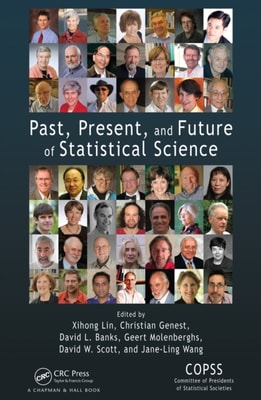
Past, Present, and Future of Statistical Science was commissioned in 2013 by the Committee of Presidents of Statistical Societies (COPSS) to celebrate its 50th anniversary and the International Year of Statistics.
Using real-life examples from the banking and insurance industries, Quantitative Operational Risk Models details how internal data can be improved based on external information of various kinds.
Drawing on the authors' varied experiences working and teaching in the field, Analysis of Multivariate Social Science Data, Second Editionenables a basic understanding of how to use key multivariate methods in the social sciences.