This graduate-level primer presents a tutorial introduction to and overview of N = 2 supergravity theories - with 8 real supercharges and in 4, 5 and 6 dimensions.
This book is a tribute to the scientific legacy of GianCarlo Ghirardi, who was one of the most influential scientists in the field of modern foundations of quantum theory.
Starting out from humankind's earliest ideas about the cosmos, this book gives the reader a clear overview of our current understanding of the universe, including big bang theories and the formation of stars and galaxies, as well as addressing open questions.
A brief introduction to gravity through Einstein's general theory of relativityOf the four fundamental forces of nature, gravity might be the least understood and yet the one with which we are most intimate.
We lift a veil of obscurity from a branch of mathematical physics in a straightforward manner that can be understood by motivated and prepared undergraduate students as well as graduate students specializing in relativity.
This book aims to present a pedagogical and self-consistent treatment of the canonical approach to Quantum Gravity, starting from its original formulation to the most recent developments in the field.
'The book concentrates attention on extended alternative theories of gravity and on the best astrophysical laboratories to probe the strong gravity-field regime: black holes, pulsars and neutron stars .
'Written by young theoretical physicists who are experts in the field, this volume is meant both to provide an introduction to the field and to offer a review of the latest developments, not discussed in many other existing books, for senior researchers.
The proceedings of the 2nd LeCosPA International Symposium, 'Everything about Gravity', collects 78 papers contributed by the symposium's Plenary Session and Parallel Session speakers.
This book aims to present a pedagogical and self-consistent treatment of the canonical approach to Quantum Gravity, starting from its original formulation to the most recent developments in the field.
This book discusses in detail the special theory of relativity without including all the instruments of theoretical physics, enabling readers who are not budding theoretical physicists to develop competence in the field.
Currently, the General Theory of Relativity (GTR) describes the physics of the very large in terms of classical physics, while quantum theory describes the physics of the very small in terms of the Standard Model of particle physics.
This textbook introduces the current astrophysical observations of black holes, and discusses the leading techniques to study the strong gravity region around these objects with electromagnetic radiation.
The workshop on The Cosmology of Extra Dimensions and Varying Fundamental Constants, which was part of JENAM 2002, was held at the Physics Department of the University of Porto (FCUP) from the 3rd to the 5th of September 2002.
REFLECTIONS ON SPACETIME - FOUNDATIONS, PHILOSOPHY AND HISTORY During the academic year 1992/93, an interdisciplinary research group constituted itself at the Zentrum fUr interdisziplinare Forschung (ZiF) in Bielefeld, Germany, under the title 'Semantical Aspects of Spacetime Theories', in which philosophers and physicists worked on topics in the interpretation and history of relativity theory.
This volume, the fourteenth in the Space Sciences Series of ISS/, is dedicated to the matter in the universe, which was the topic of a workshop organized by ISSI from 19 to 22 March 2001 in Bern.
This volume contains papers presented at an international conference to celebrate Fred Hoyle's monumental contributions to astronomy, astrophysics and astrobiology and more generally to humanity and culture.
Dynamical systems theory is especially well-suited for determining the possible asymptotic states (at both early and late times) of cosmological models, particularly when the governing equations are a finite system of autonomous ordinary differential equations.
Observability and Scientific Realism It is commonly thought that the birth of modern natural science was made possible by an intellectual shift from a mainly abstract and specuJative conception of the world to a carefully elaborated image based on observations.
The Relativists and Cosmologists in India organized an international conference in Goa, India, in 1987, known as the International Conference on Gravitation and Cosmology (ICGC-87).
In June of 1996, at the idyllic seaside resort of Guaruja, Brazil, a renowned group of researchers in space and astrophysical plasmas met to provide a forum on Advanced Topics on Astrophysical and Space Plasmas at a school consisting of some 60 students and teachers, mainly from Brazil and Argentina, but also from all the other parts of the globe.
Recent results from high-energy scattering and theoretical developments of string theory require a change in our understanding of the basic structure of space-time.
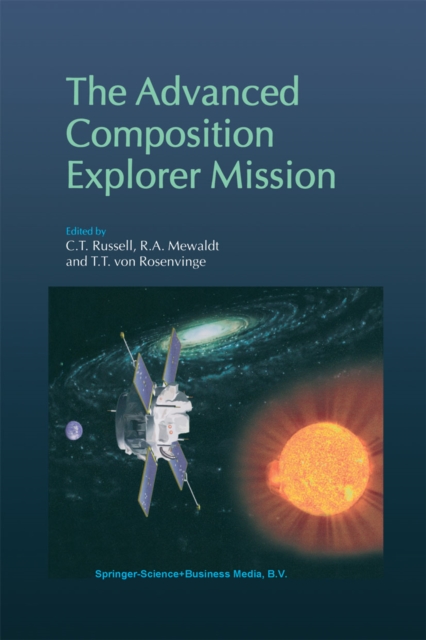
NASA's Advanced Composition Explorer (ACE) was launched on August 25, 1997, carrying six high-resolution spectrometers that measure the abundances of the elements, isotopes, and ionic charge states of energetic nuclei in space.
In May 1976, when one of us was temporarily associated with Stras- bourg Observatory for lecturing on distance determination methods (Heck 1978), Pierre Lacroute - then in his last year as Director there - mod- estly requested comments on a project he had been cherishing for quite a few years, and which he had been presenting to visitors and colleagues: an astrometric satellite.
The workshop "e;From Dust to Terrestrial Planets"e; was initiated by a working group of planetary scientists invited to ISSI by Johannes Geiss in November 1997.
For more than 25 years the Standard Model of particle physics has withstood the confrontation with experimental results of increasing precision, but this does not imply that the Standard Model can answer all questions about the ultimate constituents of nature.