During the past decade, research teams around the world have developed astrophysics-relevant research utilizing high energy-density facilities such as intense lasers and z-pinches.
This book collects the contributions presented at the conference Isolated Neutron Stars: From the Surface to the Interior, held in London in April 2006.
In recognition that no single country possesses all the answers to the critical scientific, institutional and legal questions associated with combating nuclear and radiological terrorism, the 2005 Workshop and these proceedings were structured to promote wide-ranging, multi-national exploration of critical technology needs and underlying scientific challenges to reducing the threat of nuclear/radiological terrorism; to illustrate through country-specific presentations how resulting technologies were used in national programs; and to outline the role of legal, policy and institutional frameworks in countering nuclear/radiological terrorism.
The past forty years of space research have seen a substantial improvement in our understanding of the Earth's magnetosphere and its coupling with the solar wind and interplanetary magnetic ?
Plasma methods that effectively combine ultraviolet radiation, active chemicals, and high electric fields offer an alternative to conventional water treatment methods.
We are at a critical evolutionary juncture in the research and development of low-temperature plasmas, which have become essential to synthesizing and processing vital nanoscale materials.
The Finite Difference Time Domain (FDTD) method is an essential tool in modeling inhomogeneous, anisotropic, and dispersive media with random, multilayered, and periodic fundamental (or device) nanostructures due to its features of extreme flexibility and easy implementation.
This book is designed to serve as a textbook for postgraduates, researchers of applied mathematics, theoretical physics and students of engineering who need a good understanding of classical mechanics.
This book is designed to serve as a textbook for postgraduates, researchers of applied mathematics, theoretical physics and students of engineering who need a good understanding of classical mechanics.
Mathematical Modelling of Waves in Multi-Scale Structured Media presents novel analytical and numerical models of waves in structured elastic media, with emphasis on the asymptotic analysis of phenomena such as dynamic anisotropy, localisation, filtering and polarisation as well as on the modelling of photonic, phononic, and platonic crystals.
This book offers a comprehensive and cohesive overview of transport processes associated with all kinds of charged particles, including electrons, ions, positrons, and muons, in both gases and condensed matter.
The fourth edition of Transport Phenomena Fundamentals continues with its streamlined approach to the subject, based on a unified treatment of heat, mass, and momentum transport using a balance equation approach.
The fourth edition of Transport Phenomena Fundamentals continues with its streamlined approach to the subject, based on a unified treatment of heat, mass, and momentum transport using a balance equation approach.
For the first time in a single book, Non-Linear Instabilities in Plasmas and Hydrodynamics presents the underlying physics of fast secondary instabilities.
For the first time in a single book, Non-Linear Instabilities in Plasmas and Hydrodynamics presents the underlying physics of fast secondary instabilities.
This book is the first to present flow measurement as an independent branch of the measurement techniques, according to a new global and unitary approach for the measurement of fluid flow field, starting from finding its unitary fundamental bases.
This book is the first to present flow measurement as an independent branch of the measurement techniques, according to a new global and unitary approach for the measurement of fluid flow field, starting from finding its unitary fundamental bases.
The dynamical projectors method proves to reduce a multicomponent problem to the simplest one-component problem with its solution determined by specific initial or boundary conditions.
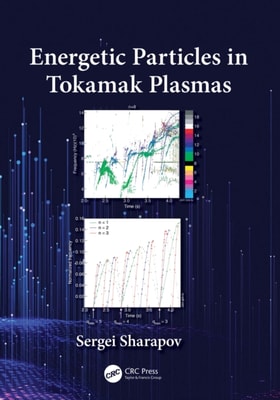
The study of energetic particles in magnetic fusion plasmas is key to the development of next-generation "e;burning"e; plasma fusion experiments, such as the International Thermonuclear Experimental Reactor (ITER) and the Demonstration Power Station (DEMO).
The study of energetic particles in magnetic fusion plasmas is key to the development of next-generation "e;burning"e; plasma fusion experiments, such as the International Thermonuclear Experimental Reactor (ITER) and the Demonstration Power Station (DEMO).
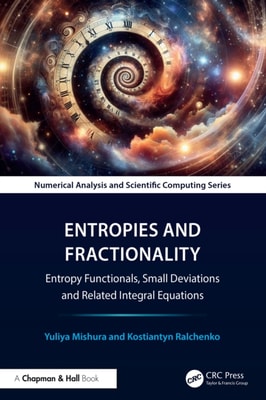
Entropies and Fractionality: Entropy Functionals, Small Deviations and Related Integral Equations starts with a systematization and calculation of various entropies (Shannon, Renyi, and some others) of selected absolutely continuous probability distributions.