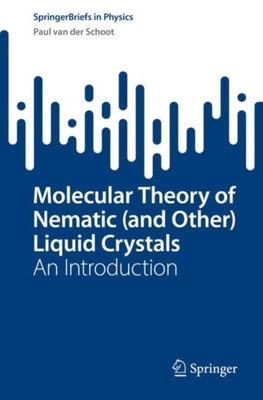
This book provides a didactic derivation of the main theories of thermotropic and lyotropic liquid crystals, revealing the common molecular-theoretic framework that underpins both theories.
The book is based on the author's PhD thesis, which deals with the concept of time in quantum gravity and its relevance for the physics of the early Universe.
This textbook provides a concise, visual introduction to Hopf algebras and their application to knot theory, most notably the construction of solutions of the Yang-Baxter equations.
This brief research monograph uses modern mathematical methods to investigate partial differential equations with nonlinear convolution terms, enabling readers to understand the concept of a solution and its asymptotic behavior.
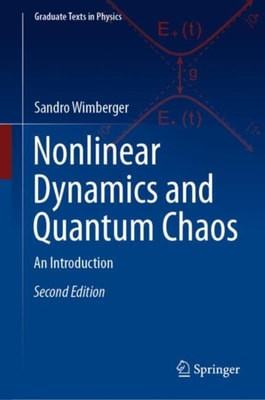
This book presents a clear and concise introduction to the field of nonlinear dynamics and chaos, suitable for graduate students in mathematics, physics, chemistry, engineering, and in natural sciences in general.
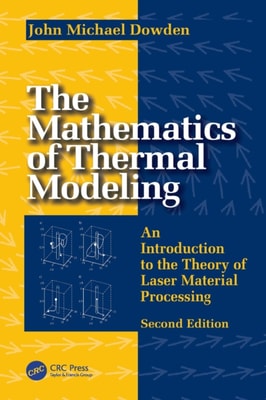
The Mathematics of Thermal Modeling, Second Edition, provides an introduction to the basics of the mathematics and physics needed to understand and use the physical principles employed in constructing models of a number of aspects of thermal modeling in industrial processes, notably laser welding; most of the techniques are applicable to many other technological processes, however.
This book is an English translation from a Hungarian book designed for graduate and postgraduate students about the use of variational principles in theoretical physics.
This revised and enhanced new edition of a well-established textbook provides a balanced overview of various areas of theoretical physics based on the use of variational principles.
In this undergraduate textbook, now in its 2nd edition, the author develops the quantum theory from first principles based on very simple experiments: a photon traveling through beam splitters to detectors, an electron moving through magnetic fields, and an atom emitting radiation.
This book provides a practical and comprehensive introduction to computational problem solving from the viewpoints of practitioners in both academic and industrial worlds.
This book provides a well-balanced and comprehensive picture based on clear physics, solid mathematical formulation, and state-of-the-art useful numerical methods in deterministic, stochastic, deep neural network machine learning approaches for computer simulations of electromagnetic and transport processes in biology, microwave and optical wave devices, and nano-electronics.
This book presents improved numerical techniques and applied computer-aided simulations as a part of emerging trends in mechatronics in all areas related to complex fluids, with particular focus on using a combination of modeling, theory, and simulation to study systems that are complex due to the rheology of fluids (i.
This textbook introduces the language and the techniques of the theory of dynamical systems of finite dimension for an audience of physicists, engineers, and mathematicians at the beginning of graduation.
This textbook aims at introducing readers, primarily students enrolled in undergraduate Mathematics or Physics courses, to the topics and methods of classical Mathematical Physics, including Classical Mechanics, its Lagrangian and Hamiltonian formulations, Lyapunov stability, plus the Liouville theorem and the Poincare recurrence theorem among others.
This volume presents lectures given at the Wisla 20-21 Winter School and Workshop: Groups, Invariants, Integrals, and Mathematical Physics, organized by the Baltic Institute of Mathematics.
This book, the much-anticipated sequel to (Almost) Impossible, Integrals, Sums, and Series, presents a whole new collection of challenging problems and solutions that are not commonly found in classical textbooks.
This book describes how complex systems from a variety of fields can be modeled using quantum mechanical ideas; from biology and ecology, to sociology and decision-making.
This book treats the subject of gravitational waves (GWs) production in binary stars or black-holes and in the early universe, using tools of quantum field theory which are familiar to graduate students and researchers in particle physics.
Quantum Continuous Variables introduces the theory of continuous variable quantum systems, from its foundations based on the framework of Gaussian states to modern developments, including its applications to quantum information and forthcoming quantum technologies.
Quantum computing is not merely an incremental advancement in computing technology; it represents a fundamentally new paradigm, distinct from classical computing.
Polish Quantum Chemistry from Kolos to Now, Volume 87 provides a survey of contributions coauthored by Polish scientists working in Poland, and in European and American Universities.
Quantum Continuous Variables introduces the theory of continuous variable quantum systems, from its foundations based on the framework of Gaussian states to modern developments, including its applications to quantum information and forthcoming quantum technologies.
La enseñanza de la física, las matemáticas, y las diferentes metodologías que pueden ser utilizadas para que los alumnos logren aprendizajes en estas áreas del conocimiento, no suele ser una tarea fácil, así como escribir un texto que permita aproximarse a esos objetivos no será algo menor.
This textbook aims at introducing readers, primarily students enrolled in undergraduate Mathematics or Physics courses, to the topics and methods of classical Mathematical Physics, including Classical Mechanics, its Lagrangian and Hamiltonian formulations, Lyapunov stability, plus the Liouville theorem and the Poincare recurrence theorem among others.
This volume presents lectures given at the Wisla 20-21 Winter School and Workshop: Groups, Invariants, Integrals, and Mathematical Physics, organized by the Baltic Institute of Mathematics.
This book, the much-anticipated sequel to (Almost) Impossible, Integrals, Sums, and Series, presents a whole new collection of challenging problems and solutions that are not commonly found in classical textbooks.
This book describes how complex systems from a variety of fields can be modeled using quantum mechanical ideas; from biology and ecology, to sociology and decision-making.
This book treats the subject of gravitational waves (GWs) production in binary stars or black-holes and in the early universe, using tools of quantum field theory which are familiar to graduate students and researchers in particle physics.
Das vorliegende Buch führt durch die Symmetrien in der Physik: Es werden wichtige Gruppen und Symmetrien aus der Molekülphysik, der Festkörperphysik und (Quanten-)Feldtheorie vorgestellt und behandelt.