This book has been prompted by our des ire to share with others our apprecia- tion of the harmony and beauty in a particular sphere of modern optics known as "e;optical phase conjugation"e;.
Once again it has become necessary to produce a new edition in order to update material provided in earlier editions and to add new descriptions of recently emerging technology.
A large number of modern problems in physics, chemistry, and quantum electronics require a consideration of population dynamics in complex multilevel quantum systems.
This book systematically introduces the most important aspects of organic semiconductor heterojunctions, including the basic concepts and electrical properties.
This proceedings book contains selected and expanded contributions presented at the 9th International Symposium of Space Optical Instruments and Applications (ISSOIA 2024), held in Guangzhou, China, from 25 to 27 September 2024.
This proceedings book contains selected and expanded contributions presented at the 9th International Symposium of Space Optical Instruments and Applications (ISSOIA 2024), held in Guangzhou, China, from 25 to 27 September 2024.
The second edition of the book published by Springer in 2006, Optical Polarization in Biomedical Applications concerns the optical methods exploring a unique feature of light —its polarization—for quantitative tissue characterization.
The second edition of the book published by Springer in 2006, Optical Polarization in Biomedical Applications concerns the optical methods exploring a unique feature of light —its polarization—for quantitative tissue characterization.
This book highlights the development and applications of hybrid materials that combine noble metals like gold, silver, platinum, and palladium with other components such as polymers, carbon-based materials, metal oxides, 2D materials, MOF’s, or mixed metal oxides.
This book highlights the development and applications of hybrid materials that combine noble metals like gold, silver, platinum, and palladium with other components such as polymers, carbon-based materials, metal oxides, 2D materials, MOF’s, or mixed metal oxides.
This book highlights the revolutionary effects of generative Artificial Intelligence (AI) on photonic sensing technologies, where intelligent systems might improve precision, effectiveness, and applicability of light-based sensors.
This book highlights the revolutionary effects of generative Artificial Intelligence (AI) on photonic sensing technologies, where intelligent systems might improve precision, effectiveness, and applicability of light-based sensors.
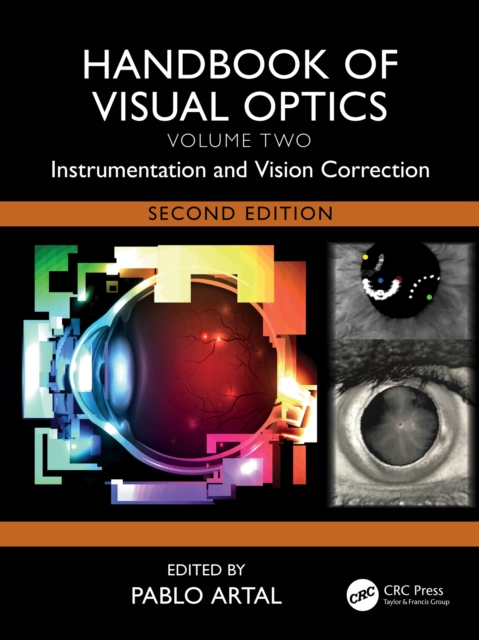
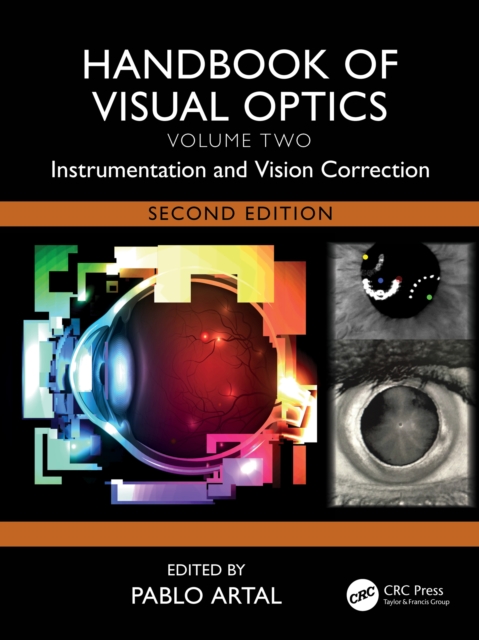
This new edition of the Handbook of Visual Optics, Volume Two, presents an authoritative survey of modern ophthalmic instrumentation, vision-correction technologies, and the optical foundations of visual performance.
This new edition of the Handbook of Visual Optics, Volume Two, presents an authoritative survey of modern ophthalmic instrumentation, vision-correction technologies, and the optical foundations of visual performance.
This book outlines physically intuitive concepts and theories for students, engineers, and scientists who will be engaged in research in nanophotonics and atom photonics.
This book is based on presentations to the International Conference of X-Ray Micro- scopy and Spectromicroscopy, XRM 96, which took place in Wiirzburg, August 19- 23, 1996.
Recent rapid advances in femtosecond technology have had a great impact on their industrial applications such as: ultrafast optoelectronic devices and optical telecommunication systems, ultrashort-pulse lasers and measurement systems, and the development of novel materials for ultrafast functions.
Since the book was first published in 1991, the field of surface nonlinear optics has grown substantially to the point where an exposition of the principles of this field will prove useful to many.
This book is dedicated to the relativistic (laser intensity above 1018 W/cm2) laser-plasma interactions, which mainly concerns two important aspects: ion acceleration and extreme-light-field (ELF).
Since the discovery that atomic-size particles can be described as waves, many interference experiments have been realized with electrons to demonstrate their wave behavior.
The book is devoted to the theory describing the interaction of ultra-short electromagnetic pulses (USP) with matter, including both classical and quantum cases.
Photons are an attractive option for testing fundamental quantum physics and developing new quantum-enhanced technology, including highly advanced computers and simulators, as well as precision sensing beyond shot-noise.
This thesis unifies the dissipative dynamics of an atom, particle or structure within an optical field that is influenced by the position of the atom, particle or structure itself.