In this dissertation, we revisit the prospects of a strongly interacting theory for the Electroweak Symmetry Breaking Sector of the Standard Model, after the discovery of a Higgs-like boson at 125GeV.
The natural generalization of the quantum-mechanical N-particle wave function to relativistic space-time is a function of N space-time points, and thus of N time variables.
This thesis documents the measurement of lifetime, width, mass, and couplings to two electroweak bosons of the recently-discovered Higgs boson using data from the CMS experiment at the Large Hadron Collider.
The work presented in this PhD dissertation is the first search at CMS for Higgs bosons produced in association with top quarks (ttH) in a final state consisting of only jets.
This thesis focuses on searches for squarks with the ATLAS detector in "e;compressed"e; scenarios where the scalar top is very close in mass to the lightest supersymmetric particle.
In this book, the author addresses selected topics in quantum mechanics that are not usually covered in books, but which are very helpful in developing a student's interest in, and a deeper understanding of the subject.
During Run 2 of the Large Hadron Collider, the ATLAS experiment recorded proton-proton collision events at 13 TeV, the highest energy ever achieved in a collider.
This primer develops Conformal Field Theory (CFT) from scratch, whereby CFT is viewed as any conformally-invariant theory that describes a fixed point of a renormalization group flow in quantum field theory.
This thesis presents two production cross-section measurements of pairs of massive bosons using final states with leptons, made with the ATLAS detector at the Large Hadron Collider.
This book focuses on new experimental and theoretical advances concerning the role of strange and heavy-flavour quarks in high-energy heavy-ion collisions and in astrophysical phenomena.
Rafelski presents Special Relativity in a language deemed accessible to students without any topical preparation - avoiding the burden of geometry, tensor calculus, and space-time symmetries - and yet advancing in highly contemporary context all the way to research frontiers.
This book provides an overview of the recent experimental and theoretical results on interactions of heavy ions with gaseous, solid and plasma targets from the perspective of atomic physics.
This biography sheds new light on the life and work of physicist Ettore Majorana (including unpublished contributions), as well as on his mysterious disappearance in March 1938.
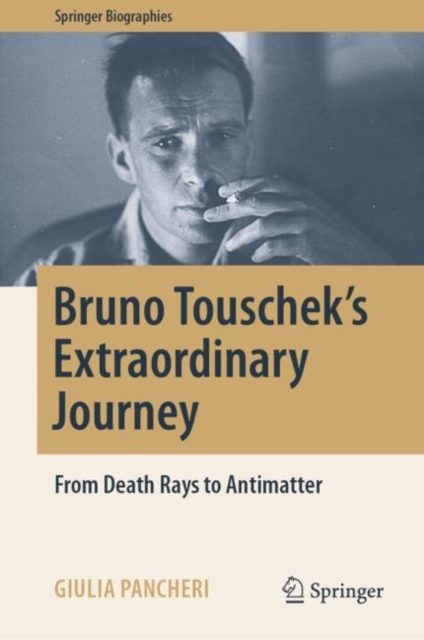
This book tells the story of a unique scientific and human adventure, following the life and science of Bruno Touschek, an Austrian born physicist, who conceived and built AdA, the first matter-antimatter colliding-beam storage ring, the ancestor of the Large Hadron Collider at CERN where the Higgs Boson was discovered in 2012.
These proceedings gather invited and contributed talks presented at the XXII DAE-BRNS High Energy Physics (HEP) Symposium, which was held at the University of Delhi, India, on 12-16 December 2016.
This thesis represents a unique mix of theoretical work discussing the Lorentz theory of gravity and experimental work searching for supersymmetry with the Compact Muon Solenoid experiment at the Large Hadron Collider.
This book takes a fresh, systematic approach to determining the equation of motion for the classical model of the electron introduced by Lorentz 130 years ago.
The lectures in this book provide graduate students and non-specialist researchers with a concise introduction to the concepts and formalism required to reduce the ten-dimensional string theories to the observable four-dimensional space-time - a procedure called string compactification.
The purpose of this book is to illustrate some of the most important techniques which are helpful in combinatorial problems when computing quantum effects in covariant theories, like general relativity.
This thesis reports the measurement of muon neutrino and antineutrino disappearance and electron neutrino and antineutrino appearance in a muon neutrino and antineutrino beam using the T2K experiment.
This book introduces the reader to the field of jet substructure, starting from the basic considerations for capturing decays of boosted particles in individual jets, to explaining state-of-the-art techniques.
This thesis describes the search for Dark Matter at the LHC in the mono-jet plus missing transverse momentum final state, using the full dataset recorded in 2012 by the ATLAS Experiment.
This thesis studies various aspects of non-critical strings both as an example of a non-trivial and solvable model of quantum gravity and as a consistent approximation to the confining flux tube in quantum chromodynamics (QCD).
This book presents more than 300 exercises, with guided solutions, on topics that span both the experimental and the theoretical aspects of particle physics.
This book introduces the physics and chemistry of plastic scintillators (fluorescent polymers) that are able to emit light when exposed to ionizing radiation, discussing their chemical modification in the early 1950s and 1960s, as well as the renewed upsurge in interest in the 21st century.