This volume contains lectures on the experimental and theoretical aspects of the present knowledge in the field of strangeness production in atomic nuclei.
This volume contains reviews and short communications on the following topics: tests of the standard model and Z physics, Higgs boson physics, K and B physics, neutrino physics, phenomenology of supersymmetry, grand unification, particle physics and cosmology, new results in strong interactions.
This volume describes the latest developments in the design, construction and operation of cyclotrons, from compact machines producing intense beams for isotope production, cancer therapy and industrial use, to the larger versions giving higher energy beams of ions of various elements for nuclear and particle physics.
This is the first systematic volume which presents a detailed introduction to every facet of the modern version of Dynamical Symmetry Breaking which has been rapidly developed in recent years.
This workshop proceedings presents interesting lectures on the theoretical and experimental problems which may be studied using the new GeV accelerators.
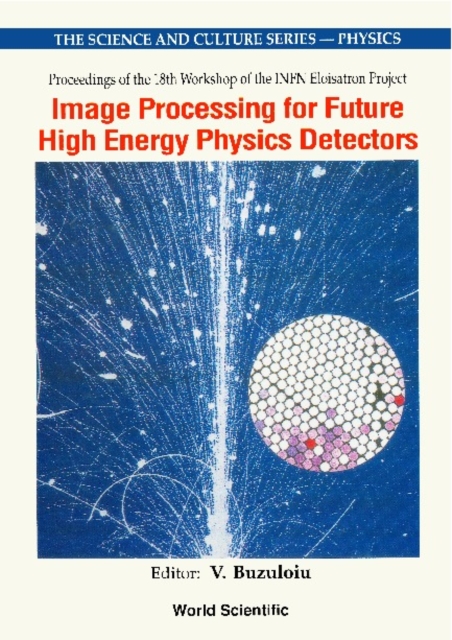
This volume stresses the necessity of image processing for future high energy physics detectors (indeed the signals - 1 megabyte of data or more, every 16 nanoseconds - will have 2D-spatial-topology-like images; only the processing/decision rates are much higher).
This seminar focusses on the key issues addressed in measuring the hyperon-nucleon strong and weak interaction observables and in modelling the hyperon-nucleon interaction.
These proceedings treat the production of high energy gamma rays and particles (mesons and dileptons) in heavy ion reactions from energies of about 30 MeV*A to a few GeV*A, and its application to the study of the Nuclear Equation of State from both the experimental and theoretical points of view.
This international meeting on ultrahigh energy multiparticle phenomena started with a summary of neutrino physics, followed by a detailed review of LEP results.
This book presents the state of the art and the outlook for the theoretical and experimental aspects of radiative corrections to the SU2L x U x SUc Standard Model (SM) of elementary particle physics.
One of the main goals of intermediate energy nuclear physics, which serves an important role as a bridge between nuclear and particle physics, is to construct the theory of strong interaction phenomena in terms of conventional degrees of freedom (nucleons, deltas and mesons) as well as of quark degrees of freedom.
An accelerating convergence of interests of particle physics and modern experimental and theoretical astrophysics has been witnessed in the past few years.
This international conference focussed on several exciting frontier areas of particle physics at energy scales not realizable in terrestrial accelerators and their significance in the fields of astrophysics and cosmology.
These proceedings contain over 80 contributions from an international group of scientists and engineers actively working on applications of fiber technology in high energy physics and related fields.
This volume includes general reviews of recent developments in particle physics, cosmology, solar neutrinos, selected topics in astroparticle theory, new methods and projects in underground physics (such as gallium-germanium solar neutrino detector SAGE, Underground Scintillation Telescope, and EAS array "e;Carpet"e;), dark matter and double beta decay searches.
The major topics in this volume are electroweak physics (including LEP physics and radiative corrections), CP violation and lepton number nonconservation, and neutrino physics and astroparticle physics.
This volume provides a topical survey of the static and dynamic properties of hydrogen in both metallic and inorganic materials studied by neutron scattering which has been the key technique in this field for a long time.
This volume contains the talks given at the above workshop which was devoted to discussing the newest developments in various models of electroweak symmetry breaking forming the basis of modern particle physics.
This conference brought together the people working on 4I detectors to discuss what had been achieved, whether the results agreed, and to think about possible collaborations to measure the excitation function of several observables.
This volume includes 45 talks and reports from facilitated discussions by outstanding contributors to the theory of hadrons that cover the entire spectrum of computational strategies being developed to solve QCD.
This volume, which is a compilation of lecture notes, seminar talks and contributed material presented at the above conference, discusses the modern approaches to hadronic physics: chiral perturbation theory, effective Lagrangians, models for hadronic structure and nuclear matter properties, method of light front quantization, etc.
Recent results from all types of high energy colliders (ee pp, ep) are presented from the view point of electroweak interaction and QCD/Jet physics together with related phenomenological reviews.
This volume reviews the recent progress of B physics, and discusses theoretical and experimental aspects of the physics which will be explored at the B factory.