The interest in understanding the physical world that we live in, the origin of its formation and evolution, is reflected in the world-wide activities in Europe, the USA and Japan to set up powerful research facilities providing beams of radioactive nuclei of various kinds, and beams of extremely large energies.
This volume concentrates on three main areas of current research in high energy physics: (1) multiparticle and diffractive production in perturbative and nonperturbative QCD, (2) confinement-deconfinement mechanism and the RHIC physics, and (3) interface between high-energy collisions and cosmic-ray/astro-physics.
The International Conference on Calorimetry in High Energy Physics has become the major forum for presenting the latest developments of calorimetry techniques.
This volume presents a selection of current developments in quantum chromodynamics, with some emphasis on the borderline between the perturbative and the nonperturbative regime.
This volume contains the proceedings of the 'Workshop on Lightcone QCD and Nonperturbative Hadron Physics', held in Adelaide, Australia, in December 1999.
This book constitutes the proceedings of a workshop on 'Exclusive and Semi-exclusive Processes at High Momentum Transfer', sponsored by the Institute for Nuclear Theory (Seattle) and the Thomas Jefferson National Accelerator Facility (Jefferson Laboratory).
This volume focusses on four main topics: structure functions, tests of quantum chromodynamics, physics at the highest Q2 and p2T, and high energy scattering and diffraction.
This book covers various experimental and theoretical aspects of multiparticle production in high energy interactions from lepton-lepton, lepton-hadron, hadron-hadron, hadron-nucleus and heavy ion collisons.
The quark confinement mechanism is one of the most difficult problems in particle physics, and is listed as the 7 difficult mathematical problems of the new millennium.
This volume encompasses current issues in the physics of baryons, including their spectroscopy and quark-gluon substructure, and investigations with electroweak and strong interacting probes.
Electrostatic particle accelerators are used in a number of fields, such as nuclear physics, atomic physics, materials science, accelerator mass spectrometry, environmental science and even art.
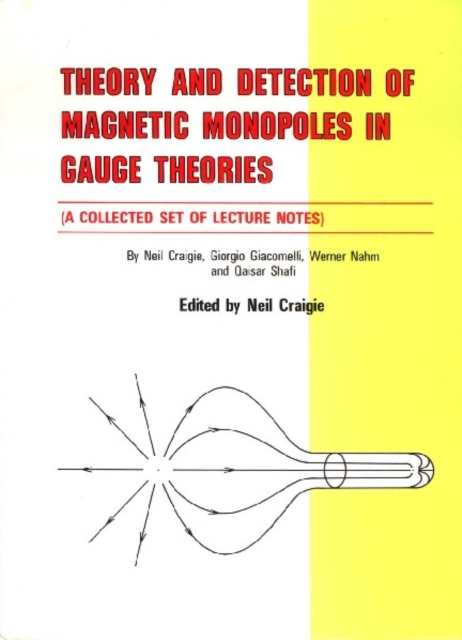
These lecture notes discusses the developments both in the theoretical understanding of the physics and mathematics of magnetic monopoles as well as the ways in which they can be detected experimentally.
Quarks '90 covers various topics in the theory of elementary particles and quantum fields (including perturbative and non-perturbative QCD, sphalerons, topological field theory, strings and superstrings, physics in TeV region), astrophysics and cosmology as related to particle physics.
Some topics covered during the workshop include String Theory, Conformal Field Theory, Physics in 2+1 Dimensions, String Phenomenology and Quantum Cosmology.
This book is a collection of original papers on dynamical gauge symmetry breaking, and is intended for graduate students and researchers in theoretical physics (elementary particle physics and others) who have an understanding of basic quantum field theory.
The masses of fermions and gauge bosons enter the Standard Model through the Higgs mechanism, which is satisfactory technically but is not understood physically.