Unlock the Ultimate Guide to Quantum AwakeningDive into the essence of quantum physics with this groundbreaking volume, a masterful synthesis of the ten greatest books about quantum physics.
Many-Body Problems and Quantum Field Theory introduces the concepts and methods of the topics on a level suitable for graduate students and researchers.
In the new edition, supplements, additional explanations and cross-references have been added at numerous places, including new formulations of some of the problems.
In this book, quantum mechanics is developed from the outset on a relativistic basis, using the superposition principle, Lorentz invariance and gauge invariance.
The Esoteric Art of Living: Metaphysics of Quantum PhysicsWhere Science Meets the Soul: A Modern Guide to Reality, Consciousness, and the Power of the Unseen.
The essays in this topical volume inquire into one of the most fundamental issues of philosophy and of the cognitive and natural sciences: the riddle of time.
Since the book was first published in 1991, the field of surface nonlinear optics has grown substantially to the point where an exposition of the principles of this field will prove useful to many.
In the original formulation of quantum mechanics the existence of a precise border between a microscopic world, governed by quantum mechanics, and a macroscopic world, described by classical mechanics was assumed.
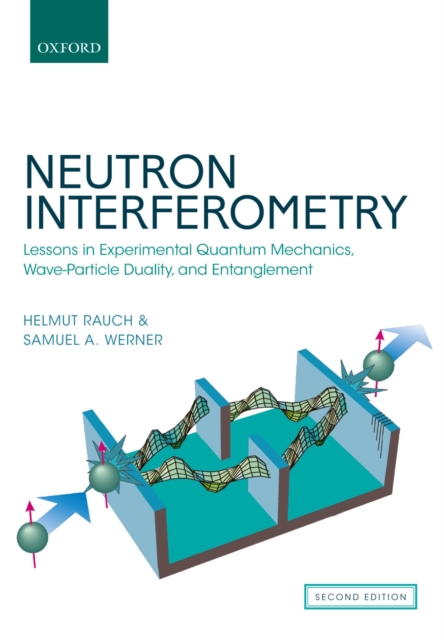
Since the discovery that atomic-size particles can be described as waves, many interference experiments have been realized with electrons to demonstrate their wave behavior.
This thesis shows how a combination of analytic and numerical techniques, such as a time dependent and finite temperature Density Matrix Renormalization Group (DMRG) technique, can be used to obtain the physical properties of low dimensional quantum magnets with an unprecedented level of accuracy.
Photons are an attractive option for testing fundamental quantum physics and developing new quantum-enhanced technology, including highly advanced computers and simulators, as well as precision sensing beyond shot-noise.
This book has evolved from lectures devoted to applications of the Wentzel - Kramers - Brillouin- (WKB or quasi-classical) approximation and of the method of 1/N -expansion for solving various problems in atomic and nuclear physics.
For more than a century, quantum mechanics has served as a very powerful theory that has expanded physics and technology far beyond their classical limits, yet it has also produced some of the most difficult paradoxes known to the human mind.
There have been many recent and important developments based on effective field theory and the renormalization group in atomic, condensed matter, nuclear and high-energy physics.
The measurement of spin-polarization observables in reactions of nuclei and particles is of great utility and advantage when the effects of single-spin sub-states are to be investigated.
Recent experimental and theoretical progress has elucidated the tunable crossover, in ultracold Fermi gases, from BCS-type superconductors to BEC-type superfluids.
Starting from basic principles, the book covers a wide variety of topics, ranging from Heisenberg, Schroedinger, second quantization, density matrix and path integral formulations of quantum mechanics, to applications that are (or will be) corner stones of present and future technologies.