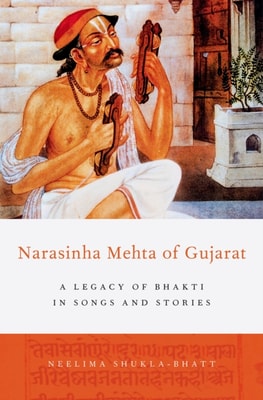
Exploring medieval manuscripts, Gandhi's writings, and performances in multiple religious and non-religious contexts, Narasinha Mehta of Gujarat demonstrates how over five centuries, performers and audiences of devotional songs and hagiographic narratives associated with the saint-poet Narasinha Mehta have sculpted them into popular sources of moral inspiration.
David Shulman and Velcheru Narayana Rao offer a groundbreaking cultural biography of Srinatha, arguably the most creative figure in the thousand-year history of Telugu literature.
Winner of the Award for Excellence in Religion: Textual Studies from the American Academy of ReligionThis book explores the relationship between ethics, aesthetics, and religion in classical Indian literature and literary theory by focusing on one of the most celebrated and enigmatic texts to emerge from the Sanskrit epic tradition, the Mahabharata.
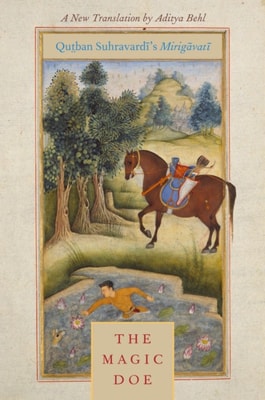
Mirigavati or The Magic Doe is the work of Shaikh Qutban Suhravardi, an Indian Sufi master who was also an expert poet and storyteller attached to the glittering court-in-exile of Sultan Husain Shah Sharqi of Jaunpur.
No Hindu god is closer to the soul of poetry than Krishna, and in North India no poet ever sang of Krishna more famously than SurdD^=as-or Sur, for short.
For countless generations families have lived in isolated communities in the Godavari Delta of coastal Andhra Pradesh, learning and reciting their legacy of Vedas, performing daily offerings and occasional sacrifices.
In this magisterial volume of essays, Wendy Doniger enhances our understanding of the ancient and complex religion to which she has devoted herself for half a century.
In this magisterial volume of essays, Wendy Doniger enhances our understanding of the ancient and complex religion to which she has devoted herself for half a century.
This book examines historical changes in the grammar of the Indo-Aryan languages from the period of their earliest attestations in Vedic Sanskrit (around 1000 bc) to contemporary Hindi.
Focusing on the idea of genealogical affiliation (sampradaya), Kiyokazu Okita explores the interactions between the royal power and the priestly authority in eighteenth-century north India.
Through pointed studies of important aspects and topics of dharma in Dharmasastra, this comprehensive collection shows that the history of Hinduism cannot be written without the history of Hindu law.
Through pointed studies of important aspects and topics of dharma in Dharmasastra, this comprehensive collection shows that the history of Hinduism cannot be written without the history of Hindu law.
This book examines several thousand examples of tense-aspect stem participles in the Rigveda, and the passages in which they appear, in terms of both their syntax and semantics.
Sayings of Gorakhnath presents a translation of late-medieval texts in Old Hindi, traditionally attributed to one of the founders of the Order of Nath Yogis.
Though Freud never overtly refers to the Mahthe companion volume to Freud's India, Alf Hiltebeitel offers what he calls a "e;pointillist introduction"e; to a new theory about the Mah
Though Freud never overtly refers to the Mahthe companion volume to Freud's India, Alf Hiltebeitel offers what he calls a "e;pointillist introduction"e; to a new theory about the Mah
The thousand-year-old Sanskrit classic the Bhagavatapurana, or "e;Stories of the Lord,"e; is the foundational source of narratives concerning the beloved Hindu deity Krishna.
After a sleepless night spent longing for his absent wife Sita, Rama, god-prince and future king, surveyed his army camps on a clear autumn morning and spied a white goose playing in a pond of lotus flowers.
The thousand-year-old Sanskrit classic the Bhagavatapurana, or "e;Stories of the Lord,"e; is the foundational source of narratives concerning the beloved Hindu deity Krishna.
After a sleepless night spent longing for his absent wife Sita, Rama, god-prince and future king, surveyed his army camps on a clear autumn morning and spied a white goose playing in a pond of lotus flowers.
No Hindu god is closer to the soul of poetry than Krishna, and in North India no poet ever sang of Krishna more famously than SurdD^=as-or Sur, for short.
For countless generations families have lived in isolated communities in the Godavari Delta of coastal Andhra Pradesh, learning and reciting their legacy of Vedas, performing daily offerings and occasional sacrifices.
Warrior-prince Rama is about to be crowned Young King, when he hears the devastating news that his father, King of Ayodhya, has been tricked into banishing him to the forest.
An 'Upanisad' is a teaching session with a guru, and these thirteen texts, the 'Principal Upanisads', form a series of philosophical discourses between teacher and student that question the inner meaning of the world.
The earliest of the four Hindu religious scriptures known as the Vedas, and the first extensive composition to survive in any Indo-European language, the Rig Veda (c.
The Bhagavad Gita is an intensely spiritual work that forms the cornerstone of the Hindu faith, and is also one of the masterpieces of Sanskrit poetry.
Part of the ancient Hindu epic The Mahabharata, The Bhagavad Gita is one of the enduring religious texts of the worldThe Bhagavad Gita is an early poem that recounts the conversation between Arjuna the warrior and his charioteer Krishna, a manifestation of God.