Developed in the context of health sciences education in the late 1960s, problem-based learning (PBL) is now widely deployed as an education methodology.
This, the first comprehensive academic volume on vocational education and training (VET) or career and technical education in the United States, features insights into a variety of issues in this field of research.
Effective knowing and learning for vocational purposes must take account of the wide range of variables that impact on knowledge formation and that promote learning.
This book is founded on the idea that 'becoming' is the most useful defining concept for a new 'professional' class whose members understand that development in their working lives is an open-ended, lifelong process of refinement and learning.
This important book breaks new ground in addressing issues of gendered learning in different contexts across the (adult) life span at the start of the 21st century.
The contributing authors of this multidisciplinary text agree that workplace learning truly is extraordinary when it is marked by structural congruence and a positive synergy among the intended and formal preparation of professionals, that tacit learning occurs within the hidden curriculum, and that the subsequent demands, both formal and tacit, are embedded in subsequent workplace settings.
With labour markets across the world and even in social democratic Europe in a state of unprecedented flux, this exhaustive study addresses the problem of how to balance job market demands, personal career interests and private life becomes a central issue for millions of employees.
In this book we respond to a higher education environment that is on the verge of profound changes by imagining an evolving and agile problem-based learning ecology for learning.
This book, by combining sociocultural, material, cognitive and embodied perspectives on human knowing, offers a new and powerful conceptualisation of epistemic fluency - a capacity that underpins knowledgeable professional action and innovation.
Tajikistan and other countries in Central Asia, such as Kazakhstan, the Kyrgyz Republic, Turkmenistan, and Uzbekistan, are striving to align technical and vocational education and training (TVET) with their economic realities.
This publication documents the process and materials needed to conduct interventions supporting the transition to local government-led community-driven development in the Philippines.
This independent tracer study examines Sri Lanka's Skills Sector Development Program, which the Asian Development Bank supported through results-based lending.
This publication presents data visualization of economic statistics from South and Central Asia relevant for the analysis of cross-border production arrangements at the local, regional, and global levels.
This publication presents data visualization of economic statistics from Southeastern Asia and the Pacific relevant for the analysis of cross-border production arrangements at the local, regional, and global levels.
This publication presents data visualization of economic statistics from Eastern Asia relevant for the analysis of cross-border production arrangements at the local, regional, and global levels.
This publication reports the results of an exploratory study on civil society organization (CSO) engagement---particularly nongovernment organizations (NGOs) and community-based organizations (CBOs)---in Asian Development Bank (ADB) operations.
Rapid advances in information and communication technology (ICT) continue to create tremendous opportunities for economic and social gains in the world's poorest areas.
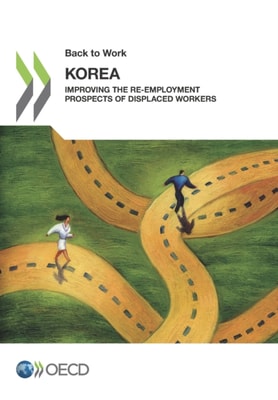
In Korea's dynamic labour market, job displacement (involuntary job loss due to firm closure or downsizing) affects many workers over the course of their working lives.
Given the emphasis on transforming professional work through the adoption of enquiry-based and trans-disciplinary approaches to service development, there is an urgent need for those involved in professional education to develop a robust understanding of how changes in practice occur.
Professionals deal with complex problems which require working with the expertise of others, but being able to collaborate resourcefully with others is an additional form of expertise.
A curious ambiguity surrounds errors in professional working contexts: they must be avoided in case they lead to adverse (and potentially disastrous) results, yet they also hold the key to improving our knowledge and procedures.
This book seeks to develop the philosophy of Heidegger notion and reflects the growing importance of work based studies which is becoming of special interest to higher education institutions and commercial organisations.
Practice-based learning-the kind of education that comes from experiencing real work in real situations-has always been a prerequisite to qualification in professions such as medicine.