The research in this volume draws on aspects of complexity theory and its integral link to systems performance to propose a new method for combatting the longstanding opportunity gap and related underperformance of so many underserved students in the American educational system.
Awarded 2nd Prize, Best Book award, the Society for Education Studies, 2011Refugees are physically and symbolically 'out of place' - their presence forces governments to address issues of rights and moral obligations.
Bringing together an international line-up of contributors, this collection provides a transnational examination of recent developments within the academic profession in the light of changes to higher education systems, globalization and marketization.
A useful compendium of 'survival' advice for the faculty newcomer on a variety of subjects: practical tips on classroom teaching, student performance evaluation, detailed advice on grant-writing, student advising, professional service, and publishing.
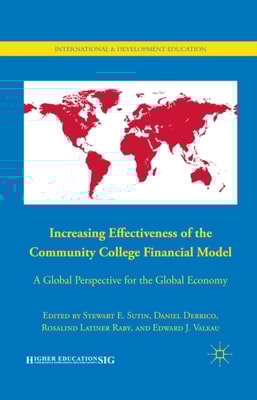
This book seeks to explore thematic and pragmatic applications of financing the community college to help facilitate educational reform, to assist efforts related to internationalization and to create systemic support systems to maintain the mission.
School boards spend almost $500 billion in taxpayer-provided funds, they employ more than 6 million people, offering pensions and lifetime health benefits that have helped build the obligation that has put state governments in fiscal peril.
Public Universities and the Public Sphere argues that two crises facing America - a crisis of public discourse and a crisis of public higher education - are closely connected.
This book walks community activists through the rationale for assuming local responsibility for academic performance, outlines steps needed to drive that change, and suggests curricular direction and school policy requirements.
Schutz demonstrates that progressive ideas of democracy emerged out of the practices of a new middle class, reacting, in part, against the more conflictive social struggles of the working-class.
This book explores the efficacy of innovative and interdisciplinary approaches to educational leadership preparation implemented at universities across the United States that serve K-12 populations in urban, rural, and suburban contexts.
This collection makes a unique contribution towards the amplification of indigenous knowledge and learning by adopting an inter/trans-disciplinary approach to the subject that considers a variety of spaces of engagement around knowledge in Asia and Africa.
In light of the growing phenomenon of Islamic schools in the United States and Europe, this compelling study outlines whether these schools share similar traits with other religious schools, while posing new challenges to education policy.
In this book, the contributors challenge dominant discourses and practices in the fields of early childhood and middle grades education that are based on the last century's grand developmental theories.
While featuring field-based examples in multiple disciplines, including political science, anthropology, communication, psychology, sociology, law and teacher training, this book presents real cases of conflict work.
In this critical look at contemporary higher education, Pasque argues that if a more thorough understanding of leaders' perspectives is not offered, then the dominant perspectives within academic discourse will continue to perpetuate the current ideas of higher education's relationship with society.
Successfully launching an academic career in the challenging environment of higher education today is apt to require more explicit preparation than the informal socialization typically afforded in graduate school.
In Search of Wholeness: African American Teachers and their Culturally Specific Classroom Practices is a theoretical and practice-oriented treatment of how culture and race influence African American teachers.
This is a cutting edge book that not only maps and criticizes venture philanthropy but also offers a new and different way of conceptualizing public education in response to the neoliberal climate affecting all aspects of public education.
The New Plantation examines the controversial relationship between predominantly White NCAA Division I Institutions (PWI s) and black athletes, utilizing an internal colonial model.
While much has been written about South African education, now, for the first time, gathered in one collection are glimpses of South African curriculum studies described by six distinctive points of view.
This historical biography examines Sarah Raymond Fitzwilliam's abolitionist roots growing up on a stop of the Underground Railroad, her training at a 'normal school,' her tenure as a teacher, principal and the nation's first city school superintendent (Bloomington, Illinois 1874-1892).
Contributors offer ideas, applications, and resources for helping leaders and educators tackle the challenges of building successful professional learning communities.
This timely book argues that the New Zealand educational reforms were the product of longstanding unresolved educational issues that came to a head during the profound economic and cultural crisis of the 1970s and early 1980s.
This book brings together a group of top international scholars who consider Pedagogy of Critique, Revolutionary Pedagogy and Radical Critical Pedagogy as forms of praxis to examine the paradoxical roles of schooling in reproducing and legitimizing large-scale structural inequalities.
"e;Perhaps the most urgentand complextask facing American education today is to figure out how to hold schools accountable for improved academic achievement.
The design process for organizational structures sometimes resembles a random walk, especially when it is embedded in an arena of competing personal interests and power games.
This new and updated edition of 10 Mindframes for Visible Learning revisits the ten behaviours or mindframes that teachers need to adopt in order to maximize student success.
This book provides a new way of understanding Japanese management by focusing on the relationship between Japanese companies and their social practices.
This casebook argues that corporate sustainability agendas should look beyond stakeholder demands and desires, towards strategic opportunities to achieve social and commercial benefits simultaneously.