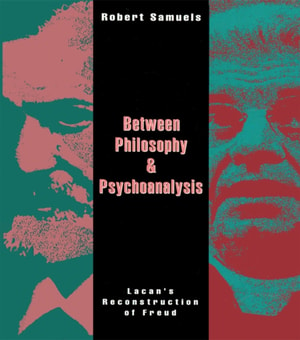
The work of Jaques Lacan, eminent French psychoanalyst and influential thinker (1901-1981), is recognized as being of vital importance to psychoanalysts, philosophers, and all those concerned with the the study of man and language.
The work of Jaques Lacan, eminent French psychoanalyst and influential thinker (1901-1981), is recognized as being of vital importance to psychoanalysts, philosophers, and all those concerned with the the study of man and language.
In his famous seminar on ethics, Jacques Lacan uses this question as his departure point for a re-examination of Freud's work and the experience of psychoanalysis in relation to ethics.
In his famous seminar on ethics, Jacques Lacan uses this question as his departure point for a re-examination of Freud's work and the experience of psychoanalysis in relation to ethics.
During the third year of his famous seminar, Jacques Lacan gives a concise definition of psychoanalysis: 'Psychoanalysis should be the science of language inhabited by the subject.
During the third year of his famous seminar, Jacques Lacan gives a concise definition of psychoanalysis: 'Psychoanalysis should be the science of language inhabited by the subject.
Using the concepts developed by Lacan to analyse the inner logic of Freud's thought Samuels provides a bridge between Lacanian theory and traditional categories of psychoanalytic theory and practice.
Using the concepts developed by Lacan to analyse the inner logic of Freud's thought Samuels provides a bridge between Lacanian theory and traditional categories of psychoanalytic theory and practice.
Wilfred Bion's insights into the analytic process have had a profound influence on how psychoanalysts and psychotherapists understand emotional change and pathological mental states.
Wilfred Bion's insights into the analytic process have had a profound influence on how psychoanalysts and psychotherapists understand emotional change and pathological mental states.
How the Brain Talks to Itself synthesizes discoveries in cognitive neuroscience with a psychoanalytic understanding of human dynamics and a working model for clinical diagnosis.
How the Brain Talks to Itself synthesizes discoveries in cognitive neuroscience with a psychoanalytic understanding of human dynamics and a working model for clinical diagnosis.
Lichtenberg collates and summarizes recent findings about the first two years of life in order to examine their implications for contemporary psychoanalysis.
Lichtenberg collates and summarizes recent findings about the first two years of life in order to examine their implications for contemporary psychoanalysis.
In the first book-length examination of the impact of pregnancy on the therapeutic process, Fenster, Phillips, and Rapoport explore the variety of clinical, technical, and practical issues that arise out of the therapist's impending motherhood.
In the first book-length examination of the impact of pregnancy on the therapeutic process, Fenster, Phillips, and Rapoport explore the variety of clinical, technical, and practical issues that arise out of the therapist's impending motherhood.
Seeking to mediate between the "e;classical"e; view of countertransference as a neurotic impediment to the treatment process and the more recent "e;totalist"e; perspective, which assumes that the therapist's emotional response necessarily reveals something about the patient, Tansey and Burke stake out a thoughtful middle ground.
Seeking to mediate between the "e;classical"e; view of countertransference as a neurotic impediment to the treatment process and the more recent "e;totalist"e; perspective, which assumes that the therapist's emotional response necessarily reveals something about the patient, Tansey and Burke stake out a thoughtful middle ground.
Gestalt Therapy: Perspectives and Applications is a classic text which, when it was first released in 1992, signaled a renaissance of Gestalt scholarship throughout the world.
Gestalt Therapy: Perspectives and Applications is a classic text which, when it was first released in 1992, signaled a renaissance of Gestalt scholarship throughout the world.
In the Image of God is a compilation of lectures by Stanley Leavy, a psychoanalyst approaching retirement, reflecting on his experience as a follower of Freud and his method and also as a lifelong, faithful Episcopalian.
In the Image of God is a compilation of lectures by Stanley Leavy, a psychoanalyst approaching retirement, reflecting on his experience as a follower of Freud and his method and also as a lifelong, faithful Episcopalian.
Traditional psychotherapy approaches, focusing on working with and correcting mental events and conditions, have placed little importance on the fundamentally physical nature of the person.
Traditional psychotherapy approaches, focusing on working with and correcting mental events and conditions, have placed little importance on the fundamentally physical nature of the person.
In this sequel to Lichtenberg's Psychoanalysis and Motivation (TAP, 1989), the authors show how their revised theory of motivation provides the foundation for a new approach to psychoanalytic technique.
In this sequel to Lichtenberg's Psychoanalysis and Motivation (TAP, 1989), the authors show how their revised theory of motivation provides the foundation for a new approach to psychoanalytic technique.
From an overview of the basic principles of intersubjectivity theory, Orange, Atwood, and Stolorow proceed to contextualist critiques of the concept of psychoanalytic technique and of the myth of analytic neutrality.