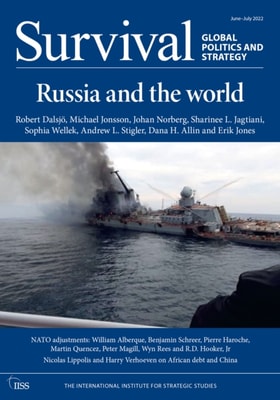
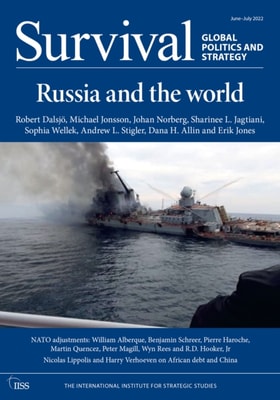
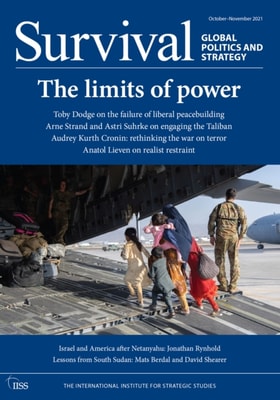
Survival, the IISS's bimonthly journal, challenges conventional wisdom and brings fresh, often controversial, perspectives on strategic issues of the moment.
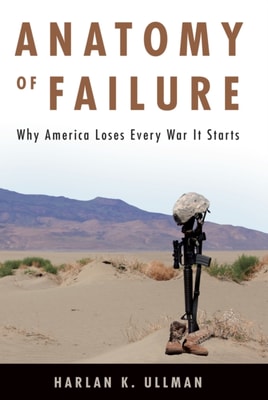
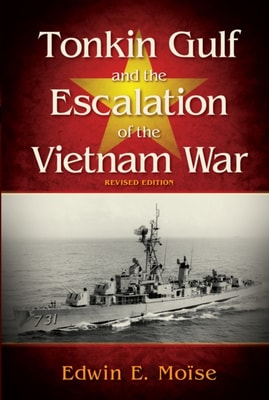
Since the end of World War II, America lost every war it started and failed in military interventions when it did not use sound strategic thinking or have sufficient knowledge and understanding of the circumstances in deciding to use force.
Survival, the IISS's bimonthly journal, challenges conventional wisdom and brings fresh, often controversial, perspectives on strategic issues of the moment.
Survival, the IISS's bimonthly journal, challenges conventional wisdom and brings fresh, often controversial, perspectives on strategic issues of the moment.
Survival, the bi-monthly publication from The International Institute for Strategic Studies, is a leading forum for analysis and debate of international and strategic affairs.
Survival, the IISS's bimonthly journal, challenges conventional wisdom and brings fresh, often controversial, perspectives on strategic issues of the moment.
Wrecking Activities at Power Stations in the Soviet Union (1933) is a valuable historical document that presents a verbatim report of the trials of various Soviet and British engineers and workers accused of acts of sabotage against the Soviet energy infrastructure.
The Communist Economic Challenge (1965) examines the substantial industrial development in the Soviet Union, and its European satellites, and China, looking at Khrushchev's boast that by 1970 the USSR's industrial output would surpass that of the USA.
Survival, the IISS's bimonthly journal, challenges conventional wisdom and brings fresh, often controversial, perspectives on strategic issues of the moment.
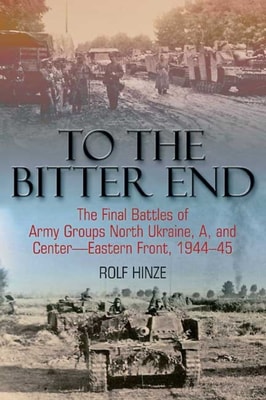
This is a penetrating and detailed account of the climactic battles of the German forces in Slovakia, the Carpathians, parts of Poland, Silesia and Saxony, from autumn 1944 until the end of the war.
Soviet Agriculture in Perspective (1969) examines the framework within which Soviet agriculture had to operate from the start: the dilemma of a revolutionary regime in a backward peasant country, the straightjacket of a bureaucratic system inherited from Tsarism, made even more rigid by the internal tensions of the new society, and the imperative needs of economic development.
Survival, the IISS's bimonthly journal, challenges conventional wisdom and brings fresh, often controversial, perspectives on strategic issues of the moment.
Acclaimed historian and New York Times bestselling author Craig Shirley delivers a compelling account of 1945, particularly the watershed events in the month of April, that details how America emerged from World War II as a leading superpower.
This handbook presents an authoritative account of the potential of advanced ceramics and composites in strategic applications, including defense, national security, aerospace, and energy security (especially nuclear energy).
Woodrow Wilson's presidential administration (1913-1921) was marked not only by America's participation in World War I, but also by numerous armed interventions by the United States in other countries.
This guide which, for years, has prepared military, emergency, and first responders to face psychological, social, and physical challenges of leading in dangerous contexts has been updated.
When Robert Haddick wrote Fire on the Water, first published in 2014, most policy experts and the public underestimated the threat China's military modernization posed to the U.
The great nineteenth century French military thinker, Ardant du Picq, argued that selfless courage is rooted in a higher moral purpose, and is found among "e;Elite Souls.
The Road to Pearl Harbor offers a timely examination of the conflict in the Pacific prior to the attacks on Pearl Harbor and offers lessons applicable to understanding contemporary Great Power flash points between Asia and the West.
Russian Information Warfare: Assault on Democracies in the Cyber Wild West examines how Moscow tries to trample the very principles on which democracies are founded and what we can do to stop it.
The Sultana was a sidewheel Mississippi steamboat carrying almost two thousand recently-released Union prisoners-of-war back north at the end of the Civil War.
War Transformed: The Future of Twenty-First-Century Great Power Competition and Conflict provides insights for those involved in the design of military strategy, and the forces that must execute that strategy.
"e;The authors set themselves a bold purpose, to examine six technologies (two weapons, two tools, and two platforms), chart their influence on naval warfare, and provide "e;new perspectives and insights"e; into how technological innovation develops and progresses.
Army Historical Foundation Distinguished Book Award If the Battle of the Bulge was Germany's last gasp, it was also America's proving ground-the largest single action fought by the U.
Winner: Army Historical Foundation Distinguished Writing AwardWhen American and South Vietnamese forces, led by General Creighton Abrams, launched an attack into neutral Cambodia in 1970, the invasion ignited a firestorm of violent antiwar protests throughout the United States, dealing yet another blow to Nixon's troubled presidency.
Under Himmler's Command addresses two areas of World War II hitherto neglected - Heinrich Himmler as a military commander, and the German staff officer corps during the last months of the war on the Eastern Front.
The so-called Seven Weeks' War of 1866 between Prussia and Italy and Austria was notable not only for its effect on future German history but also because it was the last time the armies of the smaller German states fought as independent contingents.
The Bavarian army, which fought the War of 1866, was not greatly distinguished for its performance, but a translation of the Bavarian general staff history of the war is a document, which should be available in English, since it gives an official analysis of the conflict.
Battle for Cassinga is written as a firsthand account by an ordinary South African paratrooper who was at the 1978 assault on the Angolan headquarters of PLAN, the armed wing of SWAPO.
Here is an outstanding personal memoir penned by a German infantry officer recalling his experiences during the initial days and weeks of the war in the West, July-September 1914.
A detailed account of the composition, structure and Organisation of the First World War German Army has long been needed by English-language readers - this work will fill this gap admirably.
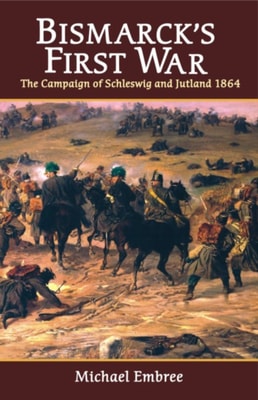
This book chronicles the final conflict over the now almost forgotten "Schleswig-Holstein Question", once a pivotal issue for the great powers of Europe.
Dutch SS accounts are very rare, particularly ones such as this, covering recruitment, training, and frontline service first with 5th SS Panzer Division 'Wiking', then later with SS Regiment Besslein.
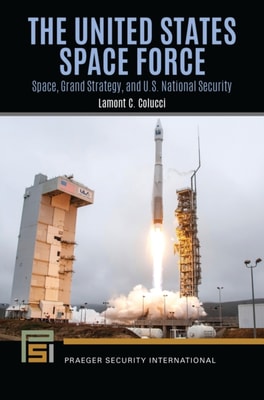
The United States Space Force, the sixth branch of the armed forces, will soon play a leading role in American foreign policy and will be necessary to protect its economic, political, and social interests at home and abroad.
Looking at topics across the spectrum of America's wars, religious groups, personalities, and ideas, this volume shows that even in an increasingly secular society, religious roots and values run deep throughout American society and are elevated in times of war.