In der Bundesrepublik Deutschland überwachen die Behörden der Länder die Einhaltung der Vorschriften, die für das Inverkehrbringen und die Anwendung von Pflanzenschutzmitteln gelten.
In der Bundesrepublik Deutschland überwachen die Behörden der Länder die Einhaltung der Vorschriften, die für das Inverkehrbringen und die Anwendung von Pflanzenschutzmitteln gelten.
In der Bundesrepublik Deutschland überwachen die Behörden der Länder die Einhaltung der Vorschriften, die für das Inverkehrbringen und die Anwendung von Pflanzenschutzmitteln gelten.
This book explains forest and woody biomass harvest, harvesting machines, systems, logistics, supply chain management, best management practices, harvest scheduling and carbon sequestration.
With one volume each year, this series keeps scientists and advanced students informed of the latest developments and results in all areas of the plant sciences.
This Monograph explains the statistical theory behind the National Forest Inventory (NFI) data collection and compares different methods for modelling and inventory design.
This book will address the major subsoil physical and chemical constraints and their implications to crop production; Plant growth is often restricted by adverse physical and chemical properties of subsoils yet these limitations are not revealed by testing surface soils and hence their significance in crop management is often overlooked.
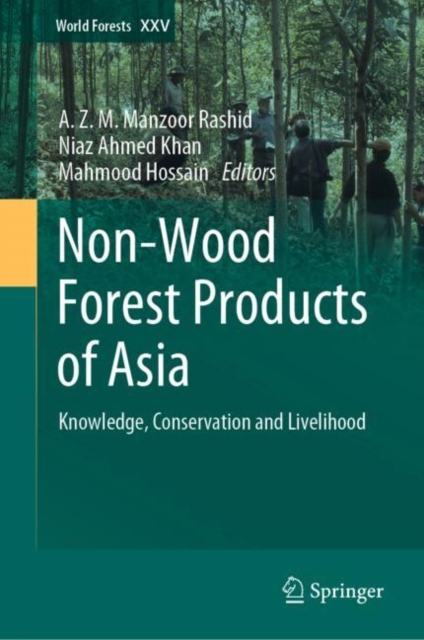
This book highlights the importance of non-wood forest products (NWFPs) and their crucial role in sustaining the livelihood of rural and indigenous communities in Asia.
This book analyses and develops overarching concepts for forest policy and forest governance and includes a detailed investigation into the historical discussion on forests.
This volume is devoted to compiling recent advancements, methodological improvements, new processing techniques, integration methods and rigorous applications associated with conceptual techniques on the conservation and monitoring of forest resources for a scientific audience, with a focus on cases and applications in India.
Written from the perspective of an urban forester and certified arborist, the reader will have a basic understanding of what makes a tree a tree in context to the philosophical and cultural underpinnings of Urban and Community Forestry, and learn how to implement model, time-tested global green practices and initiatives derived from citizen science.
This volume synthesizes and analyzes thirty years of hydrological research in the Danum Valley Conservation Area, a lowland dipterocarp rainforest in Sabah, Malaysia.
This book explains several basic concepts of forests and forestry research like social distancing of trees, solitary trees, green infrastructure of trees including typical forest stands like pocket forests, forgotten forests, community forests, and social forestry from one forest stand to another scattered in the districts of West Bengal.
Agroforestry - the practice of growing trees and crops in interacting combinations - is recognized the world over as an integrated approach to sustainable land-use.
This book focuses on more than 100 years of climatic oscillation in Bengal Duars, a unique foothill landscape of the Eastern Himalaya, to discuss the dynamics of life and livelihoods of forest dependent communities towards climate change related impacts.
Forests cover thirty-one percent of the world's land surface, provide habitats for animals, livelihoods for humans, and generate household income in rural areas of developing countries.
This textbook aims to describe the role of minerals in plant life cycle; how these nutrients are absorbed, distributed, stored; what functions each mineral plays and the disorders that their excess or absence may cause.
With one volume each year, this series keeps scientists and advanced students informed of the latest developments and results in all areas of the plant sciences.
This book surveys state-of-the-art and prospective practices, methods and technologies in agri-food and forestry sectors to document the potential measurable improvements in areas of environmental management, food security, economic growth, social cohesion and human health at the local and global scale.
This book presents modern Bayesian analysis in a format that is accessible to researchers in the fields of ecology, wildlife biology, and natural resource management.
Forest ecosystems include a great variety of communities of organisms interacting with their physical environment: multi-aged natural forests, even-aged monocultures, and secondary forests invaded by foreign species.
Global climate change requires the development of programs that consider the active restoration of degraded forests and the use of native trees in afforestation to preserve the natural environment.
This book explores microbial symbiosis, with a particular focus on soil microorganisms, highlighting their application in enhancing plant growth and yield.
Based on work by the Miombo Network in southern Africa, this book helps decision-makers and general readers alike improve their understanding of the socio-ecology of the Miombo woodlands across southern Africa.
This book is the first to integrate biological control into a conceptual framework - ecostacking - uniting all aspects of biological control and ecosystem services.
This book provides a unique exploration of the inter-relationships between the science of plant environmental responses and the understanding and management of forest fires.
Latin America is a megadiverse territory hosting several hotspots of plant diversity and many types of forest biomes, ecosystems and climate types, from tropical rainforest to semi-arid woodlands.
With one volume each year, this series keeps scientists and advanced students informed of the latest developments and results in all areas of the plant sciences.
This book proposes strategies for improving the resilience and conservation of temperate forests in South America, such that these forests can provide ecosystem services in a sustainable way.
By providing multiple economic goods and ecosystem services, Latin American forests play a key role in the environmental, social and economic welfare of the region's countries.
The aim of this book is to present, in depth, updated information on soil and microbial processes involved in mixed plantations of Eucalyptus and N2-fixing species, especially Acacia mangium, focusing on Forestry, Soils, Biology, Ecosystem Services and Sustainability.