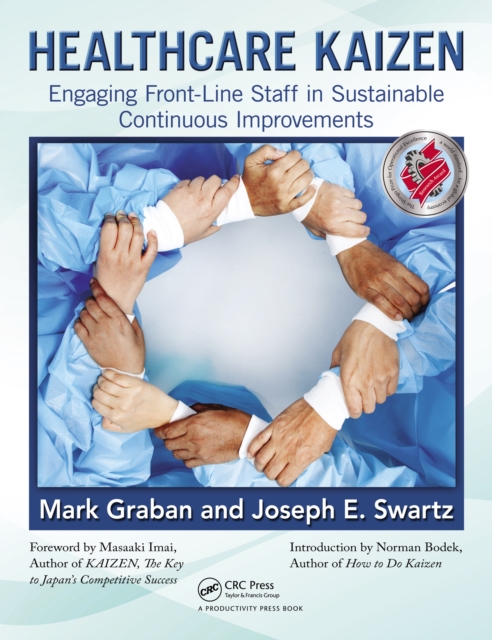
In no industry is the concept of quality more essential than it is in healthcare, which is why the lean quality principles learned through the example of the Toyota Production System are so applicable.
Presenting an alternate approach to supply chain management, Lean Supply Chain Management Essentials: A Framework for Materials Managers explains why the traditional materials planning environment, typically embodied by an Enterprise Resource Planning (ERP) system, is an ineffective support system for a company that wants to adopt Lean practices.
Encouraging efficiency, clarity, and disciplined thinking, A3 Problem Solving identifies a problem, describes the objective, and summarizes fact finding and action steps, all on a single A3-sized piece of paper.
If there is any one element to the engineering of service systems that is unique, it is the extent to which the suitability of the system for human use, human service, and excellent human experience has been and must always be considered.
Cradle-to-grave analyses are becoming the norm, as an increasing amount of corporations and government agencies are basing their procurement decisions not only on initial costs but also on life cycle costs.
Although we now have sophisticated algorithms and techniques for determining the shapes and sizes and for matching the fit between shoes and feet, few, if any, of the books currently available cover these new technologies until now.
Encouraging efficiency, clarity, and disciplined thinking, A3 Problem Solving identifies a problem, describes the objective, and summarizes fact finding and action steps, all on a single A3-sized piece of paper.
Manufacturing plays a vital role in European economy and society, and is expected to continue as a major generator of wealth in the foreseeable future.
Kaizen Events are an effective way to train organizations to break unproductive habits and adopt a continuous improvement philosophy while, at the same time, achieve breakthrough performance-level results.
As industries adopt consumer-focused product development strategies, they should offer broader product ranges in shorter design times and the processes that can manufacture in arbitrary lot sizes.
Exploring the practical, entrepreneurial, and historical aspects of medical device development, this second edition of The Medical Device R&D Handbook provides a how-to guide for medical device product development.
Cradle-to-grave analyses are becoming the norm, as an increasing amount of corporations and government agencies are basing their procurement decisions not only on initial costs but also on life cycle costs.
Written by international contributors, Learning Curves: Theory, Models, and Applications first draws a learning map that shows where learning is involved within organizations, then examines how it can be sustained, perfected, and accelerated.
In the decade since the publication of Rajan Suri's landmark book, Quick Response Manufacturing, the innovative principles of QRM have been proven with impressive results at many companies, big and small, in a variety of industries.
With stock market swings due to unethical behavior, fuel price escalation due to increased demand, and climate disasters due to global warming, operating in a socially responsible manner is quickly moving from the realm of a nice idea to abusiness imperative.
Model-Based Enterprise describes Model-Based Enterprise (MBE) and Model-Based Definition (MBD) in detail, focusing on how to obtain significant business value from MBE.
Closed-loop supply chain activities such as remanufacturing, recycling, dismantling for spare parts, and reverse logistics have helped many companies tap into new revenue streams by finding secondary markets for their products, all while reducing their overall carbon footprint.
Toyota Production System methods have rendered remarkable results in high-volume manufacturing plants, but they have not been fully understood and correctly applied in high-mix, low-volume environments.
Hailed as a groundbreaking and important textbook upon its initial publication, the latest iteration of Product Design for Manufacture and Assembly does not rest on those laurels.
The second edition of a bestseller, this book discusses an integrated product and process designA that has been successfully used to conceptualize, design, and rapidly product competitively-priced quality products.
The rapid technological development of new products, coupled with the growing consumer desire for the latest technology, has led to a new environmental problem: products that are discarded prematurely.
Even though Six Sigma programs have successfully been implemented in practice, many IT departments remain skeptical of the process or are unaware of how the tools can be used to improve system development.
In today's extremely competitive manufacturing market, effective production planning and scheduling processes are critical to streamlining production and increasing profits.
Advocating a user-centered approach to medical technology design, this book covers the essential processes and specific techniques necessary to produce safe, effective, usable, and appealing medical systems and products.
A versatile manual that can be used to stimulate product innovation, benchmarking analysis, and engineering design, this book goes beyond theory to provide relevant advanced methods and techniques that readers can apply in their work for both short- and long-term results.
Incorporating a number of the authors recent ideas and examples, Dynamic Programming: Foundations and Principles, Second Edition presents a comprehensive and rigorous treatment of dynamic programming.