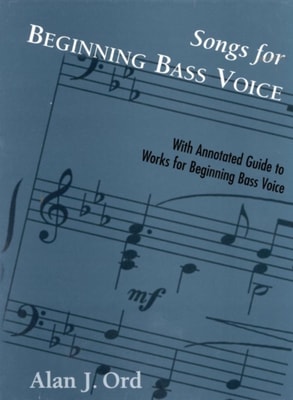
Each year as high school solo and ensemble festivals approach, choir directors and voice teachers search for the right songs for their students to sing.
The beginning bass singer, with his range and tessitura at the bottom end of the scale of voices, has unique difficulties finding suitable vocal music, which is often very frustrating for him and his teacher.
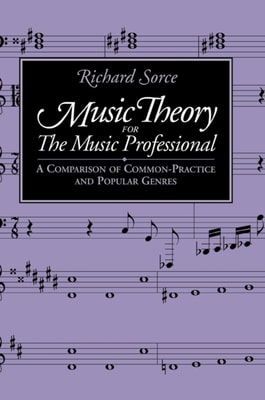
Written as a music theory text that not only addresses the important fundamental syntax of music in the classical sense but also relates this syntax to current practices and styles, this book should be particularly well-suited to musicians focusing on aspects of the music business and of popular culture.
Music Theory for Musical Theatre is a textbook designed to demystify music theory and analysis to make it more accessible to the musical theatre student.
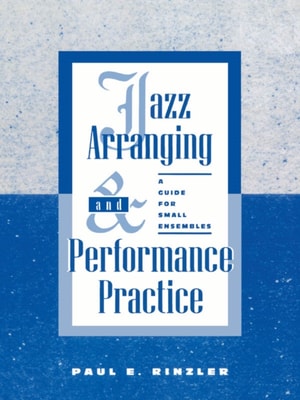
Unlike most jazz arranging books, which focus on the rudiments of arranging (transposition, ranges, notation, and so forth), this book deals with the real substance of arranging for small jazz ensembles, in addition to the rudiments.
The late Berton Coffin's considerable research in areas related to the art of singing has resulted in these reviews, with interpretations of vocal pedagogy classics in light of contemporary observations and findings.
In this collection of academic essays, award-winning pianist and music professor Yaokun Yang shares her carefully compiled analyses of classical music and aesthetics during several different periods, focusing particularly on the aspect of piano performance practice.
Originally published in 1930, this little book is not an exposition of the art of violin-playing, nor does it claim to teach a system of technical study.
This vintage book contains a comprehensive treatise on the subject of music form, and includes information on sentencing and phrasing, modulation, rhythm, and much more.
Originally published in 1921, this book was written in an attempt to, 'give the serious teacher and student the practical benefit of the knowledge acquired during a lifetime's playing the violin, including mechanical means and technical procedure as well as the ideas and ideals of art'.
The only rule I observed when selecting my fifty songs was that they should be interesting; interesting either for their intrinsic worth or for the problems they pose for the singer or the accompanist or both partners.
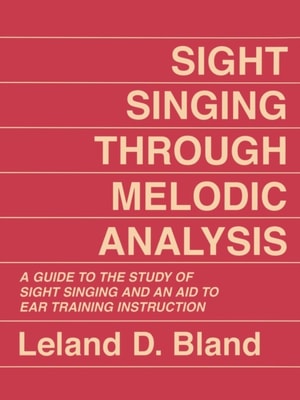
Sight-reading is a skill which offers a student access to all music literature; a skill through which he can acquaint himself with any composition, unaided by a teacher.
In this well documented and highly readable book, James Stark provides a history of vocal pedagogy from the beginning of the bel canto tradition of solo singing in the late sixteenth and early seventeenth centuries to the present.
In this well documented and highly readable book, James Stark provides a history of vocal pedagogy from the beginning of the bel canto tradition of solo singing in the late sixteenth and early seventeenth centuries to the present.