Gary Waller surveys Spenser's career in terms of the material conditions of its production - the often overlooked material factors of race, gender, class, agency - and the resonant 'places' which influenced his career - court, church, nation, colony.
Marriage features to a greater or lesser extent in virtually every play Shakespeare wrote - as the festive end of comedy, as the link across the cycles of the history plays, as a marker of the difference between his own society and that depicted in the Roman plays, and, all too often, as the starting-point for the tragedies.
A detailed chronological account of the life of Samuel Taylor Coleridge built up from contemporary documents including the letters and journals of the writer and of his family and friends.
This book examines the male Romantics' versions of poetic authority in theory and practice in the context of their involvement in the political debates of Regency Britain and argues that their response to Burke's gendered discourse about power effected radical changes in the definitions of masculinity and femininity.
Statutes of Liberty (1993) was the first book on The New York School of Poets, and offers the definitive critical account of its key figures: John Ashbery, Frank O'Hara and James Schuyler.
Focusing on England, Hungary and on some other European countries, the book explores the latent religious patterns in the appropriation of Shakespeare from the 1769 Stratford Jubilee to the tercentenary of Shakespeare's birth in 1864.
Through its recovery of the metrical principles underlying the work of some of the century's major poets, this study highlights the intricacy of the relation between the 'music' of verse and its meaning, and helping us to understand the way in which the ferment of metrical experiment eventually led to the emergence of free verse.
The Japanese Effect in Contemporary Irish Poetry provides a stimulating, original and lively analysis of the Irish-Japanese literary connection from the early 1960s to 2007.
This is the first book-length analysis of Shakespeare s depiction of specula (mirrors) to reveal the literal and allegorical functions of mirrors in the playwright s art and thought.
This collection makes the compelling argument that Chaucer, the Perle -poet, and The Cloud of Unknowing author, exploited analogue and metaphor for marking out the pedagogical gap between science and the imagination.
Edmund Spenser's censored attacks on Lord Burghley (Elizabeth I's powerful first minister) serve as the basis for a reassessment of the poet's mid-career, challenging the dates of canonical texts, the social and personal contexts for scandalous topical allegories, and the new historicist portrait of Spenser's 'worship' of power and state ideology.
Metaphor and Shakespearean Drama explores the fruitful and potentially unruly nature of metaphorical utterances in Shakespearean drama, with analyses of Othello , Titus Andronicus , King Henry IV Part 1 , Macbeth , Hamlet , and The Tempest.
This original and scholarly work uses three detailed case studies of plays - Shakespeare's Antony and Cleopatra , King Lear and Cymbeline - to cast light on the ways in which early modern writers used metaphor to explore how identities emerge from the interaction of competing regional and spiritual topographies.
This book provides provocative information on poetry written in response to the most revolutionary set of events seen in Britain since the 1640s: 'Peterloo', a peaceful protest that became a massacre; 'Cato Street', a government scripted rebellion; and the 'Queen Caroline Controversy', when the estranged wife of George IV tried to claim her crown.
The volume explores Elizabeth I's impact on English and European culture during her life and after her death, through her own writing as well as through contemporary and later writers.
Arising from a research project on depression in the eighteenth century, this book discusses the experience of depressive states both in terms of existing modes of thought and expression, and of attempts to describe and live with suffering.
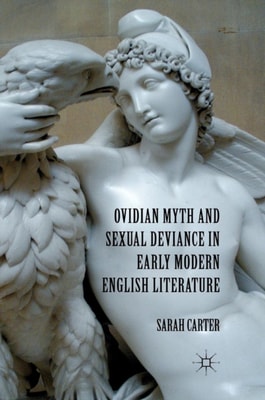
Carter explores early modern culture's reception of Ovid through the manipulation of Ovidian myth by Shakespeare, Middleton, Heywood, Marlowe and Marston.
Divided into three sections on cosmetics, clothes and hairstyling, this book explores how early modern women regarded beauty culture and in what ways skin, clothes and hair could be used to represent racial, class and gender identities, and to convey political, religious and philosophical ideals.
This collection by leading scholars in the field provides a fascinating and ground-breaking introduction to current research in Irish Romantic studies.
Traversing the themes of language, terror and representation, this is the first study to engage Coleridge through the sublime, showing him to have a compelling position in an ongoing conversation about finitude.
Exploring the complex relationship between aesthetic experience and personal identity in Larkin's work, this book gives close and original readings of three major poems ('Here', 'Livings' and 'Aubade'), and two neglected but important themes (Larkin and the supernatural, Larkin and Flaubert).
In addition to being the leading philosopher of English Romanticism and one of its greatest poets, Coleridge explores the dynamics of consciousness and mental functioning more extensively than any of his contemporaries.
Can postmodern accounts of the gaze - deriving from the psychoanalytic theories of Freud, Lacan, Fanon, and Riviere - tell us anything about those structures of vision prior to, and repressed by, modernity?
This book explores the theoretical concerns of recent literary and cultural studies through a reappraisal of three innovative women writers of the modernist period: Djuna Barnes, Mina Loy and Gertrude Stein.
In this first book-length study of Stevie Smith, Romana Huk reassesses the work of this major twentieth-century woman writer as emerging not only from the practices of female literary modernism, but also from within the tumultuous cultural context of mid-century Europe.
Blake's comic brilliance has been variously dismissed as the nervous ramblings of a neglected genius, the tomfool doodles of a distracted youngster, or a crude tool for destabilizing textual authority.