Martin Luther King's policy of non-violent protest in the struggle for civil rights in the United States during the second half of the twentieth century led to fundamental shifts in American government policy relating to segregation, and a cultural shift in the treatment of African Americans.
Robert Lucas is known among economists as one of the most influential macroeconomists of recent times - a reputation founded in no small part on the critical thinking skills displayed in his seminal 1990 paper 'Why Doesn't Capital Flow from Rich to Poor Countries?
John Lewis Gaddis had written four previous books on the Cold War by the time he published We Now Know - so the main thrust of his new work was not so much to present new arguments as to re-examine old ones in the light of new evidence that began emerging from behind the Iron Curtain after 1990.
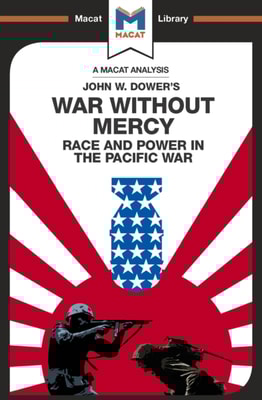
John Dower's War Without Mercy is an attempt to resolve the problem of why the United States fought World War II so very differently in the Pacific and European theaters.
John Locke's 1689 Two Treatises of Government is a key text in the history of political theory - one whose influence remains marked on modern politics, the American Constitution and beyond.
Kenneth Waltz's 1979 Theory of International Politics is credited with bringing about a "e;scientific revolution"e; in the study of international relations - bringing the field into a new era of systematic study.
Hamid Dabashi's 1997 work Theology of Discontent reveals a creative thinker capable not only of understanding how an argument is built, but also of redefining old issues in new ways.
Frantz Fanon is one of the most important figures in the history of what is now known as postcolonial studies - the field that examines the meaning and impacts of European colonialism across the world.
Few works of history have succeeded so completely in forcing their readers to take a fresh look at the evidence as Christopher Hill's The World Turned Upside Down - and that achievement is rooted firmly in Hill's exceptional problem-solving skills.
Eric Hoffer's The True Believer: Thoughts on the Nature of Mass Movements is one of the most widely read works of social psychology written in the 20th-century.
Soren Kierkegaard's The Sickness unto Death is widely recognized as one of the most significant and influential works of Christian philosophy written in the nineteenth century.
The essay for which The Sacred Wood is primarily remembered is one of the most famous pieces of criticism in English: "e;Tradition and the Individual Talent"e; helped to re-orientate arguments about the study of literature and its production by redefining the nature of tradition and the artist's relation to it.
Milton Friedman was one of the most influential economists of all time - and his ideas had a huge impact on the economic policies of governments across the world.
Paul Kennedy owes a great deal to the editor who persuaded him to add a final chapter to this study of the factors that contributed to the rise and fall of European powers since the age of Spain's Philip II.
The Republic is Plato's most complete and incisive work - a detailed study of the problem of how best to ensure that justice exists in a real society, rather than as merely the product of an idealized philosophical construct.
The German sociologist Max Weber is considered to be one of the founding fathers of sociology, and ranks among the most influential writers of the 20th-century.
How was it possible for opponents of slavery to be so vocal in opposing the practice, when they were so accepting of the economic exploitation of workers in western factories - many of which were owned by prominent abolitionists?
Antonio Gramsci's Prison Notebooks is a remarkable work, not only because it was written in jail as the Italian Marxist thinker fell victim to political oppression in his home country, but also because it shows his impressive analytical ability.
In The Night Battles, Carlo Ginzburg does more than introduce his readers to a novel group of supposed witches - the Benandanti, from the northern Italian province of Friulia.
Michelle Alexander's The New Jim Crow: Mass Incarceration in the Age of Colorblindness is an unflinching dissection of the racial biases built into the American prison system.
With his 1954 book The Nature of Prejudice, American psychologist Gordon Allport displays the crucial skill of reasoning, producing and organizing an argument that was persuasive enough to have a major impact not only in universities, but also on government policy.
In The Man Who Mistook His Wife for a Hat, neurologist Oliver Sacks looked at the cutting-edge work taking place in his field, and decided that much of it was not fit for purpose.
David Riesman's The Lonely Crowd: A Study in the Changing American Character is one of the best-known books in the history of sociology - holding a mirror up to contemporary America and showing the nation its own character as it had never seen it before.
Few historians trace grand themes across many centuries and places, but Ernst Kantorowicz's great work on the symbolic powers of kingship is a fine example of what can happen when they do.
Clifford Geertz has been called 'the most original anthropologist of his generation' - and this reputation rests largely on the huge contributions to the methodology and approaches of anthropological interpretation that he outlined in The Interpretation of Cultures.
Historians of the American Revolution had always seen the struggle for independence either as a conflict sparked by heavyweight ideology, or as a war between opposing social groups acting out of self-interest.
Few works can claim to form the foundation stones of one entire academic discipline, let alone two, but Thucydides's celebrated History of the Peloponnesian War is not only one of the first great works of history, but also the departure point from which the modern discipline of international relations has been built.