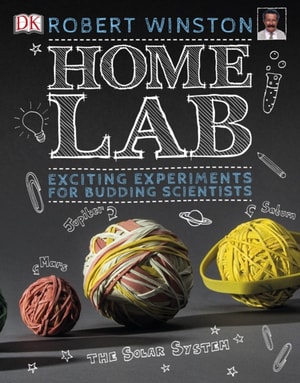
Stir up some sticky slime, build a Solar System with rubber bands, power a speed boat using soap, and construct an erupting volcano, all with Home Lab, exciting experiments for budding scientists.
Explore the world of rocks and fossils with more than 30 fun, hands-on activitiesStart your own rock collection, grow your own gems and even create an erupting volcano!
The book opens with a description of the smooth transition from Newtonian to Einsteinian behaviour from electrons as their energy is progressively increased, and this leads directly to the relativistic expressions for mass, momentum and energy of a particle.
The only textbook that fully supports the Chemistry part of the Oxford AQA International GCSE Combined Sciences specification (9204), for first teaching from September 2016.
Investigating Science for Jamaica: Separate Sciences comprehensively covers the new National Standards Curriculum (NSC) for Grade in Biology, Chemistry and Physics.
Developed exclusively with the Caribbean Examinations Council, this Study Guide will provide you with the support to maximise your performance in CSEC Integrated Science.
The only textbook that fully supports the Physics part of the Oxford AQA International GCSE Combined Sciences specification (9204), for first teaching from September 2016.
The only textbook that fully supports the Biology part of the Oxford AQA International GCSE Combined Sciences specification (9204), for first teaching from September 2016.
Written specifically for use in Caribbean schools, this course is tailored to the requirements of Integrated Science students and the latest CSEC syllabus by providing course contents in a clear, concise and accessible way.
This engaging course incorporates crucial challenge material right from the start, enabling students to confidently leap into Cambridge IGCSE(R) Science study with a solid foundation in Physics.
This engaging course incorporates crucial challenge material right from the start, enabling students to confidently leap into Cambridge IGCSE(R) Science study with a solid foundation in Chemistry.
This engaging course incorporates crucial challenge material right from the start, enabling students to confidently leap into Cambridge IGCSE(R) Science study with a solid foundation in Biology.
Covering all GCSE specifications, this tried and tested series has been fully updated to match the (9-1) GCSE Biology specifications for first examination in 2018, as well as international specifications.
Covering all GCSE specifications, this tried and tested series has been fully updated to match the (9-1) GCSE Chemistry specifications for first examination in 2018, as well as international specifications.
Covering all GCSE specifications, this tried and tested series has been fully updated to match the (9-1) GCSE Physics specifications for first examination in 2018, as well as international specifications.
Matched to the previous Cambridge syllabus, this stretching Student Book is trusted by teachers around the world to support advanced understanding and achievement at IGCSE.
Matched to the previous Cambridge syllabus, this stretching Student Book is trusted by teachers around the world to support advanced understanding and achievement at IGCSE.
Matched to the previous Cambridge syllabus, this stretching Student Book is trusted by teachers around the world to support advanced understanding and achievement at IGCSE.
The only DP Physics resource developed with the IB to accurately match the new 2014 syllabus for both SL and HL, this completely revised edition gives you unrivalled support for the new concept-based approach to learning, the Nature of science.
This book is the first comprehensive history of international efforts to protect the ozone layer, the greatest success yet achieved in managing human impacts on the global environment.
In this book Mazlish examines the historical origins of sociology, looking closely at how what he terms the "e;cash nexus"e;--the omnipresent substitution of money for personal relations--was perceived as changing the nature of human relations in the 19th century and led to the development of sociology as a means of dealing with this condition.
During the 20th century, scientists discovered what the Universe is made of; as the 21st century begins, they are preparing experiments to find out how it came to be like this.