This book constitutes the refereed proceedings of the 6th International Conference on Game Theory for Networks, GameNets 2016, held in Kelowna, Canada, in May 2016.
This book constitutes the refereed proceedings of the 10th International Conference on Provable Security, ProvSec 2016, held in Nanjing, China, in November 2016.
This book presents a deep spectrum of musical, mathematical, physical, and philosophical perspectives that have emerged in this field at the intersection of music and mathematics.
This book explains music's comprehensive ontology, its way of existence and processing, as specified in its compact characterization: music embodies meaningful communication and mediates physically between its emotional and mental layers.
This book constitutes the refereed proceedings of the 9th International Conference on Informatics in Schools: Situation, Evolution, and Perspectives, ISSEP 2016, held in Munster, Germany, in October 2015.
This book constitutes the thoroughly refereed post-conference of the 11th International Symposium on Computer Music Modeling and Retrieval, CMMR 2015, held in Plymouth, UK, in June 2015.
This book constitutes the thoroughly refereed post-workshop proceedings of the 5th International Workshop on Empathic Computing, IWEC 2014, co-loacted with PRICAI 2014, held in Gold Coast, QLD, Australia, in December 2014, as well as the 6th International Workshop on Empathic Computing, IWEC 2015, and the 15th Workshop on Computational Models of Natural Argument, CMNA XV, both co-located with PRIMA 2015, held in Bertinoro, Italy, in October 2015.
This book constitutes the proceedings of the BPM Forum from the International Conference on Business Process Management, BPM 2016, held in Rio de Janeiro, September 2016.
This book constitutes the refereed proceedings of the International Conference on Privacy in Statistical Databases, PSD 2016, held in Dubrovnik, Croatia in September 2016 under the sponsorship of the UNESCO chair in Data Privacy.
This book constitutes the proceedings of the 15th International Conference on Perspectives in Business Informatics Research, BIR 2016, held in Prague, Czech Republic, in September 2016.
This book constitutes the proceedings of the 11th European Conference on Technology Enhanced Learning, EC-TEL 2016, held in Lyon, France, in September 2016.
This book constitutes the refereed proceedings of the 7th International Conference on Computational Logistics, ICCL 2016, held in Lisbon, Portugal, in September 2016.
This book constitutes the refereed proceedings of the 12th IFIP TC 9 International Conference on Human Choice and Computers, HCC12 2016, held in Salford, UK, in September 2016.
This book constitutes the refereed conference proceedings of the 4th Annual Privacy Forum, APF 2016, held in Frankfurt/Main, Germany, in September 2016.
This book spotlights how women leaders behave in chaotic environments and features examples of women who have been key figures in determining complex socio-economic outcomes throughout history.
This book constitutes the refereed proceedings of the 6th International Conference on Well-Being in the Information Society, WIS 2016, held in Tampere, Finland, in September 2016.
This book constitutes the refereed proceedings of the 13th International Conference on Mobile Web and Intelligent Information Systems, MobiWIS 2016, held in Vienna, Austria, in August 2016.
This book offers a practical guide to Agent Based economic modeling, adopting a "e;learning by doing"e; approach to help the reader master the fundamental tools needed to create and analyze Agent Based models.
This book constitutes the refereed proceedings of the 18th International Conference on Data Warehousing and Knowledge Discovery, DaWaK 2016, held in Porto, Portugal, September 2016.
This book constitutes the refereed proceedings of the 6th Language and Technology Conference: Challenges for Computer Science and Linguistics, LTC 2013, held in Poznan, Poland, in December 2013.
This first monograph of its kind introduces the reader to fundamental definitions, key concepts and case studies addressing the following issues of rapidly growing relevance for online communities: What are emotions?
Computational creativity is an emerging field of research within AI that focuses on the capacity of machines to both generate and evaluate novel outputs that would, if produced by a human, be considered creative.
This book contains the refereed proceedings of the 7th Scandinavian Conference on Information Systems, SCIS 2016, as well as of the IFIP Working Group 8.
This volume outlines two decades of reforms at the Foreign & Commonwealth Office (FCO), British Council and BBC World Service - the so-called Public Diplomacy Partners.
This textbook is a first introduction to mathematics for music theorists, covering basic topics such as sets and functions, universal properties, numbers and recursion, graphs, groups, rings, matrices and modules, continuity, calculus, and gestures.
This book constitutes the refereed proceedings of ten international workshops held in Innsbruck, Austria, in conjunction with the 13th International Conference on Business Process Management, BPM 2015, in September 2015.
This book presents the most up-to-date coverage of procedural content generation (PCG) for games, specifically the procedural generation of levels, landscapes, items, rules, quests, or other types of content.
Born out of a major international dialogue held at the Fondazione Giorgio Cini in Venice, Italy, this collection of essays presents innovative and provocative arguments about the claims of universal knowledge schemes and the different aesthetic and material forms in which such claims have been made and executed.
The emergence of intelligent technologies, sophisticated natural language processing methodologies and huge textual repositories, invites a new approach for the challenge of automatically identifying personality dimensions through the analysis of textual data.
The two volume set LNCS 9758 and 9759, constitutes the refereed proceedings of the 15th International Conference on Computers Helping People with Special Needs, ICCHP 2015, held in Linz, Austria, in July 2016.
The two volume set LNCS 9758 and 9759, constitutes the refereed proceedings of the 15th International Conference on Computers Helping People with Special Needs, ICCHP 2015, held in Linz, Austria, in July 2016.
This book constitutes the refereed proceedings of the 9th International Conference on Blended Learning, ICBL 2016, held in Beijing, China, in July 2016.
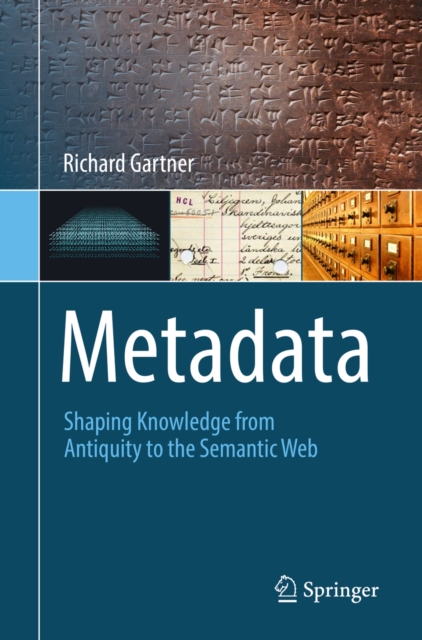
This book offers a comprehensive guide to the world of metadata, from its origins in the ancient cities of the Middle East, to the Semantic Web of today.