This book provides an accelerated introduction to Maple for scientific programmers who already have experience in other computer languages (such as C, Pascal, or FORTRAN).
System Assurances: Modeling and Management updates on system assurance and performance methods using advanced analytics and understanding of software reliability growth modeling from today's debugging team's point-of-view, along with information on preventive and predictive maintenance and the efficient use of testing resources.
Discover easy-to-follow solutions and techniques to help you to implement applied mathematical concepts such as probability, calculus, and equations using Python's numeric and scientific librariesKey FeaturesCompute complex mathematical problems using programming logic with the help of step-by-step recipesLearn how to utilize Python's libraries for computation, mathematical modeling, and statisticsDiscover simple yet effective techniques for solving mathematical equations and apply them in real-world statisticsBook DescriptionPython, one of the world's most popular programming languages, has a number of powerful packages to help you tackle complex mathematical problems in a simple and efficient way.
A comprehensive guide to getting well-versed with the mathematical techniques for building modern deep learning architecturesKey FeaturesUnderstand linear algebra, calculus, gradient algorithms, and other concepts essential for training deep neural networksLearn the mathematical concepts needed to understand how deep learning models functionUse deep learning for solving problems related to vision, image, text, and sequence applicationsBook DescriptionMost programmers and data scientists struggle with mathematics, having either overlooked or forgotten core mathematical concepts.
Engaging and accessible, this book teaches readers how to use inferential statistical thinking to check their assumptions, assess evidence about their beliefs, and avoid overinterpreting results that may look more promising than they really are.
MatLab, Third Edition is the only book that gives a full introduction to programming in MATLAB combined with an explanation of the software's powerful functions, enabling engineers to fully exploit its extensive capabilities in solving engineering problems.
This textbook summarizes the different statistical, scientific, and financial data analysis methods for users ranging from a high school level to a professional level.
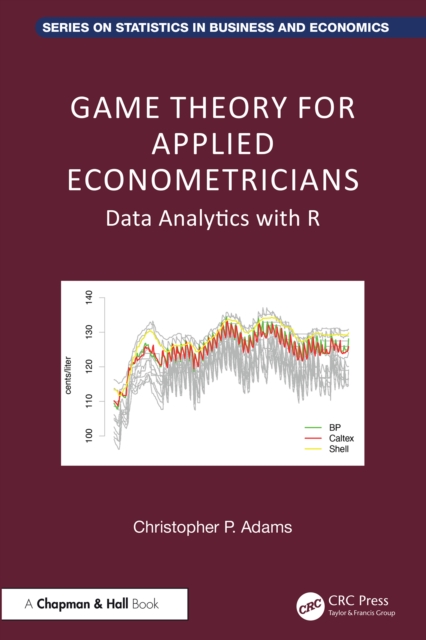
Over the last 30 years the practice and use of game theory has changed dramatically, yet textbooks continue to present game theory with algebraic formalism and toy models.
Bayesian Nonparametrics for Causal Inference and Missing Data provides an overview of flexible Bayesian nonparametric (BNP) methods for modeling joint or conditional distributions and functional relationships, and their interplay with causal inference and missing data.
This practical guide is designed for students and researchers with an existing knowledge of R who wish to learn how to apply it in an epidemiological context and exploit its versatility.
Statistical methods are a key tool for all scientists working with data, but learning the basics continues to challenge successive generations of students.
Computational complexity is one of the most beautiful fields of modern mathematics, and it is increasingly relevant to other sciences ranging from physics to biology.
R is rapidly becoming the standard software for statistical analyses, graphical presentation of data, and programming in the natural, physical, social, and engineering sciences.
R is rapidly becoming the standard software for statistical analyses, graphical presentation of data, and programming in the natural, physical, social, and engineering sciences.
Studies of evolution at the molecular level have experienced phenomenal growth in the last few decades, due to rapid accumulation of genetic sequence data, improved computer hardware and software, and the development of sophisticated analytical methods.
Studies of evolution at the molecular level have experienced phenomenal growth in the last few decades, due to rapid accumulation of genetic sequence data, improved computer hardware and software, and the development of sophisticated analytical methods.
This book presents a study of the COVID-19 pandemic using computational social scientific analysis that draws from, and employs, statistics and simulations.
The quantity, diversity and availability of transport data is increasing rapidly, requiring new skills in the management and interrogation of data and databases.
The contributions gathered in this book focus on modern methods for statistical learning and modeling in data analysis and present a series of engaging real-world applications.
This textbook, now in its second edition, provides a broad introduction to the theory and practice of both continuous and discrete dynamical systems with the aid of the Mathematica software suite.
This textbook presents an introduction to generalized linear models, complete with real-world data sets and practice problems, making it applicable for both beginning and advanced students of applied statistics.