This volume contains the proceedings of the 10th International Conference on Tools and Algorithms for the Construction and Analysis of Systems (TACAS 2004).
The LNCS journal Transactions on Computational Science reflects recent developments in the field of Computational Science, conceiving the field not as a mere ancillary science but rather as an innovative approach supporting many other scientific disciplines.
This book contains selected contributions from some of the most renowned researchers in the field of Digital Heritage and 3D representation of the Past, based in large part on invited presentations from the workshop "e;Computational Geometry and Ontologies for Cultural Heritage 3D Digital Libraries: What are the future alternatives for Europeana?
The LNCS journal Transactions on Computational Science reflects recent developments in the field of Computational Science, conceiving the field not as a mere ancillary science but rather as an innovative approach supporting many other scientific disciplines.
The LNCS journal Transactions on Computational Science reflects recent developments in the field of Computational Science, conceiving the field not as a mere ancillary science but rather as an innovative approach supporting many other scientific disciplines.
This Festschrift volume is published in honor of Ferran Hurtado on the occasion of his 60th birthday; it contains extended versions of selected communications presented at the XIV Spanish Meeting on Computational Geometry, held at the University of Alcala, Spain, in June 2011.
The idea of a FAABS workshop was first conceived in 1998 at the NASA Goddard Space Flight Center, while the Agent Technology Development Group in the Advanced Architectures and Automation Branch (Code 588) was developing a prototype agent community to automate satellite ground operations.
In 1996 the International Federation for Information Processing (IFIP) establ- hed its rst Technical Committee on foundations of computer science, TC1.
The natural mission of Computational Science is to tackle all sorts of human problems and to work out intelligent automata aimed at alleviating the b- den of working out suitable tools for solving complex problems.
This 18-volume set constitutes the refereed proceedings of the 8th Chinese Conference on Pattern Recognition and Computer Vision, PRCV 2025, held in Shanghai, China, during October 15-18, 2025.
This 18-volume set constitutes the refereed proceedings of the 8th Chinese Conference on Pattern Recognition and Computer Vision, PRCV 2025, held in Shanghai, China, during October 15-18, 2025.
This 18-volume set constitutes the refereed proceedings of the 8th Chinese Conference on Pattern Recognition and Computer Vision, PRCV 2025, held in Shanghai, China, during October 15-18, 2025.
These transactions publish research in computer-based methods of computational collective intelligence (CCI) and their applications in a wide range of fields such as the semantic Web, social networks, and multi-agent systems.
These transactions publish research in computer-based methods of computational collective intelligence (CCI) and their applications in a wide range of fields such as the semantic Web, social networks, and multi-agent systems.
These transactions publish research in computer-based methods of computational collective intelligence (CCI) and their applications in a wide range of fields such as the semantic web, social networks, and multi-agent systems.
While today's game engines and multi-agent platforms cross-fertilize each other to some extent, the technologies used in these areas are not readily compatible due to some differences in their primary concerns.
Many software systems have reached a level of complication, mainly because of their size, heterogeneity and distribution, which results in faults appearing that cannot be traced back easily to the code.
This book constitutes the refereed proceedings of the Second International Conference on Web-Age Information Management, WAIM 2001, held in Xi'an, China, in July 2001.
Cooperation among systems has gained substantial importance in recent years: electronic commerce virtual enterprises and the middleware paradigm are just some examples in this area.
During recent decades we have witnessed not only the introduction of automation into the work environment but we have also seen a dramatic change in how automation has influenced the conditions of work.
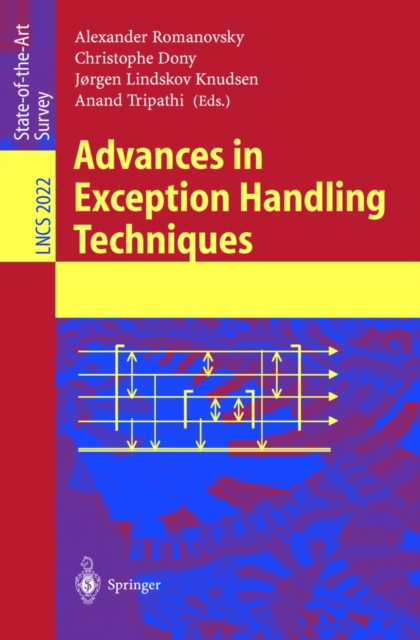
Modern software systems are becoming more complex in many ways and have to cope with a growing number of abnormal situations which, in turn, are increasingly complex to handle.
Building on classical queueing theory mainly dealing with single node queueing systems, networks of queues, or stochastic networks has been a field of intensive research over the last three decades.
In the setting of multi-party computation, sets of two or more parties with private inputs wish to jointly compute some (predetermined) function of their inputs.
Modern software systems are becoming more complex in many ways and are having to cope with a growing number of abnormal situations which, in turn, are increasingly complex to handle.
This book constitutes the thoroughly refereed post-proceedings of the 4th International Workshop on Agent-Mediated Electronic Commerce, AMEC 2002, held in Bologna, Italy in July 2002 during the AAMAS 2002 conference.
The workshop on an Infrastructure for Mobile and Wireless Systems was held in Scottsdale, Arizona on October 15, 2001 and was funded by the National Science Foundation (NSF) and sponsored by the Telecommunications and Information Technology Institute of the College of Engineering at Florida International U- versity (FIU), to establish a common infrastructure for the discipline of mobile and wireless networking, and to serve its rapidly emerging mobile and wireless community of researchers and practitioners.