Effective compilers allow for a more efficient execution of application programs for a given computer architecture, while well-conceived architectural features can support more effective compiler optimization techniques.
System-on-Chip Methodologies & Design Languages brings together a selection of the best papers from three international electronic design language conferences in 2000.
Computer-Aided Reasoning: ACL2 Case Studies illustrates how the computer-aided reasoning system ACL2 can be used in productive and innovative ways to design, build, and maintain hardware and software systems.
The popularity of Pascal as a teaching language has rapidly increased, as demonstrated by Addyman's survey conducted over a11 European and American institutions (Comput.
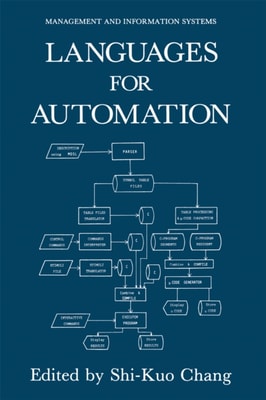
Two central ideas in the movement toward advanced automation systems are the office-of-the-future (or office automation system), and the factory- of-the-future (or factory automation system).
This book constitutes the thoroughly refereed post-conference proceedings of the 27th International Symposium on Logic-Based Program Synthesis and Transformation, LOPSTR 2017, held in Namur, Belgium, in October 2017.
The Ada Generic Library provides an extensive well-documented library of generic packages whose use can substantially increase software productivity and reliability.
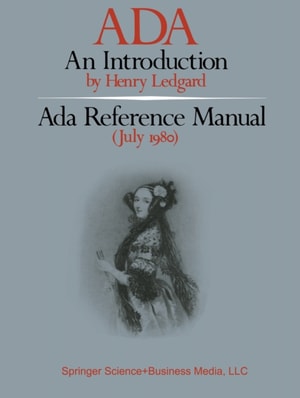
If Charles Babbage is to be regarded as the father of modern day computer technology, then surely the Countess Augusta Ada Lovelace, after whom this new language is named, must be remembered as its midwife.
Constraint Logic Programming (CLP), an area of extreme research interest in recent years, extends the semantics of Prolog in such a way that the combinatorial explosion, a characteristic of most problems in the field of Artificial Intelligence, can be tackled efficiently.
Automatic Re-engineering of Software Using Genetic Programming describes the application of Genetic Programming to a real world application area - software re-engineering in general and automatic parallelization specifically.
Distributed and Parallel Systems: From Instruction Parallelism to Cluster Computing is the proceedings of the third Austrian-Hungarian Workshop on Distributed and Parallel Systems organized jointly by the Austrian Computer Society and the MTA SZTAKI Computer and Automation Research Institute.
Appropriate for use as a graduate text or a professional reference, Languages for Digital Embedded Systems is the first detailed, broad survey of hardware and software description languages for embedded system design.
The success of VHDL since it has been balloted in 1987 as an IEEE standard may look incomprehensible to the large population of hardware designers, who had never heared of Hardware Description Languages before (for at least 90% of them), as well as to the few hundreds of specialists who had been working on these languages for a long time (25 years for some of them).
Multiprocessor Execution of Logic Programs addresses the problem of efficient implementation of logic programming languages, specifically Prolog, on multiprocessor architectures.
Parsing technology traditionally consists of two branches, which correspond to the two main application areas of context-free grammars and their generalizations.
Since the initial publication of Practical SGML the computer industry has seen a dramatic increase in the use and acceptance of SGML and many of the concepts derived from it.
Reversible grammar allows computational models to be built that are equally well suited for the analysis and generation of natural language utterances.
In brief summary, the following results were presented in this work: * A linear time approach was developed to find register requirements for any specified CS schedule or filled MRT.
Language, Compilers and Run-time Systems for Scalable Computers contains 20 articles based on presentations given at the third workshop of the same title, and 13 extended abstracts from the poster session.