Joel, Apress, Blogs, and Blooks I was learning the hard way about how to be a publisher and probably spending way too much time looking at web sites and programming than I should have in response to that.
Extreme Programming Refactored: The Case Against XP (featuring Songs of the Extremos) takes a satirical look at the increasingly-hyped extreme programming (XP) methodology.
Written in the same style that has made Ivor Horton a best-selling author, this third edition of his popular title is a comprehensive, ground-up tutorial!
In recent years, much work has been put into creating programming languages that embody a blend of many of the most admired characteristics of their predecessors.
Use Case Driven Object Modeling with UML: Theory and Practice shows how to drive an object-oriented software design from use case all the way through coding and testing, based on the minimalist, UML-based ICONIX process.
REALbasic is an easy-to-learn, powerful, cross-platform programming language, allowing you to write powerful applications that can be distributed across Windows, Mac, and Linux.
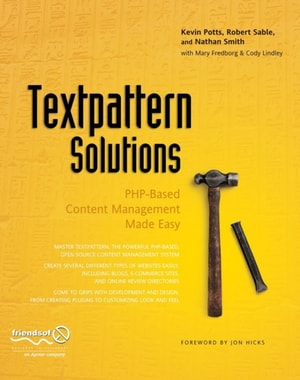
Textpattern is a powerful, PHP-based content management system that allows you to build pretty much any kind of data-driven website quickly and easily.
As information technologies become increasingly distributed and accessible to larger number of people and as commercial and government organizations are challenged to scale their applications and services to larger market shares, while reducing costs, there is demand for software methodologies and appli- tions to provide the following features: Richer application end-to-end functionality; Reduction of human involvement in the design and deployment of the software; Flexibility of software behaviour; and Reuse and composition of existing software applications and systems in novel or adaptive ways.
Automatic Quantum Computer Programming provides an introduction to quantum computing for non-physicists, as well as an introduction to genetic programming for non-computer-scientists.
The main intention of this book is to give an impression of the state of the art in energy-aware task-scheduling-related issues for very dynamic emb- ded real-time processing applications.
Design and specification languages are of utmost interest in the area of embedded systems and the Forum on Specification and Design Languages has been once again the main European event for the embedded systems and chip design community.
"e;Automatic Program Development"e; is a tribute to Robert Paige (1947-1999), our accomplished and respected colleague, and moreover our good friend, whose untimely passing was a loss to our academic and research community.
Book Description Real-Time Object Uniform Design Methodology with UML is a theoretical and practicalbookwrittenforbusy people who want to untanglethe complex world of system development, nd essential materials without digging in UML st- dard documentation, grasp subtle concepts of object orientation, practice the new Model Driven Architecture (MDA), experience the reuse mechanism, and transform the bare metal programming of real-time and embedded products into more handsome platform-independent and platform-speci c components.
In a relatively short span of time, computers have evolved from huge mainframes to small and elegant desktop computers, and now to low-power, ultra-portable handheld devices.
New software tools and a sophisticated methodology above RTL are required to answer the challenges of designing an optimized application specific processor (ASIP).
Software engineering has over the years been applied in many different fields, ranging from telecommunications to embedded systems in car and aircraft industry as well as in production engineering and computer networks.
This book focuses on source-to-source code transformations that remove addressing-related overhead present in most multimedia or signal processing application programs.
Galois connections provide the order- or structure-preserving passage between two worlds of our imagination - and thus are inherent in hu- man thinking wherever logical or mathematical reasoning about cer- tain hierarchical structures is involved.