The aim of this edited book is to provide a point of reference for the latest advancements in the different fields of interactive media applied in Digital Cultural Heritage research, ranging from visual data acquisition, classification, analysis and synthesis, 3D modelling and reconstruction, to new forms of interactive media presentation, visualization and immersive experience provision via extended reality, collaborative spaces, serious games and digital storytelling.
Alias|Wavefront's Maya 3D animation software is an integrated collection of tools for creating computer generated images, used in nearly every blockbuster special effects film that has been released in the last few years.
This book contains the research on modeling bodies, cloth and character based adaptation performed during the last 3 years at MIRALab at the University of Geneva.
John Vince explains a wide range of mathematical techniques and problem-solving strategies associated with computer games, computer animation, virtual reality, CAD, and other areas of computer graphics.
William Sims Bainbridge Virtual worlds are persistent online computer-generated environments where people can interact, whether for work or play, in a manner comparable to the real world.
Research into the 3D Physiological Human is a very active field focusing on the creation of patient-specific computer models for personalised healthcare.
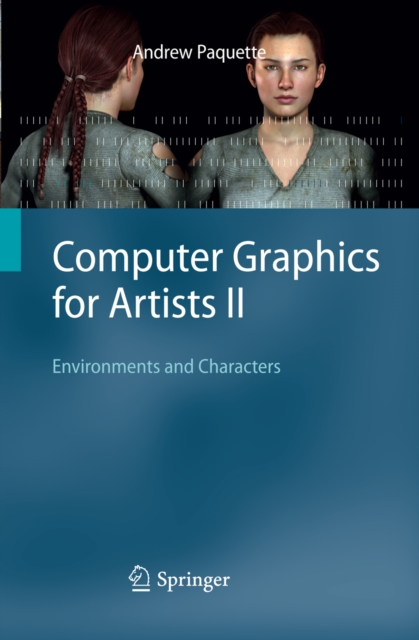
In this second volume of Computer Graphics for Artists the author, Andrew Paquette, guides the reader through the creation of realistic computer-generated backgrounds and characters.
Implicit objects have gained increasing importance in geometric modeling, visualisation, animation, and computer graphics, because their geometric properties provide a good alternative to traditional parametric objects.
The 2nd edition of this integrated guide explains and lists readily available graphics software tools and their applications, while also serving as a shortcut to graphics theory and programming.
Computer Graphics for Artists: an introduction is an application-independent, reader-friendly primer for anyone with a serious desire to understand 3D Computer GraphicsOpening with the first and most basic elements of computer graphics, the book rapidly advances into progressively more complex concepts.
The fruit of many years experience on the creation of synthetic worlds and virtual realities, this book is based on the considerable expertise of the authors, who share their knowledge of mastering the complexities behind the creation of Virtual Reality (VR) applications.
In my last book, Geometry for Computer Graphics, I employed a mixture of algebra and vector analysis to prove many of the equations used in computer graphics.
RenderMan has long been associated with top-end film production and is an essential tool for creating many of the effects and images in recent animated films (such as Monsters, Inc.
Overview Modelling and simulation is a tool that provides support for the planning, design, and evaluation of systems as well as the evaluation of strategies for system transformation and change.
Despite the availability of cheap, fast, accurate and usable eye trackers, there is little information available on how to develop, implement and use these systems.
Information visualization is not only about creating graphical displays of complex and latent information structures; it contributes to a broader range of cognitive, social, and collaborative activities.
There has been a growing interest in crowd simulation particularly in the commercial sector where it is used in security, defence, entertainment and the movie industry.
This is a hugely informative and highly practical book on a subject that is extremely relevant in today's world, where more and more households own and take pictures on digital cameras.
Geometric algebra (a Clifford Algebra) has been applied to different branches of physics for a long time but is now being adopted by the computer graphics community and is providing exciting new ways of solving 3D geometric problems.
Mathematical and Computer Programming Techniques for Computer Graphics introduces the mathematics and related computer programming techniques used in Computer Graphics.
Possibly the most comprehensive overview of computer graphics as seen in the context of geometric modelling, this two volume work covers implementation and theory in a thorough and systematic fashion.
Geometry is the cornerstone of computer graphics and computer animation, and provides the framework and tools for solving problems in two and three dimensions.
Focussing on the manipulation and representation of geometrical objects, this book explores the application of geometry to computer graphics and computer-aided design (CAD).
Possibly the most comprehensive overview of computer graphics as seen in the context of geometric modelling, this two volume work covers implementation and theory in a thorough and systematic fashion.
This book constitutes the refereed proceedings of CVM 2024, the 12th International Conference on Computational Visual Media, held in Wellington, New Zealand, in April 2024.
As an efficient 3D vision solution, point clouds have been widely applied into diverse engineering scenarios, including immersive media communication, autonomous driving, reverse engineering, robots, topography mapping, digital twin city, medical analysis, digital museum, etc.